
| Date | 17th, Dec 2020 |
|---|
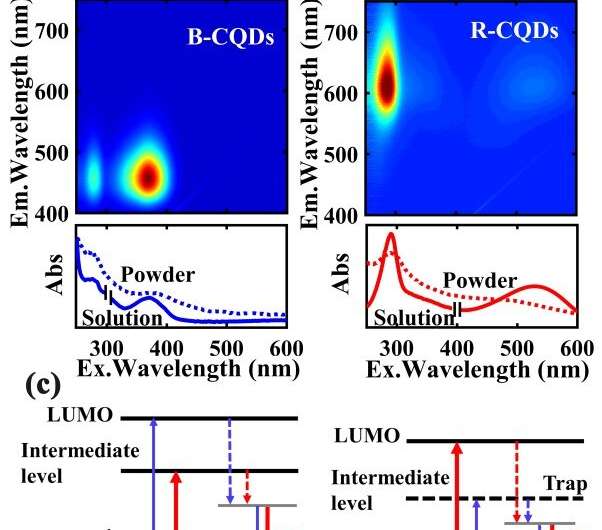 Fig.1. PL and UV-Vis absorption spectra are shown in (a) for B-CQDs and in (b) for R-CQDs. (c) The diagram of the energy levels and the electronic transition channels for PL emission from B- (left panel) and R-CQDs (right panel). Credit: SONG Dan
Recently, researchers led by Prof. XU Wen from the Institute of Solid State Physics of the Hefei Institutes of Physical Science (HFIPS), along with their collaborators from the Southwest University in Chongqing, applied the Terahertz time domain spectroscopy (THz TDS) to study the optoelectronic properties of fluorescent carbon quantum dots (FQCDs).
Carbon quantum dots (CQDs) are a class of zero-dimensional carbon materials, which have drawn great attention due to their outstanding optical and optoelectronic properties. It is an environmental-friendly material promising for realization of full-color lighting and displays, in which case, the FCQDs should be used in solid state.
This time, the research group prepared two kinds of FCQDs, which could emit bright blue (B-CQDs) and red (R-CQDs) lights in solutions under optical excitation.
After studying the THz optoelectronic response of dry FCQD particles with temperature range from 80 to 280 K, they found that R-CQDs behaved like an optical insulator in 0.2—1.2 THz range, while B-CQDs experienced insulator-to-semiconductor transition with increasing THz radiation frequency and temperature. Optical conductance and key physical parameters of FCQDs could be deduced from THz transmittance spectra.
These results explain the mechanism of this phenomenon and would lead to more sufficient understanding of the basic physical properties of FCQDs.
This is the first time scientists applied the THz TDS to the investigation of dry CQDs. And an interesting phenomenon of insulator-to-semiconductor transition in FCQDs in THz bandwidth was observed experimentally, indicating that the CQDs can be utilized to realize the advanced THz optoelectronic materials and devices.
More information: Dan Song et al. Optically induced insulator-to-semiconductor transition in fluorescent carbon quantum dots measured by terahertz time-domain spectroscopy, Carbon (2020). DOI: 10.1016/j.carbon.2020.11.075
Citation: Scientists discover insulator-to-semiconductor transition in fluorescent carbon quantum dots (2020, December 17) retrieved 28 June 2022 from https://phys.org/news/2020-12-scientists-insulator-to-semiconductor-transition-fluorescent-carbon.html
This document is subject to copyright. Apart from any fair dealing for the purpose of private study or research, no part may be reproduced without the written permission. The content is provided for information purposes only.
