
| Date | 18th, Dec 2020 |
|---|
Home > Press > Stevens creates entangled photons 100 times more efficiently than previously possible: Ultra-bright photon source brings scalable quantum photonics within reach
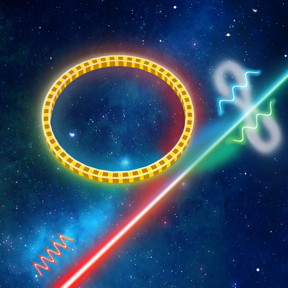 Yuping Huang and his colleagues at Stevens Institute of Technology demonstrated a quantum circuit that can readily be integrated with other optical components, paving the way for high-speed, reconfigurable, and multifaceted quantum devices.
CREDIT
QuEST Lab, Stevens Institute of Technology
Yuping Huang and his colleagues at Stevens Institute of Technology demonstrated a quantum circuit that can readily be integrated with other optical components, paving the way for high-speed, reconfigurable, and multifaceted quantum devices.
CREDIT
QuEST Lab, Stevens Institute of Technology
Abstract: Super-fast quantum computers and communication devices could revolutionize countless aspects of our lives -- but first, researchers need a fast, efficient source of the entangled pairs of photons such systems use to transmit and manipulate information. Researchers at Stevens Institute of Technology have done just that, not only creating a chip-based photon source 100 times more efficient that previously possible, but bringing massive quantum device integration within reach.
Hoboken, NJ | Posted on December 17th, 2020
"It's long been suspected that this was possible in theory, but we're the first to show it in practice," said Yuping Huang, Gallagher associate professor of physics and director of the Center for Quantum Science and Engineering.
To create photon pairs, researchers trap light in carefully sculpted nanoscale microcavities; as light circulates in the cavity, its photons resonate and split into entangled pairs. But there's a catch: at present, such systems are extremely inefficient, requiring a torrent of incoming laser light comprising hundreds of millions of photons before a single entangled photon pair will grudgingly drip out at the other end.
Huang and colleagues at Stevens have now developed a new chip-based photon source that's 100 times more efficient than any previous device, allowing the creation of tens of millions of entangled photon pairs per second from a single microwatt-powered laser beam.
"This is a huge milestone for quantum communications," said Huang, whose work will appear in the Dec. 17 issue of Physical Review Letters.
Working with Stevens graduate students Zhaohui Ma and Jiayang Chen, Huang built on his laboratory's previous research to carve extremely high-quality microcavities into flakes of lithium niobate crystal. The racetrack-shaped cavities internally reflect photons with very little loss of energy, enabling light to circulate longer and interact with greater efficiency.
By fine-tuning additional factors such as temperature, the team was able to create an unprecedentedly bright source of entangled photon pairs. In practice, that allows photon pairs to be produced in far greater quantities for a given amount of incoming light, dramatically reducing the energy needed to power quantum components.
The team is already working on ways to further refine their process, and say they expect to soon attain the true Holy Grail of quantum optics: a system with that can turn a single incoming photon into an entangled pair of outgoing photons, with virtually no waste energy along the way. "It's definitely achievable," said Chen. "At this point we just need incremental improvements."
Until then, the team plans to continue refining their technology, and seeking ways to use their photon source to drive logic gates and other quantum computing or communication components. "Because this technology is already chip-based, we're ready to start scaling up by integrating other passive or active optical components," explained Huang.
The ultimate goal, Huang said, is to make quantum devices so efficient and cheap to operate that they can be integrated into mainstream electronic devices. "We want to bring quantum technology out of the lab, so that it can benefit every single one of us," he explained. "Someday soon we want kids to have quantum laptops in their backpacks, and we're pushing hard to make that a reality."
####
About Stevens Institute of TechnologyStevens Institute of Technology is a premier, private research university situated in Hoboken, New Jersey. Since our founding in 1870, technological innovation has been the hallmark of Stevens� education and research. Within the university�s three schools and one college, 7,300 undergraduate and graduate students collaborate closely with faculty in an interdisciplinary, student-centric, entrepreneurial environment. Academic and research programs spanning business, computing, engineering, the arts and other disciplines actively advance the frontiers of science and leverage technology to confront our most pressing global challenges. As Stevens celebrates its 150th anniversary, the university continues to be consistently ranked among the nation�s leaders in career services, post-graduation salaries of alumni, and return on tuition investment.
For more information, please click here
Contacts:Thania Benios
917-930-5988
Copyright © Stevens Institute of Technology
If you have a comment, please Contact us.
Issuers of news releases, not 7th Wave, Inc. or Nanotechnology Now, are solely responsible for the accuracy of the content.
Bookmark:


Physics
 Flexing the power of a conductive polymer: A new material holds promise for the next generation of organic electronics June 24th, 2022
Quantum Physics
Quantum network nodes with warm atoms June 24th, 2022
News and information
New technology helps reveal inner workings of human genome June 24th, 2022
Boron nitride nanotube fibers get real: Rice lab creates first heat-tolerant, stable fibers from wet-spinning process June 24th, 2022
Possible Futures
New technology helps reveal inner workings of human genome June 24th, 2022
Boron nitride nanotube fibers get real: Rice lab creates first heat-tolerant, stable fibers from wet-spinning process June 24th, 2022
Chip Technology
Boron nitride nanotube fibers get real: Rice lab creates first heat-tolerant, stable fibers from wet-spinning process June 24th, 2022
Controlled synthesis of crystal flakes paves path for advanced future electronics June 17th, 2022
Quantum Computing
University of Illinois Chicago joins Brookhaven Lab's Quantum Center June 10th, 2022
Bumps could smooth quantum investigations: Rice University models show unique properties of 2D materials stressed by contoured substrates June 10th, 2022
Optical computing/Photonic computing
Photonic integrated erbium doped amplifiers reach commercial performance: Boosting light power revolutionizes communications and autopilots June 17th, 2022
Electron-phonon coupling assisted universal red luminescence of o-phenylenediamine-based CDs June 10th, 2022
Discoveries
New technology helps reveal inner workings of human genome June 24th, 2022
Boron nitride nanotube fibers get real: Rice lab creates first heat-tolerant, stable fibers from wet-spinning process June 24th, 2022
Announcements
New technology helps reveal inner workings of human genome June 24th, 2022
Boron nitride nanotube fibers get real: Rice lab creates first heat-tolerant, stable fibers from wet-spinning process June 24th, 2022
Interviews/Book Reviews/Essays/Reports/Podcasts/Journals/White papers/Posters
Quantum network nodes with warm atoms June 24th, 2022
New technology helps reveal inner workings of human genome June 24th, 2022
Photonics/Optics/Lasers
Photonic integrated erbium doped amplifiers reach commercial performance: Boosting light power revolutionizes communications and autopilots June 17th, 2022
Marching to the Cadence of Electronics: Innovation A new paper in Nature validates technology developed by John Bowers and collaborators June 10th, 2022
Quantum nanoscience
Bumps could smooth quantum investigations: Rice University models show unique properties of 2D materials stressed by contoured substrates June 10th, 2022
UCI scientists turn a hydrogen molecule into a quantum sensor: New technique enables precise measurement of electrostatic properties of materials April 22nd, 2022
