
| Date | 26th, Dec 2020 |
|---|
Home > Press > Atomic-scale nanowires can now be produced at scale: Scalable synthesis of transition metal chalcogenide nanowires for next-gen electronics
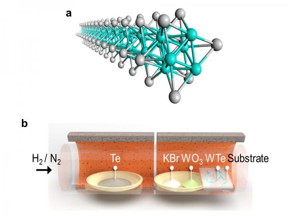 (a) Illustration of a TMC nanowire (b) Chemical vapor deposition. The ingredients are vaporized in a hydrogen/nitrogen atmosphere and allowed to deposit and self-assemble on a substrate. Reprinted with permission from Ref. 1
CREDIT
Copyright 2020 American Chemical Society (ACS)
(a) Illustration of a TMC nanowire (b) Chemical vapor deposition. The ingredients are vaporized in a hydrogen/nitrogen atmosphere and allowed to deposit and self-assemble on a substrate. Reprinted with permission from Ref. 1
CREDIT
Copyright 2020 American Chemical Society (ACS)
Abstract: Researchers from Tokyo Metropolitan University have discovered a way to make self-assembled nanowires of transition metal chalcogenides at scale using chemical vapor deposition. By changing the substrate where the wires form, they can tune how these wires are arranged, from aligned configurations of atomically thin sheets to random networks of bundles. This paves the way to industrial deployment in next-gen industrial electronics, including energy harvesting, and transparent, efficient, even flexible devices.
Tokyo, Japan | Posted on December 25th, 2020
Electronics is all about making things smaller. Smaller features on a chip, for example, means more computing power in the same amount of space and better efficiency, essential to feeding the increasingly heavy demands of a modern IT infrastructure powered by machine learning and artificial intelligence. And as devices get smaller, the same demands are made of the intricate wiring that ties everything together. The ultimate goal would be a wire that is only an atom or two in thickness. Such nanowires would begin to leverage completely different physics as the electrons that travel through them behave more and more as if they live in a one-dimensional world, not a 3D one.
In fact, scientists already have materials like carbon nanotubes and transition metal chalcogenides (TMCs), mixtures of transition metals and group 16 elements which can self-assemble into atomic-scale nanowires. The trouble is making them long enough, and at scale. A way to mass produce nanowires would be a game changer.
Now, a team led by Dr. Hong En Lim and Associate Professor Yasumitsu Miyata from Tokyo Metropolitan University has come up with a way of making long wires of transition metal telluride nanowires at unprecedentedly large scales. Using a process called chemical vapor deposition (CVD), they found that they could assemble TMC nanowires in different arrangements depending on the surface or substrate that they use as a template. Examples are shown in Figure 2; in (a), nanowires grown on a silicon/silica substrate form a random network of bundles; in (b), the wires assemble in a set direction on a sapphire substrate, following the structure of the underlying sapphire crystal. By simply changing where they are grown, the team now have access to centimeter-sized wafers covered in the arrangement they desired, including monolayers, bilayers and networks of bundles, all with different applications. They also found that the structure of the wires themselves were highly crystalline and ordered, and that their properties, including their excellent conductivity and 1D-like behavior, matched those found in theoretical predictions.
Having large amounts of long, highly crystalline nanowires is sure to help physicists characterize and study these exotic structures in more depth. Importantly, it's an exciting step towards seeing real-world applications of atomically-thin wires, in transparent and flexible electronics, ultra-efficient devices and energy harvesting applications.
This work was supported by JST CREST Grants (JPMJCR16F3, JPMJCR17I5), Japan Society for the Promotion of Science (JSPS) KAKENHI Grants-in-Aid for Scientific Research (B) (JP18H01832, JP19H02543, JP20H02572, JP20H02573), Young Scientists (JP19K15383, JP19K15393), Scientific Research on Innovative Areas (JP20H05189, JP26102012), Specially Promoted Research (JP25000003), Challenging Research (Exploratory) (19K22127), and Scientific Research (A) (JP17H01069), and grants from the Murata Science Foundation (2019, H31-068) and the Japan Keirin Autorace Foundation (2020M-121). This work was partially conducted at the AIST Nano-Processing Facility supported by "Nanotechnology Platform Program" of the Ministry of Education, Culture, Sports, Science and Technology (MEXT), Japan. Grant Number JPMXP09F19008709 and 20009034.
####
For more information, please click here
Contacts:Go Totsukawa
81-426-772-728
@TMU_PR
Copyright © Tokyo Metropolitan University
If you have a comment, please Contact us.
Issuers of news releases, not 7th Wave, Inc. or Nanotechnology Now, are solely responsible for the accuracy of the content.
Bookmark:


News and information
 New technology helps reveal inner workings of human genome June 24th, 2022
Boron nitride nanotube fibers get real: Rice lab creates first heat-tolerant, stable fibers from wet-spinning process June 24th, 2022
Govt.-Legislation/Regulation/Funding/Policy
Solving the solar energy storage problem with rechargeable batteries that can convert and store energy at once June 24th, 2022
Boron nitride nanotube fibers get real: Rice lab creates first heat-tolerant, stable fibers from wet-spinning process June 24th, 2022
UBCO researchers change the game when it comes to activity tracking: Flexible, highly sensitive motion device created by extrusion printing June 17th, 2022
University of Illinois Chicago joins Brookhaven Lab's Quantum Center June 10th, 2022
Possible Futures
New technology helps reveal inner workings of human genome June 24th, 2022
Boron nitride nanotube fibers get real: Rice lab creates first heat-tolerant, stable fibers from wet-spinning process June 24th, 2022
Chip Technology
Boron nitride nanotube fibers get real: Rice lab creates first heat-tolerant, stable fibers from wet-spinning process June 24th, 2022
Controlled synthesis of crystal flakes paves path for advanced future electronics June 17th, 2022
Self Assembly
Nanoclusters self-organize into centimeter-scale hierarchical assemblies April 22nd, 2022
Atom by atom: building precise smaller nanoparticles with templates March 4th, 2022
Nanostructures get complex with electron equivalents: Nanoparticles of two different sizes break away from symmetrical designs January 14th, 2022
Nanoelectronics
Controlled synthesis of crystal flakes paves path for advanced future electronics June 17th, 2022
Eyebrow-raising: Researchers reveal why nanowires stick to each other February 11th, 2022
Visualizing temperature transport: An unexpected technique for nanoscale characterization November 19th, 2021
Discoveries
New technology helps reveal inner workings of human genome June 24th, 2022
Boron nitride nanotube fibers get real: Rice lab creates first heat-tolerant, stable fibers from wet-spinning process June 24th, 2022
Announcements
New technology helps reveal inner workings of human genome June 24th, 2022
Boron nitride nanotube fibers get real: Rice lab creates first heat-tolerant, stable fibers from wet-spinning process June 24th, 2022
Interviews/Book Reviews/Essays/Reports/Podcasts/Journals/White papers/Posters
Quantum network nodes with warm atoms June 24th, 2022
New technology helps reveal inner workings of human genome June 24th, 2022
Grants/Sponsored Research/Awards/Scholarships/Gifts/Contests/Honors/Records
Solving the solar energy storage problem with rechargeable batteries that can convert and store energy at once June 24th, 2022
Boron nitride nanotube fibers get real: Rice lab creates first heat-tolerant, stable fibers from wet-spinning process June 24th, 2022
