
| Date | 26th, Dec 2020 |
|---|
Home > Press > Theory describes quantum phenomenon in nanomaterials: Osaka City University scientists have developed mathematical formulas to describe the current and fluctuations of strongly correlated electrons in quantum dots. Their theoretical predictions could soon be tested experimentally
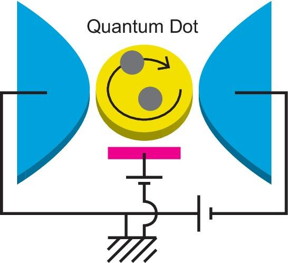 A quantum dot (the yellow part) is connected to two lead electrodes (the blue parts). Electrons tunneling into the quantum dot from the electrodes interact with each other to form a highly correlated quantum state, called "Fermi liquid." Both nonlinear electric current passing through the quantum dot and its fluctuations that appear as a noise carry important signals, which can unveil underlying physics of the quantum liquid. It is clarified that three-body correlations of the electrons evolve significantly and play essential roles in the quantum state under the external fields that break the particle-hole or time-reversal symmetry.
CREDIT
Rui Sakano
A quantum dot (the yellow part) is connected to two lead electrodes (the blue parts). Electrons tunneling into the quantum dot from the electrodes interact with each other to form a highly correlated quantum state, called "Fermi liquid." Both nonlinear electric current passing through the quantum dot and its fluctuations that appear as a noise carry important signals, which can unveil underlying physics of the quantum liquid. It is clarified that three-body correlations of the electrons evolve significantly and play essential roles in the quantum state under the external fields that break the particle-hole or time-reversal symmetry.
CREDIT
Rui Sakano
Abstract: Theoretical physicists Yoshimichi Teratani and Akira Oguri of Osaka City University, and Rui Sakano of the University of Tokyo have developed mathematical formulas that describe a physical phenomenon happening within quantum dots and other nanosized materials. The formulas, published in the journal Physical Review Letters, could be applied to further theoretical research about the physics of quantum dots, ultra-cold atomic gasses, and quarks.
Osaka, Japan | Posted on December 25th, 2020
At issue is 'the Kondo effect'. This effect was first described in 1964 by Japanese theoretical physicist Jun Kondo in some magnetic materials, but now appears to happen in many other systems, including quantum dots and other nanoscale materials.
Normally, electrical resistance drops in metals as the temperature drops. But in metals containing magnetic impurities, this only happens down to a critical temperature, beyond which resistance rises with dropping temperatures.
Scientists were eventually able to show that, at very low temperatures near absolute zero, electron spins become entangled with the magnetic impurities, forming a cloud that screens their magnetism. The cloud's shape changes with further temperature drops, leading to a rise in resistance. This same effect happens when other external 'perturbations', such as a voltage or magnetic field, are applied to the metal.
Teratani, Sakano and Oguri wanted to develop mathematical formulas to describe the evolution of this cloud in quantum dots and other nanoscale materials, which is not an easy task.
To describe such a complex quantum system, they started with a system at absolute zero where a well-established theoretical model, namely Fermi liquid theory, for interacting electrons is applicable. They then added a 'correction' that describes another aspect of the system against external perturbations. Using this technique, they wrote formulas describing electrical current and its fluctuation through quantum dots.
Their formulas indicate electrons interact within these systems in two different ways that contribute to the Kondo effect. First, two electrons collide with each other, forming well-defined quasiparticles that propagate within the Kondo cloud. More significantly, an interaction called a three-body contribution occurs. This is when two electrons combine in the presence of a third electron, causing an energy shift of quasiparticles.
"The formulas' predictions could soon be investigated experimentally", Oguri says. "Studies along the lines of this research have only just begun," he adds.
The formulas could also be extended to understand other quantum phenomena, such as quantum particle movement through quantum dots connected to superconductors. Quantum dots could be a key for realizing quantum information technologies, such as quantum computers and quantum communication.
####
About Osaka City UniversityWe are Osaka City University - the oldest research university in Osaka. With 9 undergraduate faculties and 11 graduate schools all dedicated to making urban life better, energy cleaner, and people healthier and happier, we have won numerous awards and have produced 2 Nobel laureates. For more information, please visit our website at https://www.osaka-cu.ac.jp/en
For more information, please click here
Contacts:James Gracey
066-605-3454
@OCU_PR
Copyright © Osaka City University
If you have a comment, please Contact us.
Issuers of news releases, not 7th Wave, Inc. or Nanotechnology Now, are solely responsible for the accuracy of the content.
Bookmark:


Physics
 Flexing the power of a conductive polymer: A new material holds promise for the next generation of organic electronics June 24th, 2022
Observation of fractional exclusion statistics in quantum critical matter May 27th, 2022
Quantum Physics
Quantum network nodes with warm atoms June 24th, 2022
News and information
New technology helps reveal inner workings of human genome June 24th, 2022
Boron nitride nanotube fibers get real: Rice lab creates first heat-tolerant, stable fibers from wet-spinning process June 24th, 2022
Superconductivity
Possible Futures
New technology helps reveal inner workings of human genome June 24th, 2022
Boron nitride nanotube fibers get real: Rice lab creates first heat-tolerant, stable fibers from wet-spinning process June 24th, 2022
Quantum Computing
University of Illinois Chicago joins Brookhaven Lab's Quantum Center June 10th, 2022
Bumps could smooth quantum investigations: Rice University models show unique properties of 2D materials stressed by contoured substrates June 10th, 2022
Discoveries
New technology helps reveal inner workings of human genome June 24th, 2022
Boron nitride nanotube fibers get real: Rice lab creates first heat-tolerant, stable fibers from wet-spinning process June 24th, 2022
Announcements
New technology helps reveal inner workings of human genome June 24th, 2022
Boron nitride nanotube fibers get real: Rice lab creates first heat-tolerant, stable fibers from wet-spinning process June 24th, 2022
Interviews/Book Reviews/Essays/Reports/Podcasts/Journals/White papers/Posters
Quantum network nodes with warm atoms June 24th, 2022
New technology helps reveal inner workings of human genome June 24th, 2022
Quantum Dots/Rods
New substance classes for nanomaterials: Nano spheres and diamond slivers made of silicon and germanium: Potential applications as nano semiconductor materials September 10th, 2021
�Missing jigsaw piece�: engineers make critical advance in quantum computer design August 20th, 2021
Quantum nanoscience
Bumps could smooth quantum investigations: Rice University models show unique properties of 2D materials stressed by contoured substrates June 10th, 2022
UCI scientists turn a hydrogen molecule into a quantum sensor: New technique enables precise measurement of electrostatic properties of materials April 22nd, 2022
