
| Date | 9th, Jan 2021 |
|---|
Home > Press > Detecting COVID-19 antibodies in 10-12 seconds
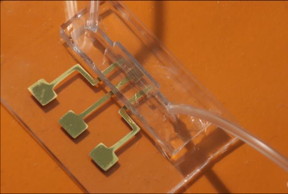 An image of the COVID-19 test chip made by aerosol jet nanoparticle 3D printing.
CREDIT
Advanced Manufacturing and Materials Lab, College of Engineering, Carnegie Mellon University
An image of the COVID-19 test chip made by aerosol jet nanoparticle 3D printing.
CREDIT
Advanced Manufacturing and Materials Lab, College of Engineering, Carnegie Mellon University
Abstract: Researchers at Carnegie Mellon University report findings on an advanced nanomaterial-based biosensing platform that detects, within seconds, antibodies specific to SARS-CoV-2, the virus responsible for the COVID-19 pandemic. In addition to testing, the platform will help to quantify patient immunological response to the new vaccines with precision.
Pittsburgh, PA | Posted on January 8th, 2021
The results were published this week in the journal Advanced Materials. Carnegie Mellon's collaborators included the University of Pittsburgh (Pitt) and the UPMC.
The testing platform identifies the presence of two of the virus' antibodies, spike S1 protein and receptor binding domain (RBD), in a very small drop of blood (about 5 microliters). Antibody concentrations can be extremely low and still detected below one picomolar (0.15 nanograms per milliliter). This detection happens through an electrochemical reaction within a handheld microfluidic device which sends results almost immediately to a simple interface on a smart phone.
"We utilized the latest advances in materials and manufacturing such as nanoparticle 3D printing to create a device that rapidly detects COVID-19 antibodies," said Rahul Panat, an associate professor of mechanical engineering at Carnegie Mellon who uses specialized additive manufacturing techniques for research ranging from brain-computer interfaces to biomonitoring devices.
An additive manufacturing technology called aerosol jet 3D printing is responsible for the efficiency and accuracy of the testing platform. Tiny, inexpensive gold micropillar electrodes are printed at nanoscale using aerosol droplets that are thermally sintered together. This causes a rough, irregular surface that provides increased surface area of the micropillars and an enhanced electrochemical reaction, where antibodies can latch on to antigens coated on the electrode. The specific geometry allows the micropillars to load more proteins for detection, resulting in very accurate, quick results.
The test has a very low error rate because the binding reaction between the antibody and antigen used in the device is highly selective. The researchers were able to exploit this natural design to their advantage.
The results come at an urgent time during the COVID-19 pandemic. "Because our technique can quantify the immune response to vaccination, it is very relevant in the current environment," Panat said.
Panat collaborated with Shou-Jiang Gao, leader of the cancer virology program at UPMC's Hillman Cancer Center and professor of microbiology and molecular genetics at Pitt. Azahar Ali, a researcher in Panat's Advanced Manufacturing and Materials Lab, was the lead author of the study.
Rapid diagnosis for the treatment and prevention of communicable diseases is a public health issue that goes beyond the current COVID-19 pandemic. Because the proposed sensing platform is generic, it can be used for the rapid detection of biomarkers for other infectious agents such as Ebola, HIV, and Zika. Such a quick and effective test could be a game-changer for controlling the spread of diseases.
####
About College of Engineering, Carnegie Mellon UniversityThe College of Engineering at Carnegie Mellon University is a top-ranked engineering college that is known for our intentional focus on cross-disciplinary collaboration in research. The College is well known for working on problems of both scientific and practical importance. Our "maker" culture is ingrained in all that we do, leading to novel approaches and transformative results. Our acclaimed faculty has a focus on innovation management and engineering to yield transformative results that will drive the intellectual and economic vitality of our community, nation and world.
For more information, please click here
Contacts:Lisa Kulick
412-268-5444
Copyright © College of Engineering, Carnegie Mellon University
If you have a comment, please Contact us.
Issuers of news releases, not 7th Wave, Inc. or Nanotechnology Now, are solely responsible for the accuracy of the content.
Bookmark:


News and information
 New technology helps reveal inner workings of human genome June 24th, 2022
Boron nitride nanotube fibers get real: Rice lab creates first heat-tolerant, stable fibers from wet-spinning process June 24th, 2022
Possible Futures
New technology helps reveal inner workings of human genome June 24th, 2022
Boron nitride nanotube fibers get real: Rice lab creates first heat-tolerant, stable fibers from wet-spinning process June 24th, 2022
Nanomedicine
New technology helps reveal inner workings of human genome June 24th, 2022
New nano-gel to protect children receiving chemotherapy from hearing loss June 17th, 2022
Discoveries
New technology helps reveal inner workings of human genome June 24th, 2022
Boron nitride nanotube fibers get real: Rice lab creates first heat-tolerant, stable fibers from wet-spinning process June 24th, 2022
Announcements
New technology helps reveal inner workings of human genome June 24th, 2022
Boron nitride nanotube fibers get real: Rice lab creates first heat-tolerant, stable fibers from wet-spinning process June 24th, 2022
Interviews/Book Reviews/Essays/Reports/Podcasts/Journals/White papers/Posters
Quantum network nodes with warm atoms June 24th, 2022
New technology helps reveal inner workings of human genome June 24th, 2022
Nanobiotechnology
New technology helps reveal inner workings of human genome June 24th, 2022
New nano-gel to protect children receiving chemotherapy from hearing loss June 17th, 2022
