
| Date | 16th, Jan 2021 |
|---|
Home > Press > New way to control electrical charge in 2D materials: Put a flake on it
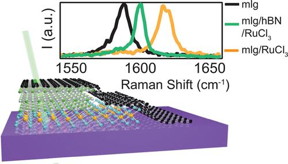 Physicists at Washington University in St. Louis have discovered how to locally add electrical charge to an atomically thin graphene device by layering flakes of another thin material, alpha-RuCl3, on top of it. Here, a layered device transfers electric charge.
CREDIT
(Image courtesy Nano Letters)
Physicists at Washington University in St. Louis have discovered how to locally add electrical charge to an atomically thin graphene device by layering flakes of another thin material, alpha-RuCl3, on top of it. Here, a layered device transfers electric charge.
CREDIT
(Image courtesy Nano Letters)
Abstract: Physicists at Washington University in St. Louis have discovered how to locally add electrical charge to an atomically thin graphene device by layering flakes of another thin material, alpha-RuCl3, on top of it.
St. Louis, MO | Posted on January 15th, 2021
A paper published in the journal Nano Letters describes the charge transfer process in detail. Gaining control of the flow of electrical current through atomically thin materials is important to potential future applications in photovoltaics or computing.
"In my field, where we study van der Waals heterostructures made by custom-stacking atomically thin materials together, we typically control charge by applying electric fields to the devices," said Erik Henriksen, assistant professor of physics in Arts & Sciences and corresponding author of the new study, along with Ken Burch at Boston College. "But here it now appears we can just add layers of RuCl33. It soaks up a fixed amount of electrons, allowing us to make 'permanent' charge transfers that don't require the external electric field."
Jesse Balgley, a graduate student in Henriksen's laboratory at Washington University, is second author of the study. Li Yang, professor of physics, and his graduate student Xiaobo Lu, also both at Washington University, helped with computational work and calculations, and are also co-authors.
Physicists who study condensed matter are intrigued by alpha-RuCl3 because they would like to exploit certain of its antiferromagnetic properties for quantum spin liquids.
In this new study, the scientists report that alpha-RuCl3 is able to transfer charge to several different types of materials -- not just graphene, Henriksen's personal favorite.
They also found that they only needed to place a single layer of alpha-RuCl3 on top of their devices to create and transfer charge. The process still works, even if the scientists slip a thin sheet of an electrically insulating material between the RuCl3 and the graphene.
"We can control how much charge flows in by varying the thickness of the insulator," Henriksen said. "Also, we are able to physically and spatially separate the source of charge from where it goes -- this is called modulation doping."
Adding charge to a quantum spin liquid is one mechanism thought to underlie the physics of high-temperature superconductivity.
"Anytime you do this, it could get exciting," Henriksen said. "And usually you have to add atoms to bulk materials, which causes lots of disorder. But here, the charge flows right in, no need to change the chemical structure, so it's a 'clean' way to add charge."
####
For more information, please click here
Contacts:Talia Ogliore
314-935-2919
@WUSTLnews
Copyright © Washington University in St. Louis
If you have a comment, please Contact us.
Issuers of news releases, not 7th Wave, Inc. or Nanotechnology Now, are solely responsible for the accuracy of the content.
Bookmark:


 Read more in Nano Letters: Modulation Doping via a Two-Dimensional Atomic Crystalline Acceptor:
News and information
New technology helps reveal inner workings of human genome June 24th, 2022
Boron nitride nanotube fibers get real: Rice lab creates first heat-tolerant, stable fibers from wet-spinning process June 24th, 2022
2 Dimensional Materials
Controlled synthesis of crystal flakes paves path for advanced future electronics June 17th, 2022
Solving the puzzle of 2D disorder: An interdisciplinary team developed a new method to characterize disorder in 2D materials June 17th, 2022
UBCO researchers change the game when it comes to activity tracking: Flexible, highly sensitive motion device created by extrusion printing June 17th, 2022
Bumps could smooth quantum investigations: Rice University models show unique properties of 2D materials stressed by contoured substrates June 10th, 2022
Graphene/ Graphite
OCSiAl expands its graphene nanotube production capacities to Europe June 17th, 2022
Bumps could smooth quantum investigations: Rice University models show unique properties of 2D materials stressed by contoured substrates June 10th, 2022
Nanotubes: a promising solution for advanced rubber cables with 60% less conductive filler June 1st, 2022
Possible Futures
New technology helps reveal inner workings of human genome June 24th, 2022
Boron nitride nanotube fibers get real: Rice lab creates first heat-tolerant, stable fibers from wet-spinning process June 24th, 2022
Chip Technology
Boron nitride nanotube fibers get real: Rice lab creates first heat-tolerant, stable fibers from wet-spinning process June 24th, 2022
Controlled synthesis of crystal flakes paves path for advanced future electronics June 17th, 2022
Discoveries
New technology helps reveal inner workings of human genome June 24th, 2022
Boron nitride nanotube fibers get real: Rice lab creates first heat-tolerant, stable fibers from wet-spinning process June 24th, 2022
Announcements
New technology helps reveal inner workings of human genome June 24th, 2022
Boron nitride nanotube fibers get real: Rice lab creates first heat-tolerant, stable fibers from wet-spinning process June 24th, 2022
Interviews/Book Reviews/Essays/Reports/Podcasts/Journals/White papers/Posters
Quantum network nodes with warm atoms June 24th, 2022
New technology helps reveal inner workings of human genome June 24th, 2022
