
| Date | 25th, Jan 2021 |
|---|
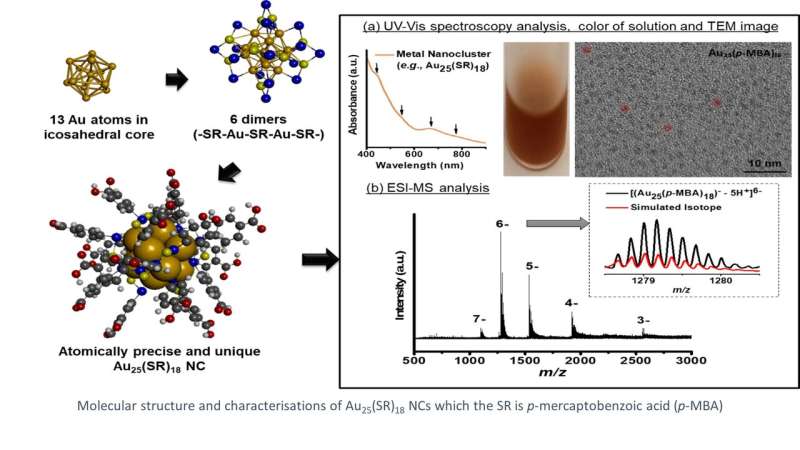 Molecular structure and characterisations of Au25(SR)18 NCs which the SR is p-mercaptobenzoic acid (p-MBA). Credit: International Islamic University Malaysia (IIUM)
Noble metal nanoparticles, such as gold and silver, are well known in the research field of catalysis and biomedical applications. For example, gold and silver nanoparticles can be good catalysts for various chemical transformations, such as hydrogenation and oxidation. They can also be used for bioimaging, and as drug carriers and radiosensitizers in cancer therapy due to their optical properties and biocompatibility. Silver nanoparticles have been widely researched and used in commercial products for their antimicrobial activity towards a broad spectrum of microorganisms.
They do have some limitations, though. Better molecular-scale insight into their behavior is difficult due to their varying sizes in the dispersed phase. Thanks to the advancement of nanoscience and nanotechnology, various new nanomaterials have been produced with interesting physicochemical properties that benefit a myriad of applications. This includes ultrasmall metal nanoclusters (size < 2 nm), which can be obtained with high uniformity of particle size in the dispersed phase, high atomic precision and consistent molecular structure. Various gold nanoclusters have been produced, crystallized and characterised. One of the most intensively studied is atomically precise thiolate-protected gold nanoclusters. There are several gold nanoclusters that have been reported. Among them thiolate-protected Au25SR18 NCs are the most intensively studied. The molecular understanding of Au25SR18 NCs has been well established by using X-ray crystallography, electrospray ionization spectroscopy, molecular dynamics and density functional theory analyses.
In general, the physicochemical properties of gold nanoclusters are different from their nanoparticle counterparts because of their ultrasmall size (
