
| Date | 28th, Jan 2021 |
|---|
Home > Press > A little soap simplifies making 2D nanoflakes: Rice lab�s experiments refine processing of hexagonal boron nitride
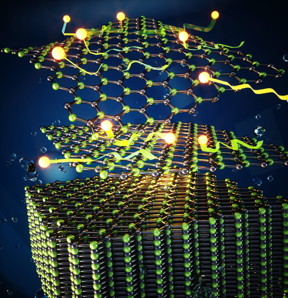 The image displays the exfoliation of hexagonal boron nitride into atomically thin nanosheets aided by surfactants, a process refined by chemists at Rice University. (Credit: Ella Maru Studio)
Abstract: Just a little soap helps clean up the challenging process of preparing two-dimensional hexagonal boron nitride (hBN).
Houston, TX | Posted on January 27th, 2021
Rice University chemists have found a way to get the maximum amount of quality 2D hBN nanosheets from its natural bulk form by processing it with surfactant (aka soap) and water. The surfactant surrounds and stabilizes the microscopic flakes, preserving their properties.
Experiments by the lab of Rice chemist Angel Mart� identified the �sweet spot� for making stable dispersions of hBN, which can be processed into very thin antibacterial films that handle temperatures up to 900 degrees Celsius (1,652 degrees Fahrenheit).
The work led by Mart�, alumna Ashleigh Smith McWilliams and graduate student Cecilia Mart�nez-Jim�nez is detailed in the American Chemical Society journal ACS Applied Nano Materials.
�Boron nitride materials are interesting, particularly because they are extremely resistant to heat,� Mart� said. �They are as light as graphene and carbon nanotubes, but you can put hBN in a flame and nothing happens to it.�
He said bulk hBN is cheap and easy to obtain, but processing it into microscopic building blocks has been a challenge. �The first step is to be able to exfoliate and disperse them, but research on how to do that has been scattered,� Mart� said. �When we decided to set a benchmark, we found the processes that have been extremely useful for graphene and nanotubes don�t work as well for boron nitride.�
Sonicating bulk hBN in water successfully exfoliated the material and made it soluble. �That surprised us, because nanotubes or graphene just float on top,� Mart� said. �The hBN dispersed throughout, though they weren�t particularly stable.
�It turned out the borders of boron nitride crystals are made of amine and nitric oxide groups and boric acid, and all of these groups are polar (with positive or negative charge),� he said. �So when you exfoliate them, the edges are full of these functional groups that really like water. That never happens with graphene.�
Experiments with nine surfactants helped them find just the right type and amount to keep 2D hBN from clumping without cutting individual flakes too much during sonication. The researchers used 1% by weight of each surfactant in water, added 20 milligrams of bulk hBN, then stirred and sonicated the mix.
Spinning the resulting solutions at low and high rates showed the greatest yield came with the surfactant known as PF88 under 100-gravity centrifugation, but the highest-quality nanosheets came from all the ionic surfactants under 8,000 g centrifugation, with the greatest stability from common ionic surfactants SDS and CTAC.
DTAB -- short for dodecyltrimethylammonium bromide -- under high centrifugation proved best at balancing the yield and quality of 2D hBN.
The researchers also produced a transparent film from hBN nanosheets dispersed in SDS and water to demonstrate how they can be processed into useful products.
�We describe the steps you need to do to produce high-quality hBN flakes,� Mart� said. �All of the steps are important, and we were able to bring to light the consequences of each one.�
Co-authors of the paper are Rice graduate student Cedric Ginestra; graduate student Asia Matatyaho Ya�akobi and Yeshayahu Talmon, professor emeritus of chemical engineering, at Technion-Israel Institute of Technology; and Matteo Pasquali, the A.J. Hartsook Professor of Chemical and Biomolecular Engineering, of chemistry and of materials science and nanoengineering at Rice. Mart� is a professor of chemistry, of bioengineering and of materials science and nanoengineering.
The National Science Foundation, Air Force Office of Scientific Research and the National Council of Science and Technology (CONACyT) of Mexico supported the research.
####
About Rice UniversityLocated on a 300-acre forested campus in Houston, Rice University is consistently ranked among the nation�s top 20 universities by U.S. News & World Report. Rice has highly respected schools of Architecture, Business, Continuing Studies, Engineering, Humanities, Music, Natural Sciences and Social Sciences and is home to the Baker Institute for Public Policy. With 3,978 undergraduates and 3,192 graduate students, Rice�s undergraduate student-to-faculty ratio is just under 6-to-1. Its residential college system builds close-knit communities and lifelong friendships, just one reason why Rice is ranked No. 1 for lots of race/class interaction and No. 1 for quality of life by the Princeton Review. Rice is also rated as a best value among private universities by Kiplinger�s Personal Finance.
Follow Rice News and Media Relations via Twitter @RiceUNews.
For more information, please click here
Contacts:Jeff Falk713-348-6775
Mike Williams713-348-6728
Copyright © Rice University
If you have a comment, please Contact us.
Issuers of news releases, not 7th Wave, Inc. or Nanotechnology Now, are solely responsible for the accuracy of the content.
Bookmark:


 Wiess School of Natural Sciences:
News and information
New technology helps reveal inner workings of human genome June 24th, 2022
Boron nitride nanotube fibers get real: Rice lab creates first heat-tolerant, stable fibers from wet-spinning process June 24th, 2022
2 Dimensional Materials
Controlled synthesis of crystal flakes paves path for advanced future electronics June 17th, 2022
Solving the puzzle of 2D disorder: An interdisciplinary team developed a new method to characterize disorder in 2D materials June 17th, 2022
UBCO researchers change the game when it comes to activity tracking: Flexible, highly sensitive motion device created by extrusion printing June 17th, 2022
Bumps could smooth quantum investigations: Rice University models show unique properties of 2D materials stressed by contoured substrates June 10th, 2022
Graphene/ Graphite
OCSiAl expands its graphene nanotube production capacities to Europe June 17th, 2022
Bumps could smooth quantum investigations: Rice University models show unique properties of 2D materials stressed by contoured substrates June 10th, 2022
Nanotubes: a promising solution for advanced rubber cables with 60% less conductive filler June 1st, 2022
Govt.-Legislation/Regulation/Funding/Policy
Solving the solar energy storage problem with rechargeable batteries that can convert and store energy at once June 24th, 2022
Boron nitride nanotube fibers get real: Rice lab creates first heat-tolerant, stable fibers from wet-spinning process June 24th, 2022
UBCO researchers change the game when it comes to activity tracking: Flexible, highly sensitive motion device created by extrusion printing June 17th, 2022
University of Illinois Chicago joins Brookhaven Lab's Quantum Center June 10th, 2022
Possible Futures
New technology helps reveal inner workings of human genome June 24th, 2022
Boron nitride nanotube fibers get real: Rice lab creates first heat-tolerant, stable fibers from wet-spinning process June 24th, 2022
Chip Technology
Boron nitride nanotube fibers get real: Rice lab creates first heat-tolerant, stable fibers from wet-spinning process June 24th, 2022
Controlled synthesis of crystal flakes paves path for advanced future electronics June 17th, 2022
Discoveries
New technology helps reveal inner workings of human genome June 24th, 2022
Boron nitride nanotube fibers get real: Rice lab creates first heat-tolerant, stable fibers from wet-spinning process June 24th, 2022
Materials/Metamaterials
Nanotubes: a promising solution for advanced rubber cables with 60% less conductive filler June 1st, 2022
New route to build materials out of tiny particles May 27th, 2022
A one-stop shop for quantum sensing materials May 27th, 2022
Announcements
New technology helps reveal inner workings of human genome June 24th, 2022
Boron nitride nanotube fibers get real: Rice lab creates first heat-tolerant, stable fibers from wet-spinning process June 24th, 2022
Interviews/Book Reviews/Essays/Reports/Podcasts/Journals/White papers/Posters
Quantum network nodes with warm atoms June 24th, 2022
New technology helps reveal inner workings of human genome June 24th, 2022
Military
Boron nitride nanotube fibers get real: Rice lab creates first heat-tolerant, stable fibers from wet-spinning process June 24th, 2022
Bumps could smooth quantum investigations: Rice University models show unique properties of 2D materials stressed by contoured substrates June 10th, 2022
Nanostructured fibers can impersonate human muscles June 3rd, 2022
Lightening up the nanoscale long-wavelength optoelectronics May 13th, 2022
Grants/Sponsored Research/Awards/Scholarships/Gifts/Contests/Honors/Records
Solving the solar energy storage problem with rechargeable batteries that can convert and store energy at once June 24th, 2022
Boron nitride nanotube fibers get real: Rice lab creates first heat-tolerant, stable fibers from wet-spinning process June 24th, 2022
Research partnerships
New technology helps reveal inner workings of human genome June 24th, 2022
Boron nitride nanotube fibers get real: Rice lab creates first heat-tolerant, stable fibers from wet-spinning process June 24th, 2022
