
Jan 29, 2021
(Nanowerk News) In conventional solar cells, the excessive energy of carriers above the band gap of a semiconductor is lost in the form of heat due to rapid cooling of hot carriers via emission of phonons. This is a major reason for Shockley-Queisser limit of solar cell efficiency.
Extracting the hot carrier to selective contacts has the potential to boost power conversion efficiency of solar cells to as high as 66%. The challenge in efficient hot carrier extraction is that intraband cooling of hot carriers usually occurs in a sub-picosecond timescale.
A research group led by Prof. WU Kaifeng from the Dalian Institute of Chemical Physics (DICP) of the Chinese Academy of Sciences (CAS) recently observed hot electrons as long-lived as more than 300 picoseconds in electron-doped (n-doped) colloidal CdSe quantum dots.
This study was published in Nature Communications ("Spin blockade and phonon bottleneck for hot electron relaxation observed in n-doped colloidal quantum dots").
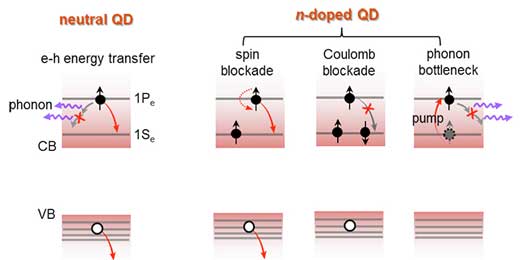 Carrier-carrier, carrier-phonon and spin-spin interactions in doped quantum dots result in long-lived hot electrons. (Image: WANG Junhui)
For lightly-doped dots they observed a slow 1Pe hot electron relaxation (~10 picosecond) resulting from a Pauli spin blockade of the preoccupying 1Se electron.
For heavily-doped dots, a large number of electrons residing in the surface states introduced picosecond Auger recombination which annihilated the valance band hole. Thus, the researchers could observe 300-picosecond-long hot electrons as a manifestation of a phonon bottleneck effect. This decreased the hot electron energy loss rate to a level of sub-meV per picosecond from a usual level of 1 eV per picosecond.
These results offered exciting opportunities of hot electron harvesting by exploiting carrier-carrier, carrier-phonon and spin-spin interactions in doped quantum dots.
"The observation of long-lived hot electrons in QDs sheds light on the utilization of long-lived hot electrons for high-efficiency photovoltaics and photocatalysis," said Prof. WU.
Source: Chinese Academy of Sciences
Share this:
Carrier-carrier, carrier-phonon and spin-spin interactions in doped quantum dots result in long-lived hot electrons. (Image: WANG Junhui)
For lightly-doped dots they observed a slow 1Pe hot electron relaxation (~10 picosecond) resulting from a Pauli spin blockade of the preoccupying 1Se electron.
For heavily-doped dots, a large number of electrons residing in the surface states introduced picosecond Auger recombination which annihilated the valance band hole. Thus, the researchers could observe 300-picosecond-long hot electrons as a manifestation of a phonon bottleneck effect. This decreased the hot electron energy loss rate to a level of sub-meV per picosecond from a usual level of 1 eV per picosecond.
These results offered exciting opportunities of hot electron harvesting by exploiting carrier-carrier, carrier-phonon and spin-spin interactions in doped quantum dots.
"The observation of long-lived hot electrons in QDs sheds light on the utilization of long-lived hot electrons for high-efficiency photovoltaics and photocatalysis," said Prof. WU.
Source: Chinese Academy of Sciences
Share this:
Carrier-carrier, carrier-phonon and spin-spin interactions in doped quantum dots result in long-lived hot electrons. (Image: WANG Junhui)
For lightly-doped dots they observed a slow 1Pe hot electron relaxation (~10 picosecond) resulting from a Pauli spin blockade of the preoccupying 1Se electron.
For heavily-doped dots, a large number of electrons residing in the surface states introduced picosecond Auger recombination which annihilated the valance band hole. Thus, the researchers could observe 300-picosecond-long hot electrons as a manifestation of a phonon bottleneck effect. This decreased the hot electron energy loss rate to a level of sub-meV per picosecond from a usual level of 1 eV per picosecond.
These results offered exciting opportunities of hot electron harvesting by exploiting carrier-carrier, carrier-phonon and spin-spin interactions in doped quantum dots.
"The observation of long-lived hot electrons in QDs sheds light on the utilization of long-lived hot electrons for high-efficiency photovoltaics and photocatalysis," said Prof. WU.
Source: Chinese Academy of Sciences
Share this:
Nanowerk Newsletter
Get our daily Nanotechnology News to your inbox!
