
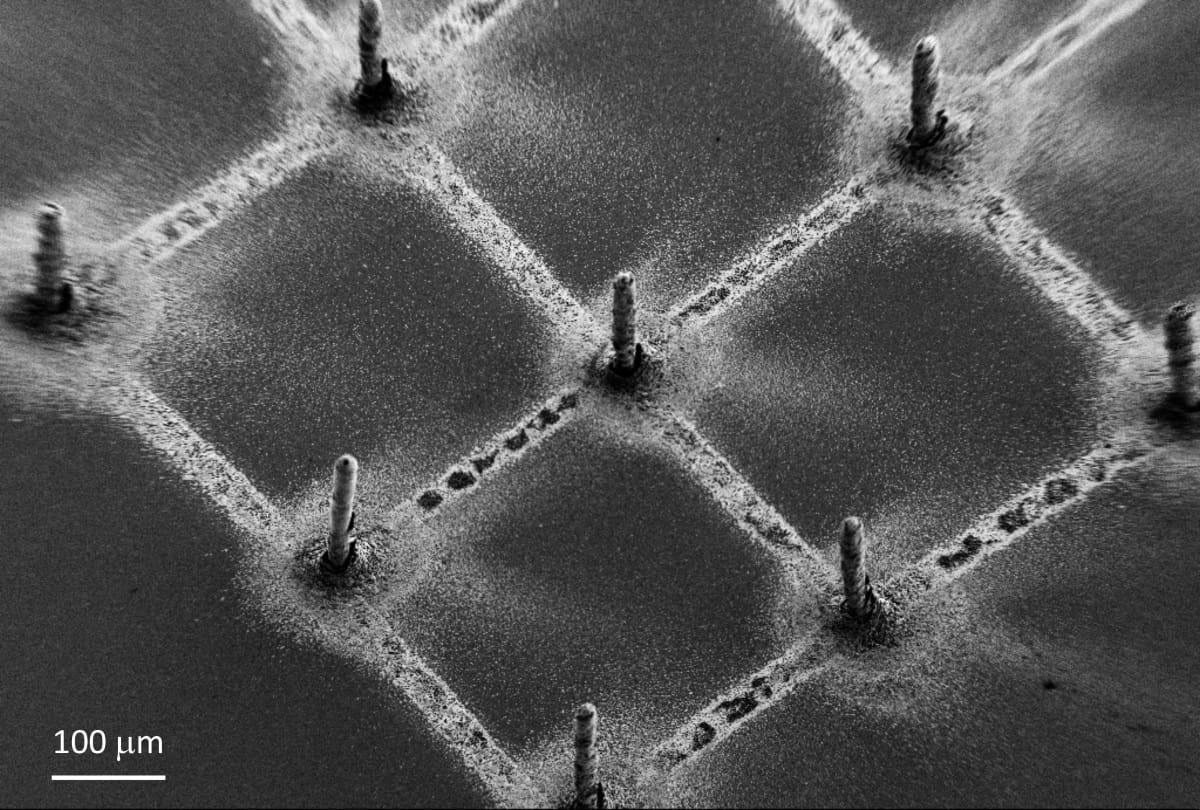
 Aerosol jet printing can create well-defined 3D perovskite structures, such as these pillars, for use in an X-ray photodetector. (Courtesy: L. Forró, EPFL)
X-ray imaging plays a vital role within diagnostic medicine, with modalities such as radiography, fluoroscopy and computed tomography (CT) enabling visualization of the internal structure of the human body. But exposing the body to ionizing radiation comes with an associated risk, and the medical imaging industry is continually seeking new ways to reduce the required imaging dose, via sensitive, high-resolution detectors.
One emerging approach is to use lead halide perovskites to create high-sensitivity X-ray detectors. These materials contain heavy elements such as lead and iodine that have a large X-ray scattering cross section. And as they directly convert X-ray photons into an electrical signal, perovskites offer higher sensitivity and lower cost than competing scintillator-based detector technology. Integrating these perovskites into standard microelectronics, however, remains a challenge.
Now, researchers in Switzerland have demonstrated that 3D aerosol jet printing, a low-cost technique that deposits material with micron precision, can be used to build X-ray detectors from the perovskite methylammonium lead iodide (MAPbI3) on graphene. As they report in ACS Nano, the resulting devices exhibited a record sensitivity of 2.2 × 10⁸ μC/Gyair/cm2 when detecting 8 keV X-ray photons at low dose rates – four orders of magnitude higher than today’s best-in-class detectors.
“By using photovoltaic perovskites with graphene, the response to X-rays has increased tremendously,” says group leader László Forró, from EPFL’s Laboratory of Physics of Complex Matter, in a press statement. “If we would use these modules in X-ray imaging, the required X-ray dose for forming an image could be decreased by more than a thousand times, decreasing the health hazard of this high-energy ionizing radiation to humans.”
Device optimization
Halide perovskites such as MAPbI3 form elongated crystallites when dissolved in a polar aprotic solvent. During aerosol jet printing, as this solution travels through the nozzle, the crystallites grow and land on the substrate as crystalline nanowires containing little solvent. Once a droplet reaches the substrate, the solvent is mostly evaporated, reducing any spatter and creating the well-defined 3D structures needed to construct an X-ray photodetector with high spatial resolution.
