
| Date | 27th, Feb 2021 |
|---|
Home > Press > How photoblueing disturbs microscopy
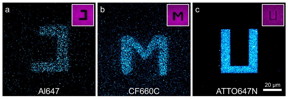 Confocal fluorescence images of glass surfaces coated with the cyanine dyes Alexa Fluor 647 (a) and CF660C (b) and with carborhodamine dye ATTO647N (c) after light excitation at 568 nanometres (nm). By exciting the red-absorbing dyes at 640 nm in certain areas (negative images top right), dyes are photoconverted there and it is possible to write letters on the surface that were excited at 568 nm and fluoresce at about 580 nm. The carborhodamine dye shows more efficient photobluing than the cyanine dyes.
CREDIT
Team Markus Sauer / University of Wuerzburg
Confocal fluorescence images of glass surfaces coated with the cyanine dyes Alexa Fluor 647 (a) and CF660C (b) and with carborhodamine dye ATTO647N (c) after light excitation at 568 nanometres (nm). By exciting the red-absorbing dyes at 640 nm in certain areas (negative images top right), dyes are photoconverted there and it is possible to write letters on the surface that were excited at 568 nm and fluoresce at about 580 nm. The carborhodamine dye shows more efficient photobluing than the cyanine dyes.
CREDIT
Team Markus Sauer / University of Wuerzburg
Abstract: The latest developments in fluorescence microscopy make it possible to image individual molecules in cells or molecular complexes with a spatial resolution of up to 20 nanometres. However, under certain circumstances, an effect occurs that falsifies the results: the laser light used can cause very reactive oxygen molecules to form in the sample. These can then damage the fluorescent dyes used to such an extent that they no longer fluoresce. Among microscopy experts, this effect is known as photobleaching.
How photoblueing disturbs microscopy
Wuerzburg, Germany | Posted on February 26th, 2021
However, various fluorescent dyes can also be transformed by photobleaching so that they absorb light of shorter wavelengths. "A previously red fluorescent dye then glows green. Its fluorescence has been shifted towards the blue range on the wavelength scale. This is why this effect is called photoblueing," explains Professor Markus Sauer, an expert in super-resolution microscopy from the Biocentre of Julius-Maximilians-Universit�t W�rzburg (JMU) in Bavaria, Germany.
First exact description of photoblueing
Sauer's team now presents the exact molecular mechanism of photoblueing for cyanine dyes like Cy5 for the first time in the journal Nature Methods. Dr. Martin Schnermann from the Center for Cancer Research in Frederick (USA) is also involved in the publication.
"Because we understood the mechanism so precisely, we were able to prevent photoblueing by simple additives such as vitamin C or to increase it by adding a kind of catalyst," says Markus Sauer.
Preventing photoblueing can be quite important. Although the effect can only affect a few percent of the dye used, it can nevertheless lead to errors or misinterpretations of the microscopy, for example in energy transfer experiments (FRET). This is because the converted dyes are detected with the same high sensitivity as the starting products.
Simple buffers prevent photoblueing
"Our results show which dyes are affected and how photoblueing can be prevented by simple buffer additions," Sauer summarises the contents of the Nature Methods paper. "But they equally show how photoblueing can possibly be used advantageously for fluorescence imaging and for tracking single, specifically converted dye molecules."
That's exactly what Sauer's team plans to tackle next: Photoblueing is to be further developed for, among other things, the targeted tracking of individual bacterial and viral particles in infection processes.
####
For more information, please click here
Contacts:Prof. Dr. Markus Sauer
@Uni_WUE
Copyright © University of Wuerzburg
If you have a comment, please Contact us.
Issuers of news releases, not 7th Wave, Inc. or Nanotechnology Now, are solely responsible for the accuracy of the content.
Bookmark:


News and information
 New technology helps reveal inner workings of human genome June 24th, 2022
Boron nitride nanotube fibers get real: Rice lab creates first heat-tolerant, stable fibers from wet-spinning process June 24th, 2022
Imaging
Snapshot measurement of single nanostructure�s circular dichroism March 25th, 2022
Better understanding superconductors with Higgs spectroscopy Prof. Stefan Kaiser from TU Dresden awarded ERC Consolidator Grant March 18th, 2022
Visualizing the invisible: New fluorescent DNA label reveals nanoscopic cancer features March 4th, 2022
Possible Futures
New technology helps reveal inner workings of human genome June 24th, 2022
Boron nitride nanotube fibers get real: Rice lab creates first heat-tolerant, stable fibers from wet-spinning process June 24th, 2022
Nanomedicine
New technology helps reveal inner workings of human genome June 24th, 2022
New nano-gel to protect children receiving chemotherapy from hearing loss June 17th, 2022
Discoveries
New technology helps reveal inner workings of human genome June 24th, 2022
Boron nitride nanotube fibers get real: Rice lab creates first heat-tolerant, stable fibers from wet-spinning process June 24th, 2022
Announcements
New technology helps reveal inner workings of human genome June 24th, 2022
Boron nitride nanotube fibers get real: Rice lab creates first heat-tolerant, stable fibers from wet-spinning process June 24th, 2022
Interviews/Book Reviews/Essays/Reports/Podcasts/Journals/White papers/Posters
Quantum network nodes with warm atoms June 24th, 2022
New technology helps reveal inner workings of human genome June 24th, 2022
