
| Date | 27th, Feb 2021 |
|---|
Home > Press > Changing the silkworm's diet to spin stronger silk
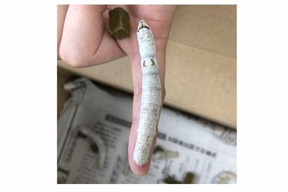 The silk worm and its CNF containing feed
CREDIT
Tohoku University
The silk worm and its CNF containing feed
CREDIT
Tohoku University
Abstract: Tohoku University researchers have produced cellulose nanofiber (CNF) synthesized silk naturally through a simple tweak to silkworms' diet. Mixing CNF with commercially available food and feeding the silkworms resulted in a stronger and more tensile silk.
Sendai City, Japan | Posted on February 26th, 2021
The results of their research were published in the journal Materials and Design on February 1, 2021.
"The idea for our research came to us when we realized the flow-focusing method by which silkworms produce silk is optimal for the nanofibril alignment of CNF," said Tohoku University materials engineer Fumio Narita and co-author of the study.
Silk is usually associated with clothes. But its usage is incredibly diverse thanks to its strength and elastic properties. Its biocompatibility makes it even safe to use inside the human body.
Because of this, researchers have been investigating ways to further strengthen silk. Processes investigated thus far, however, require the use of toxic chemicals that are harmful to humans and the environment.
Cellulose nanofibers--plant derived fibers that have been refined to the micro-level-- show promise in synthesizing low-cost, lightweight, high strength, and sustainable nanocomposites such as silk.
However, previous CNF based synthesized materials have demonstrated few mechanical improvements even with the benefit of expensive equipment due to the lack of nanofibril alignment.
In contrast, silkworms produce silk in a flow-focused method. Silk is dispersed via their salivary glands, orientating the fibrils along the flow direction and thus enabling better nanofibril alignment.
In the present study, silkworm larvae were divided into three groups and reared on food containing differing amounts of CNF content. The research group performed strength tests on the drawn silk fibers which were found to be about 2.0 times stronger than the silk from non-CNF fed silkworms.
"Our findings demonstrate an environmentally friendly way to produce sustainable biomaterials by simply using the CNF as bait," said Narita.
####
For more information, please click here
Contacts:Fumio Narita
81-227-957-342
@TohokuUniPR
Copyright © Tohoku University
If you have a comment, please Contact us.
Issuers of news releases, not 7th Wave, Inc. or Nanotechnology Now, are solely responsible for the accuracy of the content.
Bookmark:


News and information
 New technology helps reveal inner workings of human genome June 24th, 2022
Boron nitride nanotube fibers get real: Rice lab creates first heat-tolerant, stable fibers from wet-spinning process June 24th, 2022
Possible Futures
New technology helps reveal inner workings of human genome June 24th, 2022
Boron nitride nanotube fibers get real: Rice lab creates first heat-tolerant, stable fibers from wet-spinning process June 24th, 2022
Nanomedicine
New technology helps reveal inner workings of human genome June 24th, 2022
New nano-gel to protect children receiving chemotherapy from hearing loss June 17th, 2022
Discoveries
New technology helps reveal inner workings of human genome June 24th, 2022
Boron nitride nanotube fibers get real: Rice lab creates first heat-tolerant, stable fibers from wet-spinning process June 24th, 2022
Materials/Metamaterials
Nanotubes: a promising solution for advanced rubber cables with 60% less conductive filler June 1st, 2022
New route to build materials out of tiny particles May 27th, 2022
A one-stop shop for quantum sensing materials May 27th, 2022
Announcements
New technology helps reveal inner workings of human genome June 24th, 2022
Boron nitride nanotube fibers get real: Rice lab creates first heat-tolerant, stable fibers from wet-spinning process June 24th, 2022
Interviews/Book Reviews/Essays/Reports/Podcasts/Journals/White papers/Posters
Quantum network nodes with warm atoms June 24th, 2022
New technology helps reveal inner workings of human genome June 24th, 2022
Nanobiotechnology
New technology helps reveal inner workings of human genome June 24th, 2022
New nano-gel to protect children receiving chemotherapy from hearing loss June 17th, 2022
