
| Date | 10th, Mar 2021 |
|---|
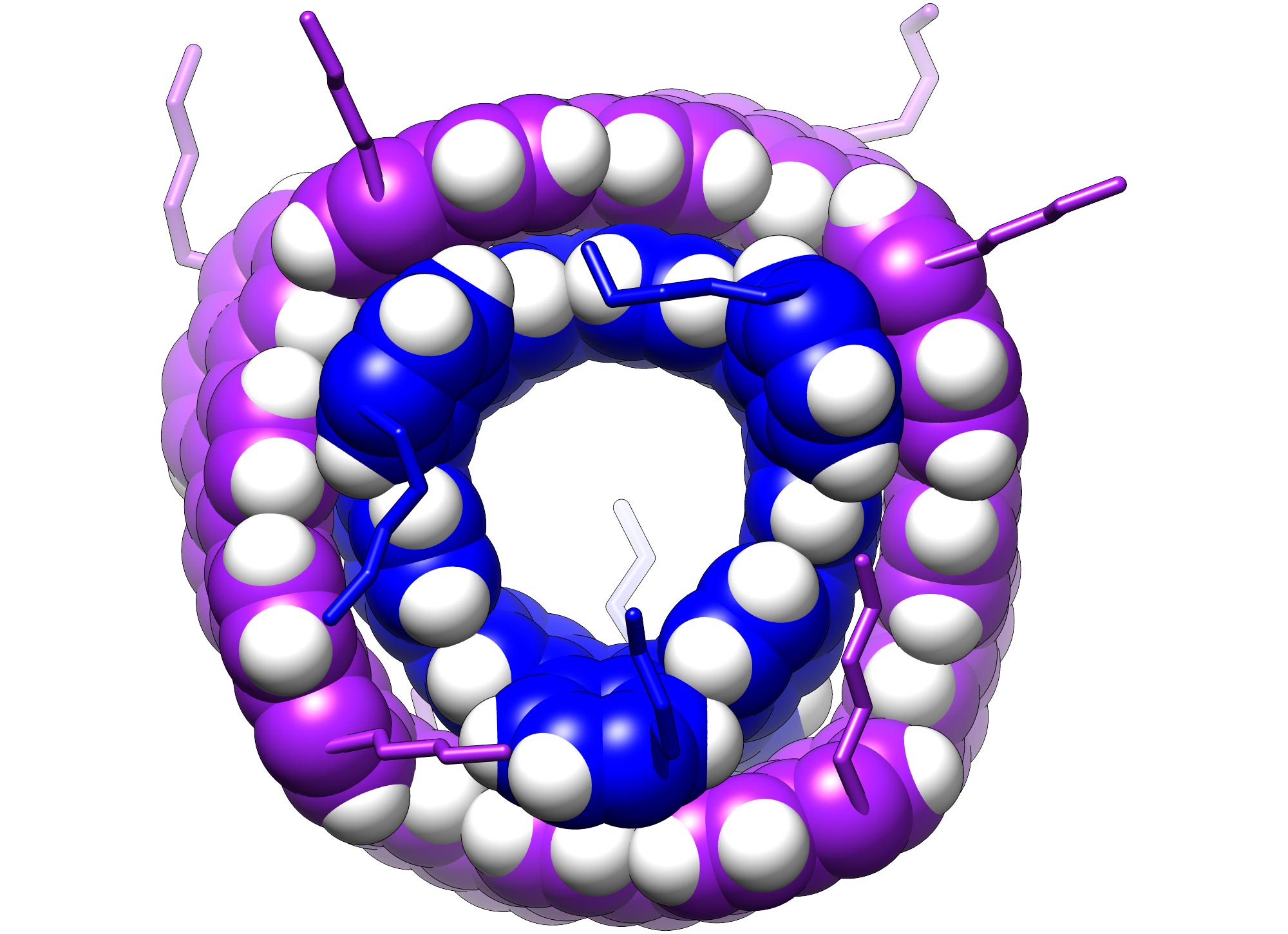
The crystal structure of a carbon bilayer. The purple outer layer and blue inner layer each have a similar arrangement of carbon atoms but are rotated relative to each other by just a few degrees. Credit: © 2021 Isobe et al.
Material behaviors depend on many things including not just the composition of the material but also the arrangement of its molecular parts. For the first time, researchers have found a way to coax carbon nanotubes into creating moiré patterns. Such structures could be useful in materials research, in particular in the field of superconducting materials.
Professor Hiroyuki Isobe from the Department of Chemistry at the University of Tokyo, and his team create nanoscopic material structures, primarily from carbon. Their aim is to explore new ways to create carbon nanostructures and to find useful applications for them. The most recent breakthrough from their lab is a new form of carbon nanotube with a very specific arrangement of atoms that has attracted much attention in the field of nanomaterials.
“We successfully created different kinds of atom-thick carbon nanotubes which self-assemble into complex structures,” said Isobe. “These nanotubes are made from rolled up sheets of carbon atoms arranged hexagonally. We made wide ones and narrow ones which fit inside them. This means the resulting complex tube structure has a double-layered wall. The hexagonal patterns of these layers are offset such that the two layers together create what is known as a moiré pattern. And this is significant for materials researchers.”
