
| Date | 13th, Mar 2021 |
|---|
Home > Press > Remote control for quantum emitters:Novel approach could become a asset in quantum computers and quantum simulation
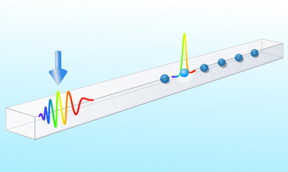 A light field with time-dependent frequencies - propagating in a waveguide. Due to self-compression the pulse addresses individual quantum emitters.
CREDIT
University of Innsbruck
A light field with time-dependent frequencies - propagating in a waveguide. Due to self-compression the pulse addresses individual quantum emitters.
CREDIT
University of Innsbruck
Abstract: In order to exploit the properties of quantum physics technologically, quantum objects and their interaction must be precisely controlled. In many cases, this is done using light. Researchers at the University of Innsbruck and the Institute of Quantum Optics and Quantum Information (IQOQI) of the Austrian Academy of Sciences have now developed a method to individually address quantum emitters using tailored light pulses. "Not only is it important to individually control and read the state of the emitters," says Oriol Romero-Isart, "but also to do so while leaving the system as undisturbed as possible." Together with Juan Jose? Garci?a-Ripoll (IQOQI visiting fellow) from the Instituto de Fi?sica Fundamental in Madrid, Romero-Isart's research group has now investigated how specifically engineered pulses can be used to focus light on a single quantum emitter.
Innsbruck, Austria | Posted on March 12th, 2021
Self-compressing light pulse
"Our proposal is based on chirped light pulses," explains Silvia Casulleras, first author of the research paper. "The frequency of these light pulses is time-dependent." So, similar to the chirping of birds, the frequency of the signal changes over time. In structures with certain electromagnetic properties - such as waveguides - the frequencies propagate at different speeds. "If you set the initial conditions of the light pulse correctly, the pulse compresses itself at a certain distance," explains Patrick Maurer from the Innsbruck team. "Another important part of our work was to show that the pulse enables the control of individual quantum emitters." This approach can be used as a kind of remote control to address, for example, individual superconducting quantum bits in a waveguide or atoms near a photonic crystal.
Wide range of applications
In their work, now published in Physical Review Letters, the scientists show that this method works not only with light or electromagnetic pulses, but also with other waves such as lattice oscillations (phonons) or magnetic excitations (magnons). The research group led by the Innsbruck experimental physicist Gerhard Kirchmair, wants to implement the concept for superconducting qubits in the laboratory in close collaboration with the team of theorists.
###
The research was financially supported by the European Union.
####
For more information, please click here
Contacts:Silvia Casulleras
43-512-507-52261
@uniinnsbruck
Copyright © University of Innsbruck
If you have a comment, please Contact us.
Issuers of news releases, not 7th Wave, Inc. or Nanotechnology Now, are solely responsible for the accuracy of the content.
Bookmark:


News and information
 New technology helps reveal inner workings of human genome June 24th, 2022
Boron nitride nanotube fibers get real: Rice lab creates first heat-tolerant, stable fibers from wet-spinning process June 24th, 2022
Superconductivity
A new step in the search for room-temperature superconductors May 27th, 2022
Quantum �shock absorbers� allow perovskite to exhibit superfluorescence at room temperature April 1st, 2022
Possible Futures
New technology helps reveal inner workings of human genome June 24th, 2022
Boron nitride nanotube fibers get real: Rice lab creates first heat-tolerant, stable fibers from wet-spinning process June 24th, 2022
Chip Technology
Boron nitride nanotube fibers get real: Rice lab creates first heat-tolerant, stable fibers from wet-spinning process June 24th, 2022
Controlled synthesis of crystal flakes paves path for advanced future electronics June 17th, 2022
Quantum Computing
University of Illinois Chicago joins Brookhaven Lab's Quantum Center June 10th, 2022
Bumps could smooth quantum investigations: Rice University models show unique properties of 2D materials stressed by contoured substrates June 10th, 2022
Discoveries
New technology helps reveal inner workings of human genome June 24th, 2022
Boron nitride nanotube fibers get real: Rice lab creates first heat-tolerant, stable fibers from wet-spinning process June 24th, 2022
Announcements
New technology helps reveal inner workings of human genome June 24th, 2022
Boron nitride nanotube fibers get real: Rice lab creates first heat-tolerant, stable fibers from wet-spinning process June 24th, 2022
Interviews/Book Reviews/Essays/Reports/Podcasts/Journals/White papers/Posters
Quantum network nodes with warm atoms June 24th, 2022
New technology helps reveal inner workings of human genome June 24th, 2022
