
The researchers designed the microscopes as part of the European project “ChipScope.” The team has also created a startup company, QubeDot GmbH, to move its nanoLED array technology to market.
The nanoLEDs that function as the base of the device are 200 nm — a size that could allow the fully functional device to be used to observe certain viruses and cellular processes in real time without demonstrating some of the problems that accompany existing high-resolution techniques. Resolution of the team’s microscope depends on the size of the light source, rather than that of the detection system.
In other words, as opposed to dependency on only a single light source, as in conventional superesolution microscopy, the researchers’ device used millions of light sources in the miniature, with the 200-nm nanoLEDs forming an array. That arrangement allowed users to observe an object and follow it in real time, said Angel Dieguez, lecturer at the Department of Electronic and Biomedical Engineering and member of the Institute of Nanoscience and Nanotechnology of the University of Barcelona (IN2UB) and coordinator of the project.
The delivered resolution specifically depended on the size of the LEDs used in the device.
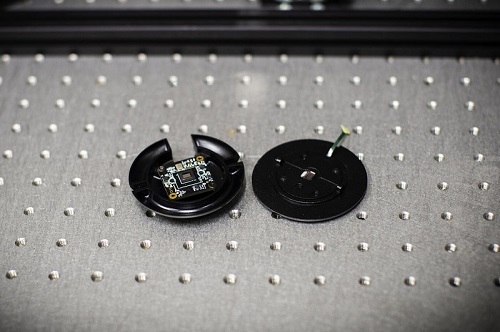
When paired with color conversion systems, that new platform will be able to operate at different wavelengths and be applicable beyond microscopy, including in the observation of chemical and biological reactions. Nanophotonic applications can be applied to the detection of viruses and diseases, as well as their distinct antibodies; last year, a team from the University of New Mexico and the Autonomous University of Madrid developed and deployed periodic arrays containing nanoparticles of different sizes to generate coherent light of desired colors. Beyond the detection of viruses, that work, too, holds potential applications in biosensing and the future development of additional nanoscale light sources.
The four-year-long ChipScope project was funded with €3.75 million within the European Future and Emerging Technologies (FET) Open. Participants also included the Technical University of Braunschweig (Germany), University of Rome Tor Vergata, Ymaging (Spain), the Austrian Institute of Technology, the Medical University of Vienna, and the Swiss Foundation for Research in Microbiology.
SMILE received funding in the amount of nearly €2 million in two years from the EIC Transition to Innovation call of the European FET-Proactive program.
QubeDot is based in Braunschweig.
