
| Date | 19th, Mar 2021 |
|---|
Home > Press > Teamwork makes light shine ever brighter: Combined energy sources return a burst of photons from plasmonic gold nanogaps
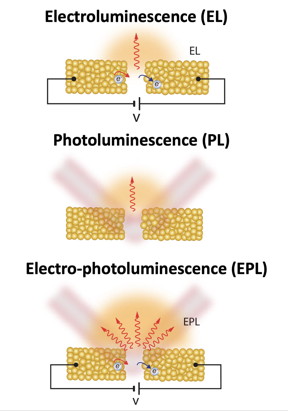 Electrical current and laser light combine at a gold nanogap to prompt a dramatic burst of light. The phenomenon could be useful for nanophotonic switches in computer chips and for advanced photocatalysts. (Credit: Natelson Research Group/Rice University)
Abstract: If you�re looking for one technique to maximize photon output from plasmons, stop. It takes two to wrangle.
Houston, TX | Posted on March 18th, 2021
Rice University physicists came across a phenomenon that boosts the light from a nanoscale device more than 1,000 times greater than they anticipated.
When looking at light coming from a plasmonic junction, a microscopic gap between two gold nanowires, there are conditions in which applying optical or electrical energy individually prompted only a modest amount of light emission. Applying both together, however, caused a burst of light that far exceeded the output under either individual stimulus.
The researchers led by Rice physicist Douglas Natelson and lead authors Longji Cui and Yunxuan Zhu found the effect while following up experiments that discovered driving current through the gap increased the number of light-emitting �hot carrier� electrons in the electrodes.
Now they know that adding energy from a laser to the same junction makes it even brighter. The dramatic enhancement could be employed to make nanophotonic switches for computer chips and for advanced photocatalysts.
The details appear in the American Chemical Society journal Nano Letters.
�It�s been known for a long time that it�s possible to get a light emission from these tiny structures,� Natelson said. �In our previous work, we showed that plasmons play an important role in generating very hot charge carriers, equivalent to a couple of thousand degrees.�
Plasmons are ripples of charge that carry energy, and when triggered, flow across the surface of certain metals, including gold. In the voltage-driven mechanism, electrons tunnel through the gap, exciting plasmons, which leads to hot electrons recombining with electron �holes� and emitting photons in the process.
Even though the effect seemed dramatic at the time, it paled in comparison to the new discovery.
�I like the idea of �1+1=1,000,� Natelson said. �You do two things, each of which doesn�t give you much light in this energy range, but together, holy cow! There�s a lot of light coming out.�
The specific mechanisms are worthy of further study, he said. One possibility is that optical and electrical drives combine to enhance the generation of hot electrons. An alternative is that light emission gets a boost via anti-Stokes electronic Raman scattering. In that process, light input prompts already excited hot carriers to relax back to their ground states, releasing more photons.
�Something interesting is going on there, where each of these individual excitations is not enough to give you the amount of light coming out,� Natelson said. �But put them together and the effective temperature is much higher. That�s one possible explanation: that the light output is an exponential function of the temperature. Reaching that effective temperature takes hundreds of femtoseconds.
�The Raman mechanism is more subtle, where light comes in, grabs energy from the voltage, and even stronger light leaves,� he said. �That happens even faster, so a time-dependent experiment could probably help us figure out the dominant mechanism.
�The reason it�s neat is that you can, in principle, couple the electrical drive and light coming in to do all kinds of things,� Natelson said. �If the hot carrier picture is right, there�s the possibility of doing some interesting chemistry.�
Co-authors of the paper are Peter Nordlander, the Wiess Chair in Physics and Astronomy and a professor of electrical and computer engineering and of materials science and nanoengineering at Rice, and Massimiliano Di Ventra, a professor of physics at the University of California, San Diego. Cui, a former postdoctoral fellow at Rice, is now an assistant professor of mechanical engineering and materials science and engineering at the University of Colorado Boulder. Zhu is a graduate student at Rice. Natelson is chair and a professor of physics and astronomy and a professor of electrical and computer engineering and of materials science and nanoengineering.
The J. Evans Attwell Welch Fellowship, Rice�s Smalley-Curl Institute, the Robert A. Welch Foundation, the University of Colorado and the National Science Foundation supported the research.
####
About Rice UniversityLocated on a 300-acre forested campus in Houston, Rice University is consistently ranked among the nation�s top 20 universities by U.S. News & World Report. Rice has highly respected schools of Architecture, Business, Continuing Studies, Engineering, Humanities, Music, Natural Sciences and Social Sciences and is home to the Baker Institute for Public Policy. With 3,978 undergraduates and 3,192 graduate students, Rice�s undergraduate student-to-faculty ratio is just under 6-to-1. Its residential college system builds close-knit communities and lifelong friendships, just one reason why Rice is ranked No. 1 for lots of race/class interaction and No. 1 for quality of life by the Princeton Review. Rice is also rated as a best value among private universities by Kiplinger�s Personal Finance.
Follow Rice News and Media Relations via Twitter @RiceUNews.
For more information, please click here
Contacts:Jeff Falk713-348-6775
Mike Williams713-348-6728
Copyright © Rice University
If you have a comment, please Contact us.
Issuers of news releases, not 7th Wave, Inc. or Nanotechnology Now, are solely responsible for the accuracy of the content.
Bookmark:


 Rice lab�s bright idea is pure gold:
Nordlander Nanophotonics Group:
Rice Department of Physics and Astronomy:
Wiess School of Natural Sciences:
News and information
New technology helps reveal inner workings of human genome June 24th, 2022
Boron nitride nanotube fibers get real: Rice lab creates first heat-tolerant, stable fibers from wet-spinning process June 24th, 2022
Chemistry
Nanoscale chemically ordered-disordered domains in Fe3Pt alloys and their three-dimensional interface and lattice strain May 27th, 2022
Flexible quantum sieve made at TU Dresden filters the fuel of Starship Enterprise April 15th, 2022
Govt.-Legislation/Regulation/Funding/Policy
Solving the solar energy storage problem with rechargeable batteries that can convert and store energy at once June 24th, 2022
Boron nitride nanotube fibers get real: Rice lab creates first heat-tolerant, stable fibers from wet-spinning process June 24th, 2022
UBCO researchers change the game when it comes to activity tracking: Flexible, highly sensitive motion device created by extrusion printing June 17th, 2022
University of Illinois Chicago joins Brookhaven Lab's Quantum Center June 10th, 2022
Possible Futures
New technology helps reveal inner workings of human genome June 24th, 2022
Boron nitride nanotube fibers get real: Rice lab creates first heat-tolerant, stable fibers from wet-spinning process June 24th, 2022
Chip Technology
Boron nitride nanotube fibers get real: Rice lab creates first heat-tolerant, stable fibers from wet-spinning process June 24th, 2022
Controlled synthesis of crystal flakes paves path for advanced future electronics June 17th, 2022
Optical computing/Photonic computing
Photonic integrated erbium doped amplifiers reach commercial performance: Boosting light power revolutionizes communications and autopilots June 17th, 2022
Electron-phonon coupling assisted universal red luminescence of o-phenylenediamine-based CDs June 10th, 2022
Discoveries
New technology helps reveal inner workings of human genome June 24th, 2022
Boron nitride nanotube fibers get real: Rice lab creates first heat-tolerant, stable fibers from wet-spinning process June 24th, 2022
Announcements
New technology helps reveal inner workings of human genome June 24th, 2022
Boron nitride nanotube fibers get real: Rice lab creates first heat-tolerant, stable fibers from wet-spinning process June 24th, 2022
Interviews/Book Reviews/Essays/Reports/Podcasts/Journals/White papers/Posters
Quantum network nodes with warm atoms June 24th, 2022
New technology helps reveal inner workings of human genome June 24th, 2022
Grants/Sponsored Research/Awards/Scholarships/Gifts/Contests/Honors/Records
Solving the solar energy storage problem with rechargeable batteries that can convert and store energy at once June 24th, 2022
Boron nitride nanotube fibers get real: Rice lab creates first heat-tolerant, stable fibers from wet-spinning process June 24th, 2022
Photonics/Optics/Lasers
Photonic integrated erbium doped amplifiers reach commercial performance: Boosting light power revolutionizes communications and autopilots June 17th, 2022
Marching to the Cadence of Electronics: Innovation A new paper in Nature validates technology developed by John Bowers and collaborators June 10th, 2022
