
QSCOUT aims to address the issue of limited access to quantum computer technology, which, while poised to become a major driver of innovation and research, is technology to which very few universities or companies have access. QSCOUT will allow scientists to conduct research that may not be possible at their home institutions without the cost or restrictions associated with the use of a commercial test bed.
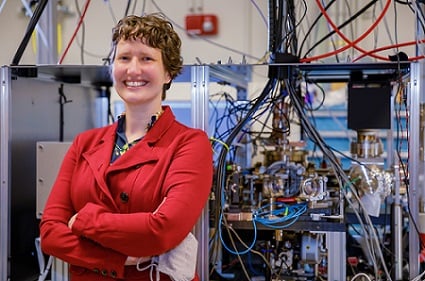
Sandia began running the test bed’s first user experiment in February with researchers from Indiana University. Teams from IBM, Oak Ridge National Laboratory, the University of New Mexico, and the University of California, Berkeley are slated to begin experimentation as well. Projects range from testing benchmarking techniques to developing algorithms that may one day solve problems in chemistry that are too complex for normal computers to process.
QSCOUT’s design is unusual in that it doesn’t use superconducting circuits; machines that rely on circuit superconductivity require ultracold temperatures, which makes them expensive to build and to operate. Sandia’s machine makes use of an ion trap, which allows it to run at warmer temperatures. Trapped ions also deliver clearer signals than circuits and can hold information longer, which allows researchers to perform different types of experiments and compare the two platforms.
Trapped ions are held inside QSCOUT with a “trap on a chip,” a flat bow-tie-shape device about 2 cm long, overlaid on a semiconductor chip. Three electrically charged ytterbium atoms are suspended in place by radio waves and an electric field above a hairline channel that runs down the center of the device. Lasers encode information in each ion as a qubit, comparable to a bit in a conventional computer, to perform calculations.
Sandia intends to expand the system from three to 32 qubits over the next three years to allow for more sophisticated operations.
