
Nanodiamonds have carbon atom lattices that sometimes contain an imperfection in which a nitrogen atom and a physical vacancy (or fluorescent center) replace two neighboring carbon atoms. The imperfection changes the quantum mechanical properties of the affected nanodiamond, altering how its nanoparticles react to light. These nanodiamonds (called “resonant” nanodiamonds when they have this fluorescent center) absorb green light and emit red fluorescence.
As a result of these properties and characteristics, resonant nanodiamonds are under investigation for biosensing applications, for biological imaging, and as single-photon sources.
In the current work, the researchers, led by Hokkaido University’s Keiji Sasaki, soaked an optical nanofiber in nanodiamond-based solutions, using nanodiamonds with and without fluorescent centers. Using a green laser and shining it through one end of the nanofiber, they trapped a single nanodiamond with fluorescent centers and successfully transported it away from the laser. The nanodiamond did absorb part of the laser light that hit it, and some of the light was scattered.
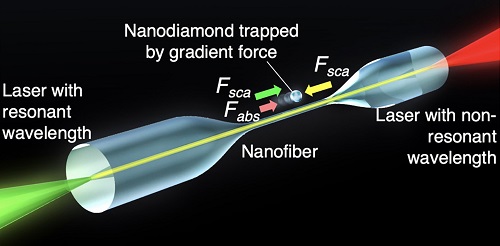
The red laser pushed the nonresonant nanodiamonds with greater strength than the green laser. The green laser pushed the resonant nanodiamonds with greater strength, as the resonant nanodiamonds absorbed the red light.
Further, by observing their movement under the precise conditions at which they performed the work, the scientists were able to determine the number of fluorescent centers present in each resonant nanodiamond.
Following the successful proof of concept, the team members said their next step is to apply their method for trapping and manipulating nanodiamonds to dye-doped nanoparticles. Those organic nanoparticles can function as nanoprobes in biodetection systems.
The study was supported by the Japan Society for the Promotion of Science and by the Cooperative Research Program of the Network Joint Research Center for Materials and Devices.
The research was published in Science Advances (www.doi.org/10.1126/sciadv.abd9551).
*This article has been updated for acccuracy
