
| Date | 2nd, Apr 2021 |
|---|
Home > Press > Plasmon-coupled gold nanoparticles useful for thermal history sensing
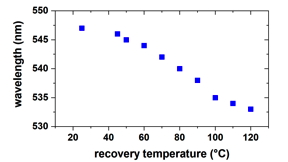 Peak wavelength of the polarized optical extinction spectrum as a function of the recovery temperature, showing the temperature-dependent behavior that can be applied for optical thermal-history sensors. Image credit: Mehedi H. Rizvi.
Abstract: Researchers have demonstrated that stretching shape-memory polymers embedded with clusters of gold nanoparticles alters their plasmon-coupling, giving rise to desirable optical properties. One potential application for the material is a sensor that relies on optical properties to track an object or environment's thermal history.
Durham, NC | Posted on April 1st, 2021
At issue is a stretchable polymer embedded with gold nanospheres. If the material is heated and stretched, followed by cooling to room temperature, the material will hold its stretched shape indefinitely. Once reheated to 120 degrees Celsius, the material returns to its original shape.
But what's really interesting is that the gold nanospheres are not perfectly dispersed in the polymer. Instead, they form clusters, in which their surface plasmon resonances are coupled. These plasmon-coupled nanoparticles have optical properties that shift depending on how close they are to each other, which changes when stretching alters the shape of the composite.
"When assessing the peak wavelength of light absorbed by the material, there are significant differences depending on whether the light is polarized parallel or perpendicular to the stretching direction," says Joe Tracy, corresponding author of a paper on the work and a professor of materials science and engineering at NC State. "For light polarized parallel to the direction of stretching, the further you have stretched the material, the further the light absorbed shifts to the red. For light polarized perpendicular to the stretching direction there is a blueshift."
"We also found that, while the shape-memory polymer holds its shape at room temperature, it recovers its original shape in a predictable way, depending on the temperature it is exposed to," says Tobias Kraus, co-author of the paper, a group leader at the Leibniz Institute for New Materials and a professor at Saarland University.
Specifically, once stretched 140% past its original length, you can determine the highest temperature to which the polymer is then exposed, up to 120 degrees Celsius, by measuring how much it has shrunk back toward its original size. What's more, because of the plasmon-coupled nanoparticles, this change can be measured indirectly, through measurements of the material's optical properties.
"From a practical perspective, this allows you to create an optical thermal-history sensor," Joe Tracy says. "You can use light to see how hot the material got. An important application of thermal-history sensors is assuring the quality or safety of shipping or storing materials that are sensitive to significant changes in heat. We have demonstrated an approach based on plasmon coupling of gold nanoparticles."
The sensor concept was developed empirically, but the researchers also used computational modeling to better understand the structure of the clusters of gold nanospheres and how the clusters changed during stretching. The strength of plasmon coupling is related to the spacings between nanospheres, which is known as a "plasmon ruler."
"Based on our simulations, we can estimate the distance between plasmon-coupled nanoparticles from their optical properties," says Amy Oldenburg, co-author of the paper and a professor of physics at the University of North Carolina at Chapel Hill. "This comparison is informative for designing future polymer nanocomposites based on plasmon-coupled nanoparticles."
####
For more information, please click here
Contacts:Matt Shipman
@NCStateNews
Copyright © North Carolina State University
If you have a comment, please Contact us.
Issuers of news releases, not 7th Wave, Inc. or Nanotechnology Now, are solely responsible for the accuracy of the content.
Bookmark:


News and information
 Bumps could smooth quantum investigations: Rice University models show unique properties of 2D materials stressed by contoured substrates June 10th, 2022
Emerging vaccine nanotechnology June 3rd, 2022
�Fruitcake� structure observed in organic polymers June 3rd, 2022
Progressive Medicinal and Herbal Nanoscience for Targeted Drug Delivery Systems June 3rd, 2022
Govt.-Legislation/Regulation/Funding/Policy
Bumps could smooth quantum investigations: Rice University models show unique properties of 2D materials stressed by contoured substrates June 10th, 2022
Nanostructured fibers can impersonate human muscles June 3rd, 2022
Bacteria-killing drills get an upgrade Visible light triggers: Rice�s molecular machines to treat infections June 1st, 2022
Possible Futures
Bumps could smooth quantum investigations: Rice University models show unique properties of 2D materials stressed by contoured substrates June 10th, 2022
Nanoscale bowtie antenna under optical and electrical excitations June 3rd, 2022
Emerging vaccine nanotechnology June 3rd, 2022
�Fruitcake� structure observed in organic polymers June 3rd, 2022
Sensors
A one-stop shop for quantum sensing materials May 27th, 2022
New nanomechanical oscillators with record-low loss May 13th, 2022
Discoveries
Bumps could smooth quantum investigations: Rice University models show unique properties of 2D materials stressed by contoured substrates June 10th, 2022
Emerging vaccine nanotechnology June 3rd, 2022
�Fruitcake� structure observed in organic polymers June 3rd, 2022
Announcements
Bumps could smooth quantum investigations: Rice University models show unique properties of 2D materials stressed by contoured substrates June 10th, 2022
Progressive Medicinal and Herbal Nanoscience for Targeted Drug Delivery Systems June 3rd, 2022
Artificial Intelligence Centered Cancer Nanomedicine: Diagnostics, Therapeutics and Bioethics June 3rd, 2022
Interviews/Book Reviews/Essays/Reports/Podcasts/Journals/White papers/Posters
�Fruitcake� structure observed in organic polymers June 3rd, 2022
Progressive Medicinal and Herbal Nanoscience for Targeted Drug Delivery Systems June 3rd, 2022
Artificial Intelligence Centered Cancer Nanomedicine: Diagnostics, Therapeutics and Bioethics June 3rd, 2022
