
| Date | 4th, Apr 2021 |
|---|
Home > Press > Oxygen-promoted synthesis of armchair graphene nanoribbons on Cu(111)
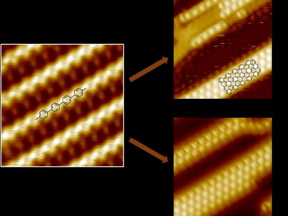 Scanning tunneling microscopy images of the synthesis of 3P sub-family armchair graphene nanoribbons through the lateral fusion of 3-AGNR on Cu(111). The introduction of O2 can reduce the temperature of the reaction by 180 K.
CREDIT
�Science China Press
Scanning tunneling microscopy images of the synthesis of 3P sub-family armchair graphene nanoribbons through the lateral fusion of 3-AGNR on Cu(111). The introduction of O2 can reduce the temperature of the reaction by 180 K.
CREDIT
�Science China Press
Abstract: On-surface synthesis has received great attention as a method to create atomically-precise one-dimensional (1D) and two-dimensional (2D) polymers with intriguing properties. In particular, graphene nanoribbons (GNRs), a category of quasi-1D nanomaterials derived from graphene, have been widely studied due to their tunable electronic properties and potential applications in semiconductor devices, such as field-effect transistors and spintronics. A series of top-down approaches have been pursued to produce GNRs, but a lack of control over the ribbon width and edge structure has hindered their further development.
Beijing, China | Posted on April 2nd, 2021
In 2010, Cai et al. firstly reported the fabrication of an atomically-precise armchair GNR (AGNR) on the Au(111) surface using a bottom-up approach. The basic mechanism involves thermally-activated dehalogenation, surface-assisted polymerization and finally cyclodehydrogenation.
In the following decade, this bottom-up approach has been extended to synthesize a wide variety of GNRs, including AGNRs with different widths, zigzag GNRs, GNR heterojunctions, chiral GNRs and chemically- doped GNRs. Based on the periodic similarity of their electronic structures, AGNRs can be classified into three families, 3p, 3p+1 and 3p+2 (representing the number of carbon atoms in the narrow direction).
So far, few studies have focused on GNR synthesis on Cu(111) due to the stronger surface interaction, despite the lower temperature for dehalogenation. It has been shown that chiral GNRs can be synthesized on Cu(111) using the same precursor which yields non-chiral 7-AGNR on Au(111) and that dehalogenation can be reversible on Au(111) but not Cu(111), which implies that the reaction pathway and products achieved could be controlled through the choice of substrate.
A second approach to tailor the reaction pathway in surface-confined synthesis is to introduce different atomic species, which has been considered in only a few recent studies. Exposure to iodine creates a monolayer intercalated between the polymers and the Ag(111) surface that decouples their electronic interactions. In addition, hydrogen was shown to remove halogen by-products and to induce covalent coupling, and sulphur to switch the surface-confined Ullmann reaction on or off.
Prof. Lifeng Chi's research group in Soochow University recently investigated the effect of oxygen on the synthesis of 3-AGNRs by surface-confined Ullmann coupling and determined that it, instead, caused a 1D to 2D transformation of the organometallic (OM) structures.
Here, their objective was to investigate the synthesis of 3p-AGNRs on Cu(111), extending from the previous study on Au(111), and to examine the effect of oxygen on lateral fusion of 3-AGNRs, inspired by their potential to promote C-H activation.
Their investigation demonstrated the successful synthesis of 3p-AGNRs on Cu(111) via lateral fusion of poly(para-phenylene) (i.e. 3-AGNR). Introduction of co-adsorbed atomic oxygen substantially reduced the temperature required to induce the lateral fusion reaction. The identification of this catalytic effect could benefit on-surface synthesis that applies dehydrogenation reactions, not restricting to GNRs, and highlights the potential of additional atomic adsorbates to steer surface reactions.
####
For more information, please click here
Contacts:Lifeng Chi
Copyright © Science China Press
If you have a comment, please Contact us.
Issuers of news releases, not 7th Wave, Inc. or Nanotechnology Now, are solely responsible for the accuracy of the content.
Bookmark:


News and information
 Bumps could smooth quantum investigations: Rice University models show unique properties of 2D materials stressed by contoured substrates June 10th, 2022
Emerging vaccine nanotechnology June 3rd, 2022
�Fruitcake� structure observed in organic polymers June 3rd, 2022
Progressive Medicinal and Herbal Nanoscience for Targeted Drug Delivery Systems June 3rd, 2022
Possible Futures
Bumps could smooth quantum investigations: Rice University models show unique properties of 2D materials stressed by contoured substrates June 10th, 2022
Nanoscale bowtie antenna under optical and electrical excitations June 3rd, 2022
Emerging vaccine nanotechnology June 3rd, 2022
�Fruitcake� structure observed in organic polymers June 3rd, 2022
Spintronics
Magnet-free chiral nanowires for spintronic devices March 18th, 2022
NGI advances graphene spintronics as 1D contacts improve mobility in nano-scale devices February 11th, 2022
Terahertz light-driven spin-lattice control: A new potential path to faster and more efficient data storage January 7th, 2022
Chip Technology
Bumps could smooth quantum investigations: Rice University models show unique properties of 2D materials stressed by contoured substrates June 10th, 2022
�Fruitcake� structure observed in organic polymers June 3rd, 2022
On-Chip Photodetection: Two-dimensional material heterojunctions hetero-integration May 13th, 2022
Nanoelectronics
Eyebrow-raising: Researchers reveal why nanowires stick to each other February 11th, 2022
Visualizing temperature transport: An unexpected technique for nanoscale characterization November 19th, 2021
Leibniz Prize winner Professor Dr. Oliver G. Schmidt moves to Chemnitz University of Technology: President Professor Dr. Gerd Strohmeier refers to an 'absolute top transfer' September 10th, 2021
Discoveries
Bumps could smooth quantum investigations: Rice University models show unique properties of 2D materials stressed by contoured substrates June 10th, 2022
Emerging vaccine nanotechnology June 3rd, 2022
�Fruitcake� structure observed in organic polymers June 3rd, 2022
Announcements
Bumps could smooth quantum investigations: Rice University models show unique properties of 2D materials stressed by contoured substrates June 10th, 2022
Progressive Medicinal and Herbal Nanoscience for Targeted Drug Delivery Systems June 3rd, 2022
Artificial Intelligence Centered Cancer Nanomedicine: Diagnostics, Therapeutics and Bioethics June 3rd, 2022
Interviews/Book Reviews/Essays/Reports/Podcasts/Journals/White papers/Posters
�Fruitcake� structure observed in organic polymers June 3rd, 2022
Progressive Medicinal and Herbal Nanoscience for Targeted Drug Delivery Systems June 3rd, 2022
Artificial Intelligence Centered Cancer Nanomedicine: Diagnostics, Therapeutics and Bioethics June 3rd, 2022
