
| Date | 4th, Apr 2021 |
|---|
Home > Press > Kirigami-style fabrication may enable new 3D nanostructures
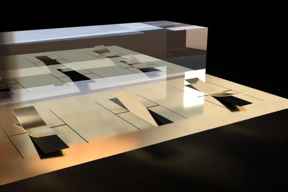 Strategically placed cuts to structural films can create 3D nanostructures when force is applied to the films, similar to how kirigami cuts made to paper can create pop-up structures.
CREDIT
Jennifer M. McCann/Penn State MRI
Strategically placed cuts to structural films can create 3D nanostructures when force is applied to the films, similar to how kirigami cuts made to paper can create pop-up structures.
CREDIT
Jennifer M. McCann/Penn State MRI
Abstract: A new technique that mimics the ancient Japanese art of kirigami may offer an easier way to fabricate complex 3D nanostructures for use in electronics, manufacturing and health care.
University Park, PA | Posted on April 2nd, 2021
Kirigami enhances the Japanese artform of origami, which involves folding paper to create 3D structural designs, by strategically incorporating cuts to the paper prior to folding. The method enables artists to create sophisticated three-dimensional structures more easily.
"We used kirigami at the nanoscale to create complex 3D nanostructures," said Daniel Lopez, Penn State Liang Professor of Electrical Engineering and Computer Science, and leader of the team that published this research in Advanced Materials. "These 3D structures are difficult to fabricate because current nanofabrication processes are based on the technology used to fabricate microelectronics which only use planar, or flat, films. Without kirigami techniques, complex three-dimensional structures would be much more complicated to fabricate or simply impossible to make."
Lopez said that if force is applied to a uniform structural film, nothing really happens other than stretching it a bit, like what happens when a piece of paper is stretched. But when cuts are introduced to the film, and forces are applied in a certain direction, a structure pops up, similar to when a kirigami artist applies force to a cut paper. The geometry of the planar pattern of cuts determines the shape of the 3D architecture.
"We demonstrated that it is possible to use conventional planar fabrication methods to create different 3D nanostructures from the same 2D cut geometry," Lopez said. "By introducing minimum changes to the dimensions of the cuts in the film, we can drastically change the three-dimensional shape of the pop-up architectures. We demonstrated nanoscale devices that can tilt or change their curvature just by changing the width of the cuts a few nanometers."
This new field of kirigami-style nanoengineering enables the development of machines and structures that can change from one shape to another, or morph, in response to changes in the environment. One example is an electronic component that changes shape in elevated temperatures to enable more air flow within a device to keep it from overheating.
"This kirigami technique will allow the development of adaptive flexible electronics that can be incorporated onto surfaces with complicated topography, such as a sensor resting on the human brain," Lopez said. "We could use these concepts to design sensors and actuators that can change shape and configuration to perform a task more efficiently. Imagine the potential of structures that can change shape with minuscule changes in temperature, illumination or chemical conditions."
Lopez will focus his future research on applying these kirigami techniques to materials that are one atom thick, and thin actuators made of piezoelectrics. These 2D materials open new possibilities for applications of kirigami-induced structures. Lopez said his goal is to work with other researchers at Penn State's Materials Research Institute (MRI) to develop a new generation of miniature machines that are atomically flat and are more responsive to changes in the environment.
"MRI is a world leader in the synthesis and characterization of 2D materials, which are the ultimate thin-films that can be used for kirigami engineering," Lopez said. "Moreover, by incorporating ultra-thin piezo and ferroelectric materials onto kirigami structures, we will develop agile and shape-morphing structures. These shape-morphing micro-machines would be very useful for applications in harsh environments and for drug delivery and health monitoring. I am working at making Penn State and MRI the place where we develop these super-small machines for a specific variety of applications."
###
Other authors on the study include Xu Zhang from Carnegie Mellon University and Haogang Cai from New York University, both former postdoctoral fellows with Lopez. Lior Medina and H. Espinosa from Northwestern University and Vladimir Askyuk from the National Institute of Standards and Technology also are part of the team. The research was supported by the U.S. Department of Energy.
####
For more information, please click here
Contacts:A'ndrea Elyse Messer
814-865-5689
@penn_state
Copyright © Penn State
If you have a comment, please Contact us.
Issuers of news releases, not 7th Wave, Inc. or Nanotechnology Now, are solely responsible for the accuracy of the content.
Bookmark:


News and information
 Bumps could smooth quantum investigations: Rice University models show unique properties of 2D materials stressed by contoured substrates June 10th, 2022
Emerging vaccine nanotechnology June 3rd, 2022
�Fruitcake� structure observed in organic polymers June 3rd, 2022
Progressive Medicinal and Herbal Nanoscience for Targeted Drug Delivery Systems June 3rd, 2022
Robotics
Nanostructured fibers can impersonate human muscles June 3rd, 2022
2 Dimensional Materials
UCI scientists turn a hydrogen molecule into a quantum sensor: New technique enables precise measurement of electrostatic properties of materials April 22nd, 2022
Graphene crystals grow better under copper cover April 1st, 2022
Graphene gets enhanced by flashing: Rice process customizes one-, two- or three-element doping for applications March 31st, 2022
Nanofabrication
First integrated laser on lithium niobate chip: Research paves the way for high-powered telecommunication systems April 8th, 2022
Possible Futures
Bumps could smooth quantum investigations: Rice University models show unique properties of 2D materials stressed by contoured substrates June 10th, 2022
Nanoscale bowtie antenna under optical and electrical excitations June 3rd, 2022
Emerging vaccine nanotechnology June 3rd, 2022
�Fruitcake� structure observed in organic polymers June 3rd, 2022
Nanomedicine
Emerging vaccine nanotechnology June 3rd, 2022
Progressive Medicinal and Herbal Nanoscience for Targeted Drug Delivery Systems June 3rd, 2022
Artificial Intelligence Centered Cancer Nanomedicine: Diagnostics, Therapeutics and Bioethics June 3rd, 2022
Nanostructured fibers can impersonate human muscles June 3rd, 2022
Discoveries
Bumps could smooth quantum investigations: Rice University models show unique properties of 2D materials stressed by contoured substrates June 10th, 2022
Emerging vaccine nanotechnology June 3rd, 2022
�Fruitcake� structure observed in organic polymers June 3rd, 2022
Announcements
Bumps could smooth quantum investigations: Rice University models show unique properties of 2D materials stressed by contoured substrates June 10th, 2022
Progressive Medicinal and Herbal Nanoscience for Targeted Drug Delivery Systems June 3rd, 2022
Artificial Intelligence Centered Cancer Nanomedicine: Diagnostics, Therapeutics and Bioethics June 3rd, 2022
Interviews/Book Reviews/Essays/Reports/Podcasts/Journals/White papers/Posters
�Fruitcake� structure observed in organic polymers June 3rd, 2022
Progressive Medicinal and Herbal Nanoscience for Targeted Drug Delivery Systems June 3rd, 2022
Artificial Intelligence Centered Cancer Nanomedicine: Diagnostics, Therapeutics and Bioethics June 3rd, 2022
