
The research and a tomography technique that the researchers developed to measure high-dimensional, classically entangled light support future developments in quantum metrology, optical communications, quantum error correction, and more.
Tailoring light typically involves altering its spatial properties, such as its phase, polarization, and/or amplitude. Structuring light, which can involve spatial light modulators, makes it possible to see smaller, more focused images with fewer photons and, accordingly, to store information in light for high-bandwidth communications.
However, the possibility of applying classical light to quantum processes or developing light that harnesses quantum-like properties (in effect, developing this type of tailored light so that it appears “classically entangled”) has so far been beyond the ability to create and control. This stems from the fact that structuring light from laser sources often requires specialized lasers. Further, the commonly considered two-dimensional (pattern and polarization) paradigm only considers classically entangled light in two dimensions.
As it relates to quantum light applications, those two degrees of freedom (pattern and polarization) mimic the two dimensions of the qubit quantum state. Creating higher dimensions requires finding more degrees of freedom in a system that is constrained to just two.
The laser used in the new work contained only a gain crystal and two mirrors. The process followed the quantum mechanical principle of ray-wave duality; the scientists controlled the path and the polarization inside their laser by making a simple adjustment to length to exploit a ray-wave structured laser beam in a tri-partite, eight-dimensional state.
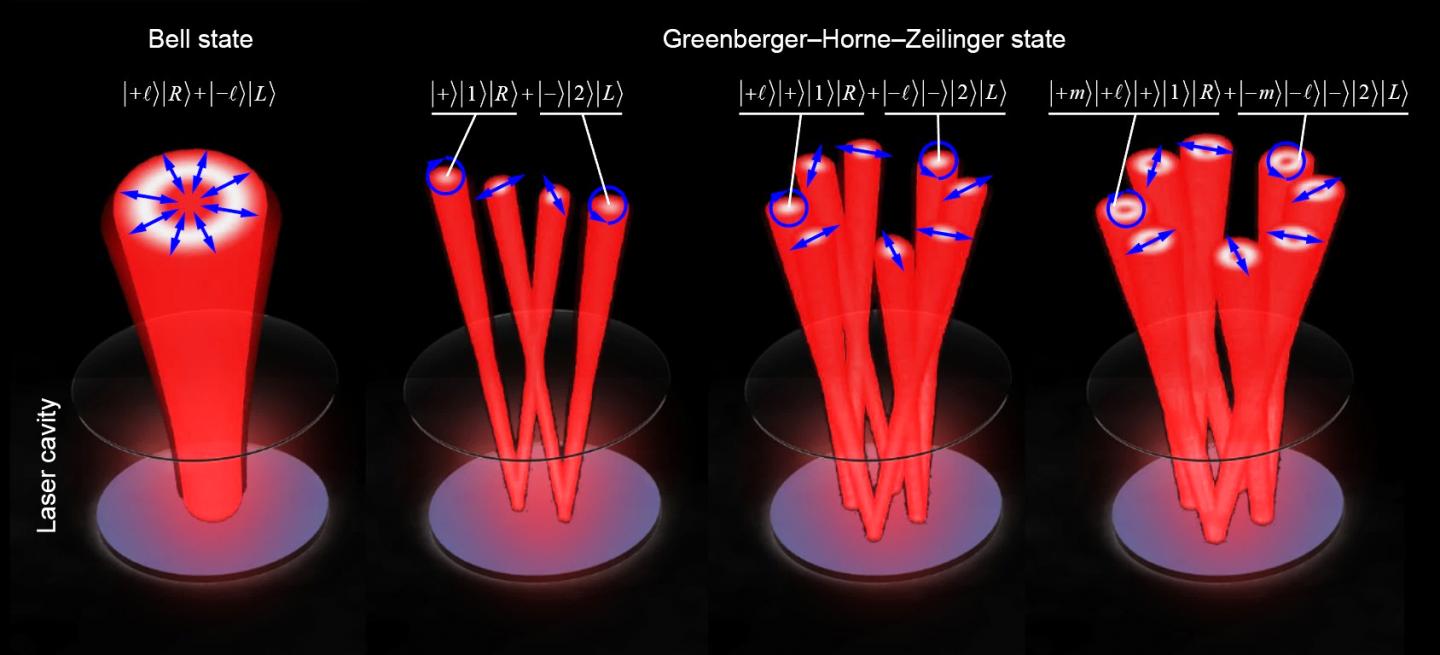
As a demonstration, the team produced all of the Greenberger-Horne-Zeilinger (GHZ) states (entangled quantum states that involve three or more subsystems) in vector beams. Measurements necessitated developing a new test and measurement approach; the researchers translated tomography of high-dimensional quantum states into a technique they could gauge. The result, they reported, was a new type of tomography for classically entangled light that reveals its quantum-like correlations beyond two dimensions.
The research was published in Light: Science & Applications (www.doi.org/10.1038/s41377-021-00493-x)
