
| Date | 10th, Apr 2021 |
|---|
Home > Press > Energy transmission by gold nanoparticles coupled to DNA structures
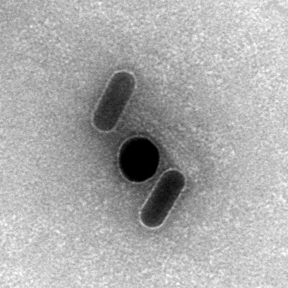 A 40 nm gold sphere induces plasmonic coupling between two 50 nm long gold rods that are arranged in a chiral fashion.
Source: T. Liedl
A 40 nm gold sphere induces plasmonic coupling between two 50 nm long gold rods that are arranged in a chiral fashion.
Source: T. Liedl
Abstract: Using DNA structures as scaffolds, Tim Liedl, a scientist of Ludwig-Maximilians-Universitaet (LMU) in Munich, has shown that precisely positioned gold nanoparticles can serve as efficient energy transmitters.
Munich, Germany | Posted on April 9th, 2021
Since the inception of the field in 2006, laboratories around the world have been exploring the use of 'DNA origami' for the assembly of complex nanostructures. The method is based on DNA strands with defined sequences that interact via localized base pairing. "With the aid of short strands with appropriate sequences, we can connect specific regions of long DNA molecules together, rather like forming three-dimensional structures by folding a flat sheet of paper in certain ways," as Professor Tim Liedl of the Faculty of Physics at LMU explains.
Image and mirror image
Liedl has now used DNA origami to construct chiral objects, i.e. structures that cannot be superimposed by any combination of rotation and translation. Instead they possess 'handedness', and are mirror images of one another. Such pairs often differ in their physical properties, for example, in the degree to which they absorb polarized light. This effect can be exploited in many ways. For example, it is the basis for CD spectroscopy (the 'CD' here stands for 'circular dichroism'), a technique that is used to elucidate the overall spatial configuration of chemical compounds, and even whole proteins.
With a view to assembling chiral metal structures, Liedl and his group synthesized complex DNA-origami structures that provide precisely positioned binding sites for the attachment of spherical and rod-shaped gold nanoparticles. The scaffold therefore serves as a template or mold for the placement of nanoparticles at predetermined positions and in a defined spatial orientation. "One can assemble a chiral object based solely on the arrangement of the gold nanoparticles," says Liedl
Gold is not only chemically robust, as a noble metal it exhibits what are known as surface plasmon resonances. Plasmons are coherent electron oscillations that are generated when light interacts with the surface of a metal structure. "One can picture these oscillations as being like the waves that are excited when a bottle of water is shaken either parallel or at right angles to its long axis," says Liedl.
Gold nanoparticles as energy transmitters
Oscillations excited in spatially contiguous gold particles can couple to one another, and the plasmons in Liedl's experiments behave as image and mirror image, thanks to their chiral disposition on the origami scaffold. "This is confirmed by our CD spectroscopic measurements," says Liedl. In the experiments, the chiral structures are irradiated with circularly polarized light and the level of absorption is measured as a percentage of the input. This enables right- and left-handed arrangements to be distinguished from one another.
In principle, two gold nanorods should be sufficient for the construction of chiral object, as they can be arranged either in the form of an L or an inverted L. However, the rods used in the experiments were relatively far apart (on the nanoscale) and the plasmons excited in one had little effect on those generated in the other, i.e. the two hardly coupled to each other at all. But Liedl and his colleagues had a trick up their sleeves. By appropriate redesign of the origami structure, they were able to position a gold nanosphere between the pair of L-formed rods, which effectively amplified the coupling. CD spectroscopy revealed the presence of energy transitions, thus confirming the hypothesis which the team had derived from simulations.
Liedl envisages two potential settings in which these nanostructures could find practical application. They could be used to detect viruses, since the binding of viral nucleic acids to a gold particle will amplify the CD signal. In addition, chiral plasmonic transmitters could serve as model switching devices in optical computers, in which optical elements replace the transistors that are the workhorses of electronic computers.
####
For more information, please click here
Contacts:Constanze Drewlo
0049-089-218-03423
Copyright © Ludwig-Maximilians-Universit�t M�nchen (LMU)
If you have a comment, please Contact us.
Issuers of news releases, not 7th Wave, Inc. or Nanotechnology Now, are solely responsible for the accuracy of the content.
Bookmark:


News and information
 �Fruitcake� structure observed in organic polymers June 3rd, 2022
Progressive Medicinal and Herbal Nanoscience for Targeted Drug Delivery Systems June 3rd, 2022
Artificial Intelligence Centered Cancer Nanomedicine: Diagnostics, Therapeutics and Bioethics June 3rd, 2022
Possible Futures
Nanoscale bowtie antenna under optical and electrical excitations June 3rd, 2022
Emerging vaccine nanotechnology June 3rd, 2022
�Fruitcake� structure observed in organic polymers June 3rd, 2022
Progressive Medicinal and Herbal Nanoscience for Targeted Drug Delivery Systems June 3rd, 2022
Chip Technology
�Fruitcake� structure observed in organic polymers June 3rd, 2022
On-Chip Photodetection: Two-dimensional material heterojunctions hetero-integration May 13th, 2022
Small microring array enables large complex-valued matrix multiplication May 13th, 2022
Nanomedicine
Emerging vaccine nanotechnology June 3rd, 2022
Progressive Medicinal and Herbal Nanoscience for Targeted Drug Delivery Systems June 3rd, 2022
Artificial Intelligence Centered Cancer Nanomedicine: Diagnostics, Therapeutics and Bioethics June 3rd, 2022
Nanostructured fibers can impersonate human muscles June 3rd, 2022
Optical computing/Photonic computing
Lightening up the nanoscale long-wavelength optoelectronics May 13th, 2022
On-Chip Photodetection: Two-dimensional material heterojunctions hetero-integration May 13th, 2022
Small microring array enables large complex-valued matrix multiplication May 13th, 2022
Nanoelectronics
Eyebrow-raising: Researchers reveal why nanowires stick to each other February 11th, 2022
Visualizing temperature transport: An unexpected technique for nanoscale characterization November 19th, 2021
Leibniz Prize winner Professor Dr. Oliver G. Schmidt moves to Chemnitz University of Technology: President Professor Dr. Gerd Strohmeier refers to an 'absolute top transfer' September 10th, 2021
Discoveries
Nanoscale bowtie antenna under optical and electrical excitations June 3rd, 2022
Emerging vaccine nanotechnology June 3rd, 2022
�Fruitcake� structure observed in organic polymers June 3rd, 2022
Announcements
�Fruitcake� structure observed in organic polymers June 3rd, 2022
Progressive Medicinal and Herbal Nanoscience for Targeted Drug Delivery Systems June 3rd, 2022
Artificial Intelligence Centered Cancer Nanomedicine: Diagnostics, Therapeutics and Bioethics June 3rd, 2022
Interviews/Book Reviews/Essays/Reports/Podcasts/Journals/White papers/Posters
�Fruitcake� structure observed in organic polymers June 3rd, 2022
Progressive Medicinal and Herbal Nanoscience for Targeted Drug Delivery Systems June 3rd, 2022
Artificial Intelligence Centered Cancer Nanomedicine: Diagnostics, Therapeutics and Bioethics June 3rd, 2022
Nanobiotechnology
Emerging vaccine nanotechnology June 3rd, 2022
Bacteria-killing drills get an upgrade Visible light triggers: Rice�s molecular machines to treat infections June 1st, 2022
Diabetes drug improves antibacterial treatment speed and effectiveness, researchers report May 27th, 2022
Oregon State University research pushes closer to new therapy for pancreatic cancer May 6th, 2022
