
The metalens that the team produced had a focal length of about 8 μm at an operating wavelength of 980 nm and an optimized focal spot at the scale of 100 nm. Those values, the researchers said, created a metalens platform that is suitable for two-photon direct laser lithography.
3D nanoprinting, or two-photon polymerization, is a method that is capable of printing structures with 100-nm resolution. Such a thin and compact lens will also allow users to print and create structures on surfaces that are otherwise difficult to achieve through DLW.
Where the conventional method for the creation of optical elements begins with knowledge of a desired physical structure, inverse-design allows for an arbitrary guess for an optical component’s initial design. To start the fabrication process through this alternate approach, the Northwestern researchers set a hard constraint on the objective of the design before they took steps to make a design. They then combined a two-photon polymerization process with inverse-design to fabricate complicated optical structures.
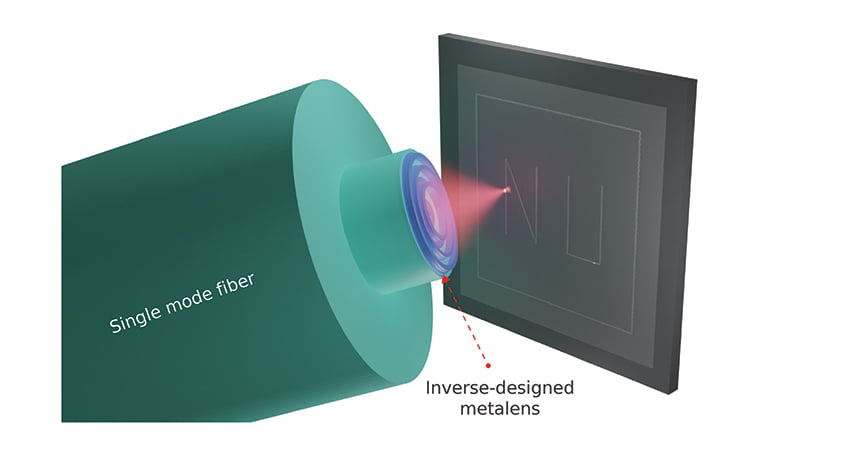
“Imagine being able to bring several of these optical fiber-tip metalenses along different directions to enable simultaneous 3D printing from multiple angles,” Krishnaswamy said. “That is something we cannot do today because of the bulky lenses typically used.”
The group submitted a provisional patent, according to a release from Northwestern.
The research is funded by the Office of Naval Research and was published in Nano Letters (www.doi.org/10.1021/acs.nanolett.0c04463).
