
| Date | 2nd, May 2021 |
|---|
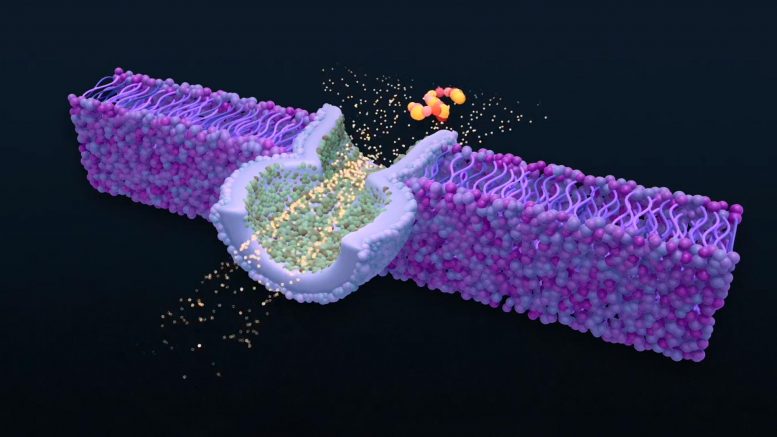
Researchers have spent more than three decades developing and studying miniature biosensors that can identify single molecules. In five to 10 years, when such devices may become a staple in doctors’ offices, they could detect molecular markers for cancer and other diseases and assess the effectiveness of drug treatment to fight those illnesses.
To help make that happen and to boost the accuracy and speed of these measurements, scientists must find ways to better understand how molecules interact with these sensors. Researchers from the National Institute of Standards and Technology (NIST) and Virginia Commonwealth University (VCU) have now developed a new approach. They reported their findings in a recent issue of Science Advances.
The team built its biosensor by making an artificial version of the biological material that forms a cell membrane. Known as a lipid bilayer, it contains a tiny pore, about 2 nanometers (billionths of a meter) wide in diameter, surrounded by fluid. Ions that are dissolved in the fluid pass through the nanopore, generating a small electric current. However, when a molecule of interest is driven into the membrane, it partially blocks the flow of current. The duration and magnitude of this blockade serve as a fingerprint, identifying the size and properties of a specific molecule.
