
| Date | 11th, May 2021 |
|---|
Home > Press > Graphene key for novel hardware security
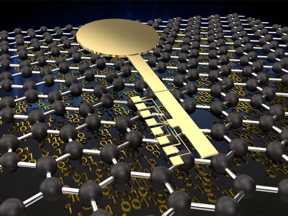 A team of Penn State researchers has developed a new hardware security device that takes advantage of microstructure variations to generate secure keys.
CREDIT
Jennifer McCann,Penn State
A team of Penn State researchers has developed a new hardware security device that takes advantage of microstructure variations to generate secure keys.
CREDIT
Jennifer McCann,Penn State
Abstract: As more private data is stored and shared digitally, researchers are exploring new ways to protect data against attacks from bad actors. Current silicon technology exploits microscopic differences between computing components to create secure keys, but artificial intelligence (AI) techniques can be used to predict these keys and gain access to data. Now, Penn State researchers have designed a way to make the encrypted keys harder to crack.
University Park, PA | Posted on May 10th, 2021
Led by Saptarshi Das, assistant professor of engineering science and mechanics, the researchers used graphene -- a layer of carbon one atom thick -- to develop a novel low-power, scalable, reconfigurable hardware security device with significant resilience to AI attacks. They published their findings in Nature Electronics today (May 10).
"There has been more and more breaching of private data recently," Das said. "We developed a new hardware security device that could eventually be implemented to protect these data across industries and sectors."
The device, called a physically unclonable function (PUF), is the first demonstration of a graphene-based PUF, according to the researchers. The physical and electrical properties of graphene, as well as the fabrication process, make the novel PUF more energy-efficient, scalable, and secure against AI attacks that pose a threat to silicon PUFs.
The team first fabricated nearly 2,000 identical graphene transistors, which switch current on and off in a circuit. Despite their structural similarity, the transistors' electrical conductivity varied due to the inherent randomness arising from the production process. While such variation is typically a drawback for electronic devices, it's a desirable quality for a PUF not shared by silicon-based devices.
After the graphene transistors were implemented into PUFs, the researchers modeled their characteristics to create a simulation of 64 million graphene-based PUFs. To test the PUFs' security, Das and his team used machine learning, a method that allows AI to study a system and find new patterns. The researchers trained the AI with the graphene PUF simulation data, testing to see if the AI could use this training to make predictions about the encrypted data and reveal system insecurities.
"Neural networks are very good at developing a model from a huge amount of data, even if humans are unable to," Das said. "We found that AI could not develop a model, and it was not possible for the encryption process to be learned."
This resistance to machine learning attacks makes the PUF more secure because potential hackers could not use breached data to reverse engineer a device for future exploitation, Das said. Even if the key could be predicted, the graphene PUF could generate a new key through a reconfiguration process requiring no additional hardware or replacement of components.
"Normally, once a system's security has been compromised, it is permanently compromised," said Akhil Dodda, an engineering science and mechanics graduate student conducting research under Das's mentorship. "We developed a scheme where such a compromised system could be reconfigured and used again, adding tamper resistance as another security feature."
With these features, as well as the capacity to operate across a wide range of temperatures, the graphene-based PUF could be used in a variety of applications. Further research can open pathways for its use in flexible and printable electronics, household devices and more.
###
Paper co-authors include Dodda, Shiva Subbulakshmi Radhakrishnan, Thomas Schranghamer and Drew Buzzell from Penn State; and Parijat Sengupta from Purdue University. Das is also affiliated with the Penn State Department of Materials Science and Engineering and the Materials Research Institute.
####
For more information, please click here
Contacts:Megan Lakatos
814-865-5544
@penn_state
Copyright © Penn State
If you have a comment, please Contact us.
Issuers of news releases, not 7th Wave, Inc. or Nanotechnology Now, are solely responsible for the accuracy of the content.
Bookmark:


Graphene/ Graphite
 Bumps could smooth quantum investigations: Rice University models show unique properties of 2D materials stressed by contoured substrates June 10th, 2022
Dynamic metasurfaces and metadevices empowered by graphene May 6th, 2022
News and information
Bumps could smooth quantum investigations: Rice University models show unique properties of 2D materials stressed by contoured substrates June 10th, 2022
Emerging vaccine nanotechnology June 3rd, 2022
�Fruitcake� structure observed in organic polymers June 3rd, 2022
Progressive Medicinal and Herbal Nanoscience for Targeted Drug Delivery Systems June 3rd, 2022
Law enforcement/Anti-Counterfeiting/Security/Loss prevention
How randomly moving electrons can improve cyber security May 27th, 2022
Possible Futures
Bumps could smooth quantum investigations: Rice University models show unique properties of 2D materials stressed by contoured substrates June 10th, 2022
Progressive Medicinal and Herbal Nanoscience for Targeted Drug Delivery Systems June 3rd, 2022
Artificial Intelligence Centered Cancer Nanomedicine: Diagnostics, Therapeutics and Bioethics June 3rd, 2022
Discoveries
Bumps could smooth quantum investigations: Rice University models show unique properties of 2D materials stressed by contoured substrates June 10th, 2022
Emerging vaccine nanotechnology June 3rd, 2022
�Fruitcake� structure observed in organic polymers June 3rd, 2022
Announcements
Bumps could smooth quantum investigations: Rice University models show unique properties of 2D materials stressed by contoured substrates June 10th, 2022
Progressive Medicinal and Herbal Nanoscience for Targeted Drug Delivery Systems June 3rd, 2022
Artificial Intelligence Centered Cancer Nanomedicine: Diagnostics, Therapeutics and Bioethics June 3rd, 2022
Interviews/Book Reviews/Essays/Reports/Podcasts/Journals/White papers/Posters
�Fruitcake� structure observed in organic polymers June 3rd, 2022
Progressive Medicinal and Herbal Nanoscience for Targeted Drug Delivery Systems June 3rd, 2022
Artificial Intelligence Centered Cancer Nanomedicine: Diagnostics, Therapeutics and Bioethics June 3rd, 2022
Artificial Intelligence
Artificial Intelligence Centered Cancer Nanomedicine: Diagnostics, Therapeutics and Bioethics June 3rd, 2022
�Nanomagnetic� computing can provide low-energy AI, researchers show May 6th, 2022
Artificial neurons go quantum with photonic circuits: Quantum memristor as missing link between artificial intelligence and quantum computing March 25th, 2022
Research partnerships
Nanostructured fibers can impersonate human muscles June 3rd, 2022
Bacteria-killing drills get an upgrade Visible light triggers: Rice�s molecular machines to treat infections June 1st, 2022
Novel sensors enable precise measurement of dopamine May 27th, 2022
