
How to transmit quantum bits over long optical fibers is among the challenges in building a quantum internet; small changes in ambient conditions, such as fluctuations in temperature, cause the fibers to expand and contract. This scrambles the fragile qubits encoded as a phase delay of a weak optical pulse in the fiber.
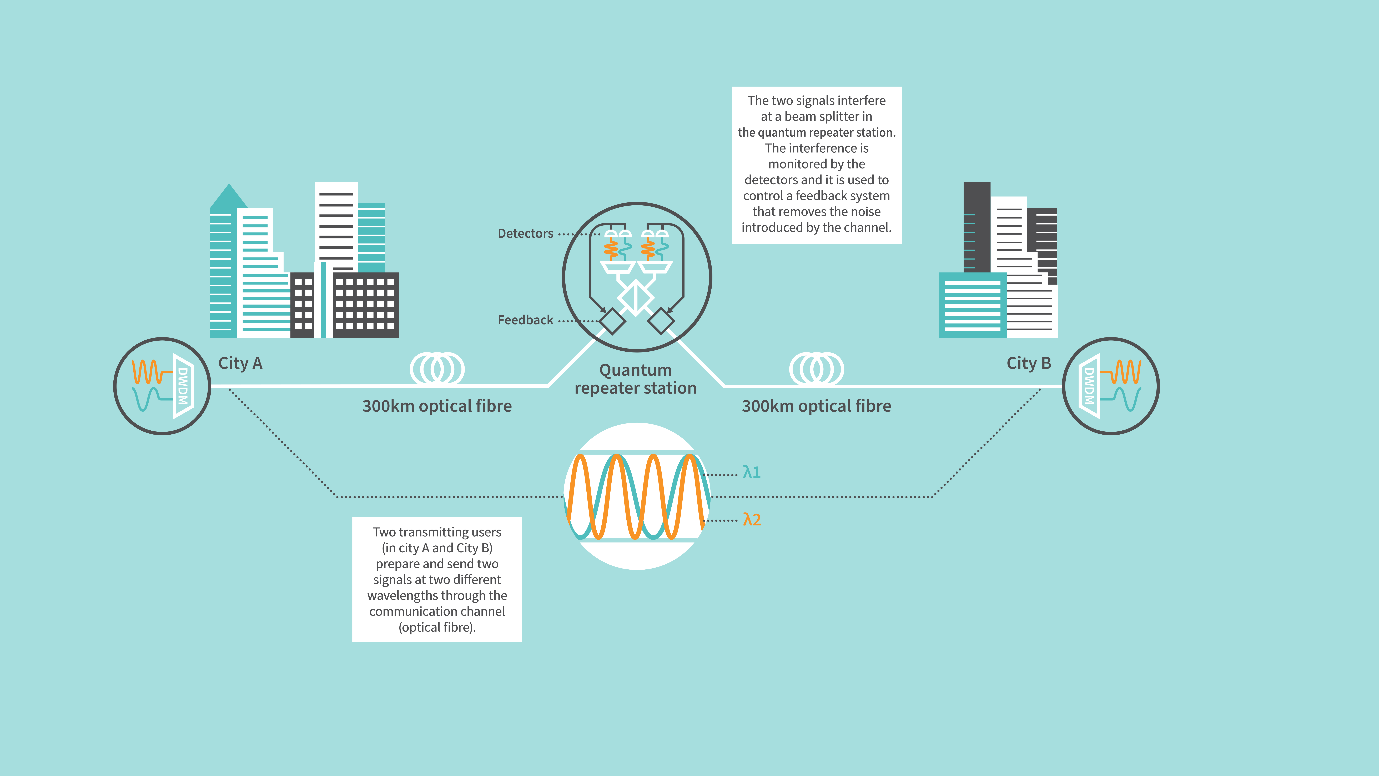
The first application of this method will be in long distance quantum key distribution (QKD). Current commercially available QKD systems are limited to around 100 to 200 km of fiber. In 2018, Toshiba published a paper in Nature Photonics that proposed the Twin Field QKD protocol as a way to extend that distance, and tested its resilience to optical loss using short fibers and attenuators. With the introduction of the dual-band stabilization technique, the team demonstrated Twin Field QKD on longer fibers of more than 600 km.
“With the new techniques we have developed, further extensions of the communication distance for QKD are possible, and our solutions can be applied to other quantum communications protocols and applications,” said Mirko Pittaluga, first author of the paper describing the results.
The development follows news in 2020 of the first industrial quantum secure network in the U.K., built by U.K. communications company BT and Toshiba. The system transmits data between the National Composites Centre and the Centre for Modelling & Simulation. Toshiba’s multiplexing compatibility enables the data and quantum keys to be transmitted along the same fiber, eliminating the need for dedicated infrastructure for key distribution. The researchers believe the combination of multiplexed QKD using existing infrastructure for shorter distances and Twin Field QKD for longer distances could pave the way for a commercially viable global quantum-secure network.
The research was published in Nature Photonics (www.doi.org/10.1038/s41566-021-00811-0).
