
| Date | 12th, Jun 2021 |
|---|
Home > Press > Researchers turned transparent calcite into artificial gold
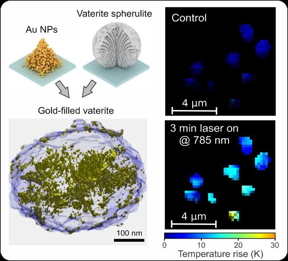 Figure shows 3D reconstruction of the golden vaterite and the laser-induced heating of the spherulites.
CREDIT
Tel Aviv University
Figure shows 3D reconstruction of the golden vaterite and the laser-induced heating of the spherulites.
CREDIT
Tel Aviv University
Abstract: Breakthrough in metamaterials: for the first time in the world, researchers at Tel Aviv University developed an innovative nanotechnology that transforms a transparent calcite nanoparticle into a sparkling gold-like particle. In other words, they turned the transparent particle into a particle that is visible despite its very small dimensions. According to the researchers the new material can serve as a platform for innovative cancer treatments.
Tel Aviv, Israel | Posted on June 11th, 2021
In a new paper published in Advanced Materials, an international team of scientists, coordinated by Dr. Roman Noskov and Dr. Pavel Ginzburg from the Iby and Aladar Fleischman Faculty of Engineering at Tel Aviv University, Prof. Dmitry Gorin from the Center for Photonics and Quantum Materials at the Skolkovo Institute of Science and Technology (Skoltech) and Dr. Evgeny Shirshin from M.V. Lomonosov Moscow State University, has introduced the concept of biofriendly delivery of optical resonances via a mesoscopic metamaterial, a material with properties that are not found in nature. This approach opens promising prospects for multifunctionality in biomedical systems, allowing the use of a single designer-made nanoparticle for sensing, photothermal therapy, photoacoustic tomography, bioimaging, and targeted drug delivery.
"This concept is the result of cross-disciplinary thinking at the interface between the physics of metamaterials and bioorganic chemistry, aiming to meet the needs of nanomedicine. We were able to create a mesoscopic submicron metamaterial from biocompatible components that demonstrates strong Mie resonances covering the near-infrared spectral window in which biological tissues are transparent," says Dr. Roman Noskov.
The nanostructures capable of nanoscale light localization as well as performing several functions are highly desirable in a plethora of biomedical applications. However, biocompatibility is typically a problem, as engineering of optical properties often calls for using toxic compounds and chemicals. The researchers have resolved this issue by employing gold nanoseeds and porous vaterite (calcium carbonate) spherulites, currently considered promising drug-delivery vehicles. This approach involves controllable infusion of gold nanoseeds into a vaterite scaffold resulting in a mesoscopic metamaterial - golden vaterite - whose resonance properties can be widely tuned by changing the quantity of gold inside the vaterite. Additionally, high payload capacity of vaterite spherulites allows simultaneous loading of both drugs and fluorescent tags. To exemplify the performance of their system, the researchers demonstrated efficient laser heating of golden vaterite at red and near?infrared wavelengths, highly desirable in photothermal therapy, and photoacoustic tomography.
Prof. Pavel Ginzburg summarizes: "This novel platform enables the accommodation of multiple functionalities - as simple add-ons that can be introduced almost on demand. Alongside optical imaging and thermotherapy, MRI visibility, functional biomedical materials and many other modalities can be introduced within a miniature nano-scale particle. I believe that our collaborative efforts will lead to in-vivo demonstrations, which will pave the way for a new biomedical technology."
####
For more information, please click here
Contacts:Noga Shahar
054-770-5223
Copyright © Tel Aviv University
If you have a comment, please Contact us.
Issuers of news releases, not 7th Wave, Inc. or Nanotechnology Now, are solely responsible for the accuracy of the content.
Bookmark:


News and information
 Bumps could smooth quantum investigations: Rice University models show unique properties of 2D materials stressed by contoured substrates June 10th, 2022
Emerging vaccine nanotechnology June 3rd, 2022
�Fruitcake� structure observed in organic polymers June 3rd, 2022
Progressive Medicinal and Herbal Nanoscience for Targeted Drug Delivery Systems June 3rd, 2022
Artificial Intelligence Centered Cancer Nanomedicine: Diagnostics, Therapeutics and Bioethics June 3rd, 2022
Cancer
Emerging vaccine nanotechnology June 3rd, 2022
Possible Futures
Bumps could smooth quantum investigations: Rice University models show unique properties of 2D materials stressed by contoured substrates June 10th, 2022
Progressive Medicinal and Herbal Nanoscience for Targeted Drug Delivery Systems June 3rd, 2022
Artificial Intelligence Centered Cancer Nanomedicine: Diagnostics, Therapeutics and Bioethics June 3rd, 2022
Discoveries
Bumps could smooth quantum investigations: Rice University models show unique properties of 2D materials stressed by contoured substrates June 10th, 2022
Emerging vaccine nanotechnology June 3rd, 2022
�Fruitcake� structure observed in organic polymers June 3rd, 2022
Materials/Metamaterials
Nanotubes: a promising solution for advanced rubber cables with 60% less conductive filler June 1st, 2022
New route to build materials out of tiny particles May 27th, 2022
A one-stop shop for quantum sensing materials May 27th, 2022
Announcements
Bumps could smooth quantum investigations: Rice University models show unique properties of 2D materials stressed by contoured substrates June 10th, 2022
Progressive Medicinal and Herbal Nanoscience for Targeted Drug Delivery Systems June 3rd, 2022
Artificial Intelligence Centered Cancer Nanomedicine: Diagnostics, Therapeutics and Bioethics June 3rd, 2022
Interviews/Book Reviews/Essays/Reports/Podcasts/Journals/White papers/Posters
�Fruitcake� structure observed in organic polymers June 3rd, 2022
Progressive Medicinal and Herbal Nanoscience for Targeted Drug Delivery Systems June 3rd, 2022
Artificial Intelligence Centered Cancer Nanomedicine: Diagnostics, Therapeutics and Bioethics June 3rd, 2022
