
| Date | 13th, Jun 2021 |
|---|

Research team, L-R: Yuval Adiv, Yaniv Kurman, Professor Ido Kaminer, Raphael Dahan and Dr. Kangpeng Wang. Credit: Technion – Israel Institute of Technology
Using an ultrafast transmission electron microscope, researchers from the Technion – Israel Institute of Technology have, for the first time, recorded the propagation of combined sound and light waves in atomically thin materials.
The experiments were performed in the Robert and Ruth Magid Electron Beam Quantum Dynamics Laboratory headed by Professor Ido Kaminer, of the Andrew and Erna Viterbi Faculty of Electrical & Computer Engineering and the Solid State Institute.
Single-layer materials, alternatively known as 2D materials, are in themselves novel materials, solids consisting of a single layer of atoms. Graphene, the first 2D material discovered, was isolated for the first time in 2004, an achievement that garnered the 2010 Nobel Prize. Now, for the first time, Technion scientists show how pulses of light move inside these materials. Their findings, “Spatiotemporal Imaging of 2D Polariton Wavepacket Dynamics Using Free Electrons,” were published in Science following great interest by many scientists.
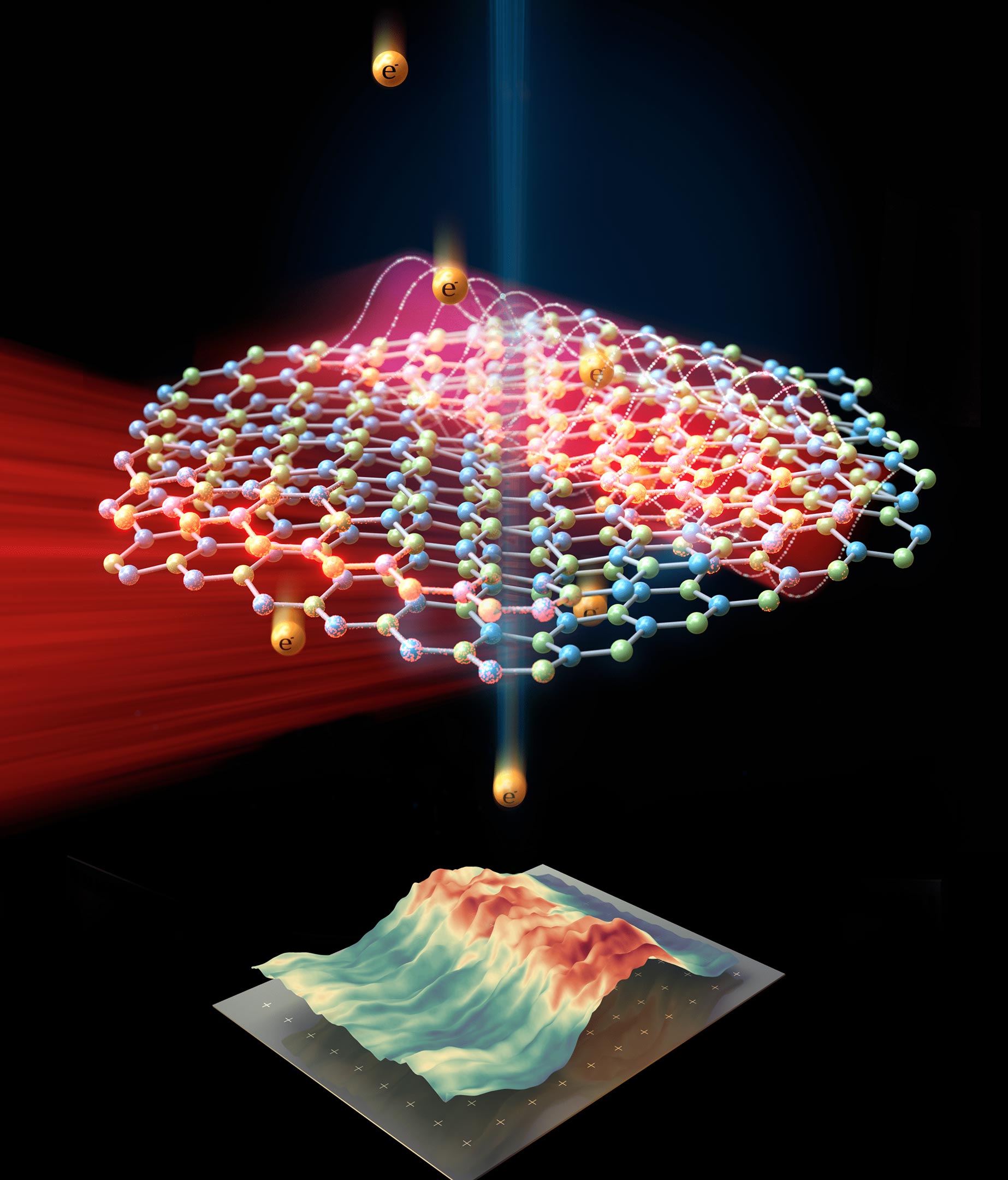
Illustration of a Sound-Light wave in 2D materials and its measurement using free electrons. Credit: Technion – Israel Institute of Technology
Light moves through space at 300,000 km/s. Moving through water or through glass, it slows down by a fraction. But when moving through certain few-layers solids, light slows down almost a thousand-fold. This occurs because the light makes the atoms of these special materials vibrate to create sound waves (also called phonons), and these atomic sound waves create light when they vibrate. Thus, the pulse is actually a tightly bound combination of sound and light, called “phonon-polariton.” Lit up, the material “sings.”
The scientists shone pulses of light along the edge of a 2D material, producing in the material the hybrid sound-light waves. Not only were they able to record these waves, but they also found the pulses can spontaneously speed up and slow down. Surprisingly, the waves even split into two separate pulses, moving at different speeds.
The experiment was conducted using an ultrafast transmission electron microscope (UTEM). Contrary to optical microscopes and scanning electron microscopes, here particles pass through the sample and then are received by a detector. This process allowed the researchers to track the sound-light wave in unprecedented resolution, both in space and in time. The time resolution is 50 femtosecond – 50X10-15 seconds – the number of frames per second is similar to the number of seconds in a million years.
