
“Our technology is able to transform infrared light, normally invisible to the human eye, and turn this into images people can clearly see — even at a distance,” said lead researcher Rocio Camacho Morales, a postdoctoral fellow in the department of electronic materials engineering at Australian National University (ANU). “We’ve made a very thin film, consisting of nanometer-scale crystals, hundreds of times thinner than a human hair, that can be directly applied to glasses and acts as a filter, allowing you to see in the darkness of the night.”
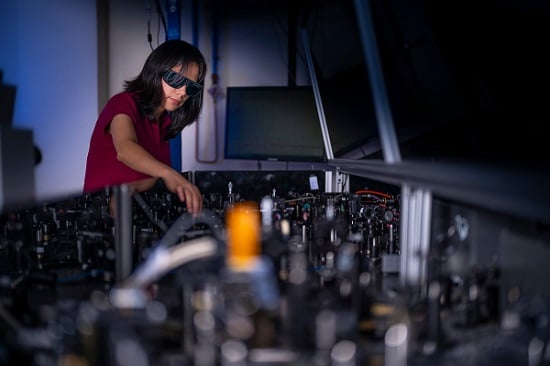
The technology, said Dragomir Neshev, director of the ARC Centre for Excellence in Transformative Meta-Optical Systems and a professor of physics at ANU, incorporates nonlinear metasurfaces to manipulate light in new ways.
“This is the first time anywhere in the world that infrared light has been successfully transformed into visible images in an ultrathin screen,” Neshev said. “It’s a really exciting development and one that we know will change the landscape for night vision forever.”
“We previously demonstrated the potential of individual nanoscale crystals, but to exploit them in our everyday life we had to overcome enormous challenges to arrange the crystals in an array fashion,” said Mohsen Rahmani, leader of the Advanced Optics and Photonics Lab at Nottingham Trent University’s School of Science and Technology, who led the development of the nanoscale crystal films. “While this is the first proof-of-concept experiment, we are actively working to further advance the technology.”
The research was published in Advanced Photonics (www.doi.org/10.1117/1.AP.3.3.036002).
