
| Date | 24th, Jun 2021 |
|---|
Home > Press > �Flashed� nanodiamonds are just a phase: Rice produces fluorinated nanodiamond, graphene, concentric carbon via flash Joule heating
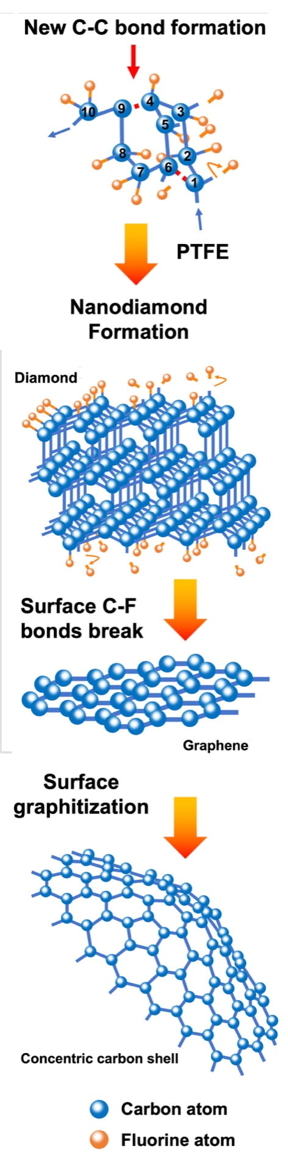 The mechanism by Rice University chemists for the phase evolution of fluorinated flash nanocarbons shows stages with longer and larger energy input. Carbon and fluorine atoms first form a diamond lattice, then graphene and finally polyhedral concentric carbon. (Credit: Illustration by Weiyin Chen/Rice University)
Abstract: Diamond may be just a phase carbon goes through when exposed to a flash of heat, but that makes it far easier to obtain.
Houston, TX | Posted on June 23rd, 2021
The Rice University lab of chemist James Tour is now able to �evolve� carbon through phases that include valuable nanodiamond by tightly controlling the flash Joule heating process they developed 18 months ago.
Best of all, they can stop the process at will to get product they want.
In the American Chemical Society journal ACS Nano, the researchers led by Tour and graduate student and lead author Weiyin Chen show that adding organic fluorine compounds and fluoride precursors to elemental carbon black turns it into several hard-to-get allotropes when flashed, including fluorinated nanodiamonds, fluorinated turbostratic graphene and fluorinated concentric carbon.
With the flash process introduced in 2020, a strong jolt of electricity can turn carbon from just about any source into layers of pristine turbostratic graphene in less than a second. (�Turbostratic� means the layers are not strongly bound to each other, making them easier to separate in a solution.)
The new work shows it�s possible to modify, or functionalize, the products at the same time. The duration of the flash, between 10 and 500 milliseconds, determines the final carbon allotrope.
The difficulty lies in how to preserve the fluorine atoms, since the ultrahigh temperature causes the volatilization of all atoms other than carbon. To overcome the problem, the team used a Teflon tube sealed with graphite spacers and high-melting-point tungsten rods, which can hold the reactant inside and avoid the loss of fluorine atoms under the ultrahigh temperature. The improved sealed tube is important, Tour said.
�In industry, there has been a long-standing use for small diamonds in cutting tools and as electrical insulators,� he said. �The fluorinated version here provides a route to modifications of these structures. And there is a large demand for graphene, while the fluorinated family is newly produced here in bulk form.�
Nanodiamonds are microscopic crystals -- or regions of crystals -- that display the same carbon-atom lattice that macro-scale diamonds do. When first discovered in the 1960s, they were made under heat and high pressure from detonations.
In recent years, researchers have found chemical processes to create the same lattices. A report from Rice theorist Boris Yakobson last year showed how fluorine can help make nanodiamond without high pressure, and Tour�s own lab demonstrated using pulsed lasers to turn Teflon into fluorinated nanodiamond.
Nanodiamonds are highly desirable for electronics applications, as they can be doped to serve as wide-bandgap semiconductors, important components in current research by Rice and the Army Research Laboratory.
The new process simplifies the doping part, not only for nanodiamonds but also for the other allotropes. Tour said the Rice lab is exploring the use of boron, phosphorous and nitrogen as additives as well.
At longer flash times, the researchers got nanodiamonds embedded in concentric shells of fluorinated carbon. Even longer exposure converted the diamond entirely into shells, from the outside in.
�The concentric-shelled structures have been used as lubricant additives, and this flash method might provide an inexpensive and fast route to these formations,� Tour said.
Co-authors of the paper are Rice graduate students John Tianci Li, Zhe Wang, Wala Algozeeb, Emily McHugh, Kevin Wyss, Paul Advincula, Jacob Beckham and Bo Jiang, research scientist Carter Kittrell and alumni Duy Xuan Luong and Michael Stanford. Tour is the T.T. and W.F. Chao Chair in Chemistry as well as a professor of computer science and of materials science and nanoengineering at Rice.
The Air Force Office of Scientific Research and the Department of Energy supported the research.
####
About Rice UniversityLocated on a 300-acre forested campus in Houston, Rice University is consistently ranked among the nation�s top 20 universities by U.S. News & World Report. Rice has highly respected schools of Architecture, Business, Continuing Studies, Engineering, Humanities, Music, Natural Sciences and Social Sciences and is home to the Baker Institute for Public Policy. With 3,978 undergraduates and 3,192 graduate students, Rice�s undergraduate student-to-faculty ratio is just under 6-to-1. Its residential college system builds close-knit communities and lifelong friendships, just one reason why Rice is ranked No. 1 for lots of race/class interaction and No. 1 for quality of life by the Princeton Review. Rice is also rated as a best value among private universities by Kiplinger�s Personal Finance.
Follow Rice News and Media Relations via Twitter @RiceUNews.
For more information, please click here
Contacts:Jeff Falk713-348-6775
Mike Williams713-348-6728
Copyright © Rice University
If you have a comment, please Contact us.
Issuers of news releases, not 7th Wave, Inc. or Nanotechnology Now, are solely responsible for the accuracy of the content.
Bookmark:


 Rice lab turns trash into valuable graphene in a flash:
Wiess School of Natural Sciences:
News and information
University of Illinois Chicago joins Brookhaven Lab's Quantum Center June 10th, 2022
Organic water splitters get a boost June 10th, 2022
Graphene/ Graphite
Bumps could smooth quantum investigations: Rice University models show unique properties of 2D materials stressed by contoured substrates June 10th, 2022
Nanotubes: a promising solution for advanced rubber cables with 60% less conductive filler June 1st, 2022
Dynamic metasurfaces and metadevices empowered by graphene May 6th, 2022
Govt.-Legislation/Regulation/Funding/Policy
University of Illinois Chicago joins Brookhaven Lab's Quantum Center June 10th, 2022
Bumps could smooth quantum investigations: Rice University models show unique properties of 2D materials stressed by contoured substrates June 10th, 2022
Nanostructured fibers can impersonate human muscles June 3rd, 2022
Possible Futures
Electron-phonon coupling assisted universal red luminescence of o-phenylenediamine-based CDs June 10th, 2022
Marching to the Cadence of Electronics: Innovation A new paper in Nature validates technology developed by John Bowers and collaborators June 10th, 2022
Small materials may be key to reducing cardiovascular disease deaths, researchers say June 10th, 2022
Decoding a key part of the cell, atom by atom June 10th, 2022
Discoveries
Electron-phonon coupling assisted universal red luminescence of o-phenylenediamine-based CDs June 10th, 2022
Marching to the Cadence of Electronics: Innovation A new paper in Nature validates technology developed by John Bowers and collaborators June 10th, 2022
Small materials may be key to reducing cardiovascular disease deaths, researchers say June 10th, 2022
Decoding a key part of the cell, atom by atom June 10th, 2022
Materials/Metamaterials
Nanotubes: a promising solution for advanced rubber cables with 60% less conductive filler June 1st, 2022
New route to build materials out of tiny particles May 27th, 2022
A one-stop shop for quantum sensing materials May 27th, 2022
Announcements
Organic water splitters get a boost June 10th, 2022
Interviews/Book Reviews/Essays/Reports/Podcasts/Journals/White papers/Posters
Decoding a key part of the cell, atom by atom June 10th, 2022
Organic water splitters get a boost June 10th, 2022
Military
Bumps could smooth quantum investigations: Rice University models show unique properties of 2D materials stressed by contoured substrates June 10th, 2022
Nanostructured fibers can impersonate human muscles June 3rd, 2022
Lightening up the nanoscale long-wavelength optoelectronics May 13th, 2022
