
Previously, the phenomenon had been demonstrated in a CONASH composed of a zinc atom bonded with a porphyrin-dipyrrin molecule. However, the CONASH quickly degraded due to the low stability of organic molecules in liquid electrolytes, which are commonly used for current conduction.
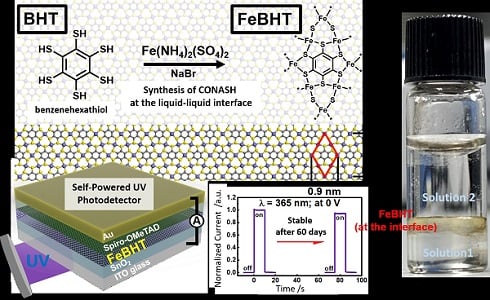
In the current work, Nishihara and colleagues from Tokyo University of Science, the National Institute for Materials Research, National Taiwan University, and National Chiao Tung University developed a CONASH using an iron (Fe) ion bonded to a benzene hexathiol (BHT) molecule. The FeBHT CONASH-based photodetector is able to retain more than 94% of its photocurrent after 60 days of exposure. Further, the device requires no external power source.
The team sought an all-solid architecture, which they achieved by replacing the liquid electrolyte with a solid-state layer of Spiro-OMeTAD, a material known to be an efficient transporter of “holes,” or vacancies left by electrons.
The FeBHT network was synthesized from a reaction between iron ammonium sulfate and BHT, which achieved two things: One, the reaction was slow enough to keep the sulfur group protected from being oxidized, and two, it helped the resultant FeBHT network become resilient to oxidation, which the researchers confirmed using density functional theory calculations.
In addition, the FeBHT CONASH favored high electrical conductivity, showed an enhanced photoresponse with a conversion efficiency of 6% (the highest efficiency previously reported was 2%), and had a response time of less than 40 ms for UV light illumination.
“The high performance of the CONASH-based photodetectors coupled with the fact that they are self-powered can pave the way for their practical applications such as in light-receiving sensors that can be used for mobile applications and recording the light exposure history of objects,” Nishihara said.
The research was published in Advanced Science (www.doi.org/10.1002/advs.202100564).
