
The research team led by professor Long Ju focused an IR laser positioned on the tip of an atomic force microscope (AFM), turning it into an antenna for amplifying the interaction between light and material. The AFM scans the surface of the material and creates a high-resolution map of the material’s topography. The 20-nm tip of the AFM is able to pinpoint physical features in the material that are less than 1 nm in height or depth.
By analyzing the backscattered light collected from the light-material interaction, the researchers found they could learn more about the surface of the material than would be possible with a conventional AFM. “You can get an image of your sample with three orders of magnitude better spatial resolution than that of conventional infrared measurements,” Ju said.
Depending on their needs and sample materials, users can scan the tip of the nanoscope across the material’s surface while the tip is irradiated with a single wavelength, or they can park the tip over a specific surface area and probe the area with different wavelengths of light.
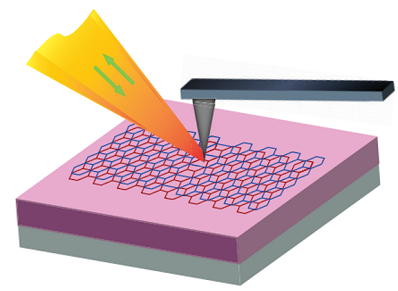
Images comparable in detail to those made with the MIT nanoscope can be captured with transmission electron microscopy (TEM), but TEM must be operated in an ultrahigh vacuum, which limits the experimental throughput. Additionally, TEM samples must be extremely thin for suspension on a film or membrane — a requirement, Ju said, that is not compatible with most materials. In contrast, the near-field nanoscope “can be operated in air, does not require suspension of the sample, and you can work on most solid substrates,” Ju said.
The near-field nanoscope provided high-resolution images of surface characteristics; an analysis of backscattered light from the nanoscope’s tip can additionally provide meaningful information about the sample material’s internal properties. Finally, the device can distinguish between metals and insulators, and between materials that have the same chemical composition but different internal structures, such as diamond versus pencil lead.
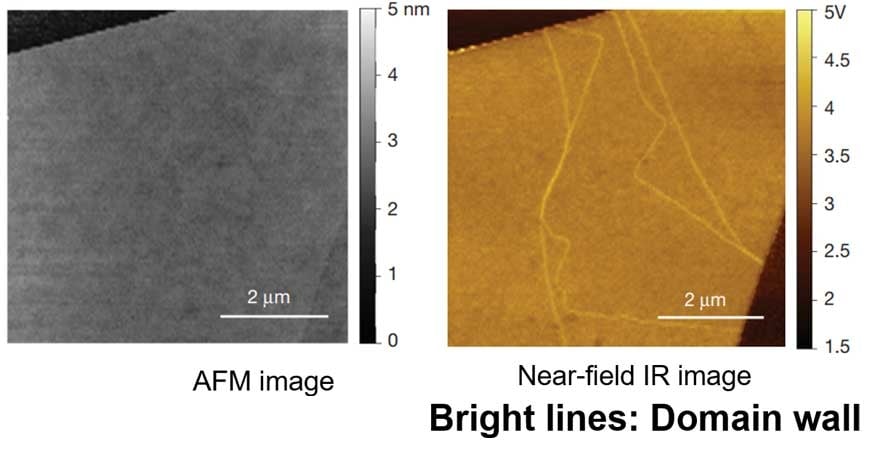
Ju’s team completed a second, more advanced version of its near-field nanoscope in May 2021.
The team continues to add functionality to the instrument.
