
“People have studied classical metasurfaces for a long time,” said Diego Dalvit of the Physics of Condensed Matter and Complex Systems group in the laboratory’s Theoretical Division. “But we came up with this new idea, which was to modulate in time and space the optical properties of a quantum metasurface that allow us to manipulate, on demand, all degrees of freedom of a single photon.”
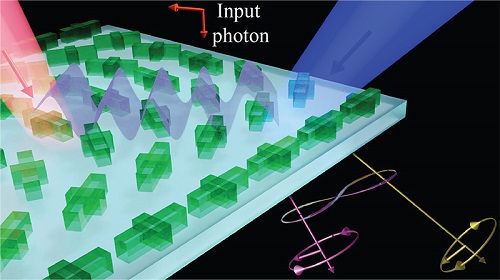
“When the metasurface is modulated with laser or electrical pulses, one can control the frequency of the refracted single photon, alter its angle of trajectory, the direction of its electrical field, as well as its twist,” said Abul Azad from the Center for Integrated Nanotechnologies at the laboratory’s Materials Physics and Applications Division.
In manipulating these properties, the technology could be used to encode information in photons traveling within a quantum network. Encoding photons is particularly desirable in cryptography, as hackers are unable to view a photon without changing its fundamental physics, which would alert the sender and receiver that the information has been compromised.
The researchers are also working on how to pull photons from a vacuum by modulating the quantum metasurface.
“The quantum vacuum is not empty but full of fleeting virtual photons. With the modulated quantum metasurface, one is able to efficiently extract and convert virtual photons into real photon pairs,” said Wilton Kort-Kamp, in the Theoretical Division at the lab’s Physics of Condensed Matter and Complex Systems group.
Harnessing photons that exist within the vacuum and firing them in one direction should create propulsion in the opposite direction. Similarly, stirring the vacuum should create rotational motion from the twisted photons. Structured quantum light could then one day be used to generate mechanical thrust, using only tiny amounts of energy to drive the metasurface.
The research was published in Physics Review Letters (www.doi.org/10.1103/PhysRevLett.127.043603).
