
| Date | 7th, Aug 2021 |
|---|
Home > Press > A universal intercalation strategy for high-stable perovskite photovoltaics: Researchers at Kanazawa University demonstrate that the use of CsI intercalation technology greatly passivate defects, subsequently improve device performance. This technology may encourage a more widesp
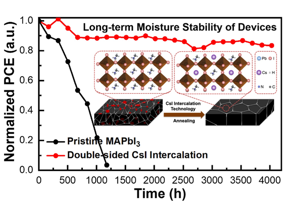 Normalized PCE versus time for unencapsulated PSCs stored in the dark under ambient air without a UV filter at the 40�50% RH. Inset diagram shows the change in perovskite crystal structure after CsI intercalation.
CREDIT
Kanazawa University
Normalized PCE versus time for unencapsulated PSCs stored in the dark under ambient air without a UV filter at the 40�50% RH. Inset diagram shows the change in perovskite crystal structure after CsI intercalation.
CREDIT
Kanazawa University
Abstract: A team of scientists led by the Nanomaterials Research Institute at Kanazawa University have demonstrated that the stability and efficiency of certain solar panels can be greatly enhanced by using cesium iodide (CsI) intercalation technology. This work may help make solar cells more competitive with other renewable energy sources.
Kakuma, Japan | Posted on August 6th, 2021
Solar panels have the potential to be an abundant and clean source of energy. In particular, photovoltaic cells with the perovskite crystal structure, named after the mineral with the same atomic configuration, have many attractive features. Their strong optical absorption and high charge mobilities lead to low cost of manufacture and high energy output. However, deployment by consumers of perovskite solar cells has been hampered by the limited robustness of these cells, because their structure can decompose after exposure to moisture, light, or heat. New formulations that increase the lifetime of perovskite solar cells are thus needed to instill consumer confidence before people start installing perovskite-based solar panels on their roofs.
Now, a team of scientists headed by Kanazawa University has discovered that adding CsI to the commonly used MAPbI3 perovskite structure greatly increases the stability of the resulting devices. The Cs atoms migrate and become �intercalated� into the crystal lattice, and the improved devices showed power conversion efficiencies as high as 18.43%. �Hybrid organic-inorganic metal halide perovskite solar cells are a very fast-growing technology,� corresponding author Md. Shahiduzzaman says. Using scanning electron microscopy, the scientists verified that the size of the crystal grains inside the material also increased from 300 to 700 nm due to the addition of CsI. They hypothesize that the intercalation of cesium reduces the spacing between the atomic planes, so that moisture from the air cannot intrude as easily. Also, the surfaces become smoother, which allows charges to reach the electrodes. �Our approach allowed us to produce layers with precise control over the CsI intercalation,� corresponding author Tetsuya Taima says. This work may help bring a revolution in renewable energy, in which perovskite solar panels become a much more common sight.
####
For more information, please click here
Contacts:Tomoya Sato
Office: 81-762-645-076
Copyright © Kanazawa University
If you have a comment, please Contact us.
Issuers of news releases, not 7th Wave, Inc. or Nanotechnology Now, are solely responsible for the accuracy of the content.
Bookmark:


News and information
 University of Illinois Chicago joins Brookhaven Lab's Quantum Center June 10th, 2022
Organic water splitters get a boost June 10th, 2022
Perovskites
Quantum �shock absorbers� allow perovskite to exhibit superfluorescence at room temperature April 1st, 2022
�Workhorse� of photovoltaics combined with perovskite in tandem for the first time February 25th, 2022
Possible Futures
Electron-phonon coupling assisted universal red luminescence of o-phenylenediamine-based CDs June 10th, 2022
Marching to the Cadence of Electronics: Innovation A new paper in Nature validates technology developed by John Bowers and collaborators June 10th, 2022
Small materials may be key to reducing cardiovascular disease deaths, researchers say June 10th, 2022
Decoding a key part of the cell, atom by atom June 10th, 2022
Discoveries
Electron-phonon coupling assisted universal red luminescence of o-phenylenediamine-based CDs June 10th, 2022
Marching to the Cadence of Electronics: Innovation A new paper in Nature validates technology developed by John Bowers and collaborators June 10th, 2022
Small materials may be key to reducing cardiovascular disease deaths, researchers say June 10th, 2022
Decoding a key part of the cell, atom by atom June 10th, 2022
Announcements
Organic water splitters get a boost June 10th, 2022
Interviews/Book Reviews/Essays/Reports/Podcasts/Journals/White papers/Posters
Decoding a key part of the cell, atom by atom June 10th, 2022
Organic water splitters get a boost June 10th, 2022
Energy
Organic water splitters get a boost June 10th, 2022
Engineering piezoelectricity and strain sensitivity in CdS to promote piezocatalytic hydrogen evolution May 13th, 2022
USTC found a pathway to high-quality ZnSe quantum wires April 8th, 2022
Solar/Photovoltaic
USTC found a pathway to high-quality ZnSe quantum wires April 8th, 2022
Graphene crystals grow better under copper cover April 1st, 2022
Peering into precise ultrafast dynamics in matter March 25th, 2022
�Workhorse� of photovoltaics combined with perovskite in tandem for the first time February 25th, 2022
