
| Date | 12th, Aug 2021 |
|---|
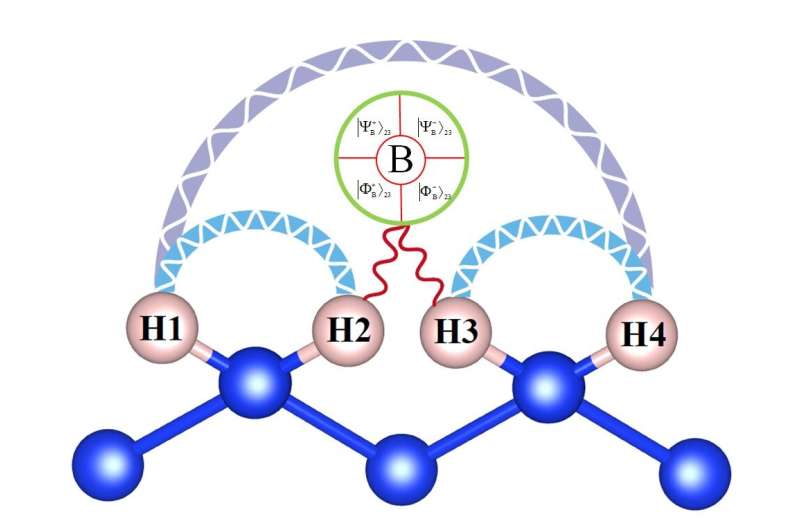 This study shows how quantum entanglement displays a huge energy difference between its states unlike those of molecular hydrogen, promising ultra-fast processing in the order of 106 qubits and atom teleportation (H1H4). Credit: Takahiro Matsumoto from NCU, Japan
Quantum entanglement is one of the most fundamental and intriguing phenomena in nature. Recent research on entanglement has proven to be a valuable resource for quantum communication and information processing. Now, scientists from Japan have discovered a stable quantum entangled state of two protons on a silicon surface, opening doors to an organic union of classical and quantum computing platforms and potentially strengthening the future of quantum technology.
One of the most interesting phenomena in quantum mechanics is "quantum entanglement." This phenomenon describes how certain particles are inextricably linked, such that their states can only be described with reference to each other. This particle interaction also forms the basis of quantum computing. And this is why, in recent years, physicists have looked for techniques to generate entanglement. However, these techniques confront a number of engineering hurdles, including limitations in creating large number of "qubits" (quantum bits, the basic unit of quantum information), the need to maintain extremely low temperatures (
