
| Date | 14th, Aug 2021 |
|---|
Home > Press > One-dimensional red phosphorous glows in unexpected ways: New study published in Nature Communications is the first to show strong optical properties in a 1D van der Waal material
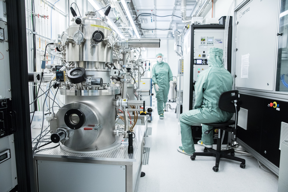 The researchers made use of the exceptional facilities of Micronova Nanofabrication Cleanroom.
CREDIT
Mikko Raskinen/Aalto University
The researchers made use of the exceptional facilities of Micronova Nanofabrication Cleanroom.
CREDIT
Mikko Raskinen/Aalto University
Abstract: When electrons are confined into very small spaces, they can exhibit unusual electrical, optical and magnetic behaviour. From confining electrons in two-dimensional atomic sheet graphene � a feat that won the Nobel Prize in physics in 2010 � to restricting electrons even further to achieve one-dimensionality, this broad line of research is transforming the landscape of fundamental research and technological advances in physics, chemistry, energy harvesting, information and beyond.
Aalto, Finland | Posted on August 13th, 2021
In a study published in Nature Communications, an international team led by Aalto University researchers has now found that fibrous red phosphorous, when electrons are confined in its one-dimensional sub-units, can show large optical responses � that is, the material shows strong photoluminescence under light irradiation. Red phosphorous, like graphene, belongs to a unique group of materials called one-dimensional van der Waals (1D vdW) materials. A 1D vdW material is a radically new type of material that was discovered only in 2017. Until now, research on 1vdW materials has focused on electrical properties.
The team uncovered the optical properties of 1D vdW fibrous red phosphorous through measurements like photoluminescence spectroscopy, where they shone laser light on the samples and measured the colour and brightness of the light emitted back. The findings show the 1D vdW material demonstrates giant anisotropic linear and non-linear optical responses � in other words, the optical responses strongly depend on the orientation of the fibrous phosphorous crystal � as well as emission intensity, which relates to the number of photons emitted during a specific time.
�The way it responded in the experiments makes 1D vdW fibrous red phosphorus a really exciting material. For example, it shows both giant anisotropic linear and non-linear responses as well as emission intensity, which is striking,� says Dr Luojun Du, a postdoctoral researcher at Aalto University.
The material�s photoluminescence � the effect commonly seen in everyday life in reflective signs or children�s glow-in-the-dark toys, when light is emitted after absorption � also struck the researchers by surprise. The team compared the photoluminescence of fibrous red phosphorous with monolayer molybdenum disulfide (MoS2), which is well-known for its strong photoluminescence, and found that the intensity of the photoluminescence was more than 40 times more intense, making it ultra-bright � albeit very briefly.
�The strong photoluminescence of fibrous red phosphorus is unexpected. In fact, we initially expected that the photoluminescence of fibrous red phosphorous would be only weak. Based on theoretical calculations, this effect shouldn�t actually be strong so we�re now doing more experiments to clarify the origin of its after-glow,� says Du.
�I believe that one-dimensional van der Waals materials like fibrous red phosphorous show real promise for displays and other applications, which rely on materials that demonstrate exactly the behaviours we�ve seen in this study. The spectrum of its anisotropic optical response also seems to be very wide if we compare it with responses from conventional materials,� says Professor Zhipei Sun, who leads the group behind the study.
The study was published in Nature Communications on 10 August 2021.
####
For more information, please click here
Contacts:Katrina Jurva
Cell: 504346805Expert Contacts
Luojun Du, Postdoctoral researcher
Cell: +358406817981Zhipei Sun, Professor of photonics
Cell: +358504302820
Copyright © Aalto University
If you have a comment, please Contact us.
Issuers of news releases, not 7th Wave, Inc. or Nanotechnology Now, are solely responsible for the accuracy of the content.
Bookmark:


News and information
 University of Illinois Chicago joins Brookhaven Lab's Quantum Center June 10th, 2022
Organic water splitters get a boost June 10th, 2022
Chemistry
Nanoscale chemically ordered-disordered domains in Fe3Pt alloys and their three-dimensional interface and lattice strain May 27th, 2022
Physics
Observation of fractional exclusion statistics in quantum critical matter May 27th, 2022
Possible Futures
Electron-phonon coupling assisted universal red luminescence of o-phenylenediamine-based CDs June 10th, 2022
Marching to the Cadence of Electronics: Innovation A new paper in Nature validates technology developed by John Bowers and collaborators June 10th, 2022
Small materials may be key to reducing cardiovascular disease deaths, researchers say June 10th, 2022
Decoding a key part of the cell, atom by atom June 10th, 2022
Chip Technology
Marching to the Cadence of Electronics: Innovation A new paper in Nature validates technology developed by John Bowers and collaborators June 10th, 2022
Bumps could smooth quantum investigations: Rice University models show unique properties of 2D materials stressed by contoured substrates June 10th, 2022
�Fruitcake� structure observed in organic polymers June 3rd, 2022
On-Chip Photodetection: Two-dimensional material heterojunctions hetero-integration May 13th, 2022
Discoveries
Electron-phonon coupling assisted universal red luminescence of o-phenylenediamine-based CDs June 10th, 2022
Marching to the Cadence of Electronics: Innovation A new paper in Nature validates technology developed by John Bowers and collaborators June 10th, 2022
Small materials may be key to reducing cardiovascular disease deaths, researchers say June 10th, 2022
Decoding a key part of the cell, atom by atom June 10th, 2022
Announcements
Organic water splitters get a boost June 10th, 2022
Interviews/Book Reviews/Essays/Reports/Podcasts/Journals/White papers/Posters
Decoding a key part of the cell, atom by atom June 10th, 2022
Organic water splitters get a boost June 10th, 2022
Energy
Organic water splitters get a boost June 10th, 2022
Engineering piezoelectricity and strain sensitivity in CdS to promote piezocatalytic hydrogen evolution May 13th, 2022
USTC found a pathway to high-quality ZnSe quantum wires April 8th, 2022
