
MSU professor Bryan Smith and his team worked with researchers from Emory and Stanford universities to develop nanoparticles made from carbon (i.e., carbon nanotubes) that selectively target the types of immune cells that are abundant in inflammatory plaques. Though it is difficult to prove whether a particular plaque is responsible for a stroke or heart attack, the prevailing belief is that vulnerable plaques are the most dangerous, Smith said. These are inflammatory plaques that can rupture and consequently block blood vessels.
“The power of our new technique is in its selectivity,” Smith said. “There are certainly other methods to image plaques, but what distinguishes this strategy is that it’s cellular. We’re specifically looking at the cells — called macrophages and monocytes — that are most responsible for making a plaque vulnerable in the first place.”
Single-cell flow cytometry performed within the plaques revealed that the nanoparticles were almost exclusively absorbed by the inflamed immune cells that infiltrate plaques.
“If you look at a normal blood vessel versus one with a plaque, there’re a lot more macrophages and monocytes in the one with the plaque,” Smith said. “And our method is really looking at the monocytes and macrophages. Virtually no other cell type takes up the nanoparticles.”
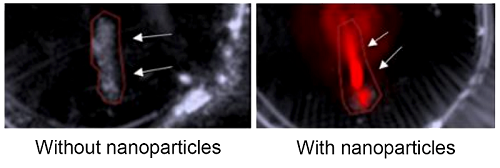
Using photoacoustic imaging, the researchers identified inflamed atherosclerotic plaques that displayed an approximately sixfold greater signal compared to the controls — six hours after the mice were injected with the carbon nanotubes.
This approach could offer a targeted, noninvasive way to accurately identify and diagnose inflamed atherosclerotic lesions.
“Currently, there is no effective way to accurately locate and treat vulnerable plaques before they lead to a heart attack or stroke,” Emory University professor Eliver Ghosn said. “We hope our studies will help change that.”
From a treatment standpoint, Smith’s lab also showed that the nanoparticles can be loaded with a drug for fighting plaques. The team will also explore how to use the nanoparticles to aid with imaging as well as delivering a therapeutic.
The research was published in Advanced Functional Materials (www.doi.org/10.1002/adfm.202101005).
