
| Date | 21st, Aug 2021 |
|---|
Home > Press > From anti-icing coatings to protection of containers with flammable liquids: heating films with graphene nanotubes enter the market
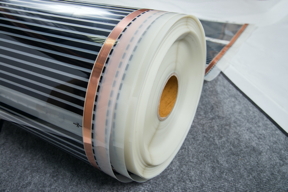
Abstract: �Heating films with graphene nanotubes have been proven to be an economical, efficient, and durable solution.�Nanotube solutions have successfully passed probation as an anti-icing system for roofs.�Optimization of energy consumption is achieved by efficient heating technology in combination with an automatic heat-stop system.
Luxembourg | Posted on August 20th, 2021
Electrically conductive heating films with nanotubes feature a polyethylene film 8�150 cm wide and 0.35 mm thick with a conductive coating modified by TUBALL graphene nanotubes from OCSiAl. When connected to a standard 220 W power supply, the film generates heat. The power of such a heating system is 350 W/m2, while the service life surpasses 10,000 on/off cycles.
The fundamental difference between film heating and other anti-icing systems, such as, for example, a heating cable, lies in its high efficiency � the film is capable of heating a much larger surface area with the same power consumed. Heating films can be used both in industrial facilities for heating pipelines, tanks, and electrical cabinets, and in architectural facilities for roof anti-icing, heating sidewalks, steps, and ramps, and residential heating.
�Graphene nanotubes make it possible to produce heating elements that show no degradation over time. The solution that has been developed allows producers to integrate the film heating system into any complex surface,� said Vasily Kozhukhov, Sales Director of OCSiAl Russia. �Last winter, a heating film with nanotubes was tested on the roofs of two houses in St. Petersburg, Russia, and received positive recommendations for further use from the municipal housing authorities.�
The solution developed with graphene nanotubes also demonstrates a �self-regulation effect,� which allows the system to automatically stop heating when the required temperature is reached, without the use of additional temperature sensors. This is crucial when maintaining a stable temperature in containers with flammable liquids.
####
About OCSiAl GroupToday, OCSiAl offers a wide range of nanotube solutions for coatings, providing them with high electrical conductivity, additionally maintaining or improving mechanical properties. Conductive primers and flooring, lining and powder coatings, gelcoats and PU cast systems � these and more final products empowered by graphene nanotubes are already on the market.
For more information, please click here
Contacts:Anastasia ZirkaSenior PR & Advertising ManagerOCSiAl Group+7 913 989 9239
Copyright © OCSiAl Group
If you have a comment, please Contact us.
Issuers of news releases, not 7th Wave, Inc. or Nanotechnology Now, are solely responsible for the accuracy of the content.
Bookmark:


News and information
 University of Illinois Chicago joins Brookhaven Lab's Quantum Center June 10th, 2022
Organic water splitters get a boost June 10th, 2022
Graphene/ Graphite
Bumps could smooth quantum investigations: Rice University models show unique properties of 2D materials stressed by contoured substrates June 10th, 2022
Nanotubes: a promising solution for advanced rubber cables with 60% less conductive filler June 1st, 2022
Dynamic metasurfaces and metadevices empowered by graphene May 6th, 2022
Possible Futures
Electron-phonon coupling assisted universal red luminescence of o-phenylenediamine-based CDs June 10th, 2022
Marching to the Cadence of Electronics: Innovation A new paper in Nature validates technology developed by John Bowers and collaborators June 10th, 2022
Small materials may be key to reducing cardiovascular disease deaths, researchers say June 10th, 2022
Decoding a key part of the cell, atom by atom June 10th, 2022
Nanotubes/Buckyballs/Fullerenes/Nanorods
Nanotubes: a promising solution for advanced rubber cables with 60% less conductive filler June 1st, 2022
Protective equipment with graphene nanotubes meets the strictest ESD safety standards March 25th, 2022
CEA and Startup C12 Join Forces to Develop Next-Generation Quantum Computers with Multi-Qubit Chips at Wafer Scale March 25th, 2022
Discoveries
Electron-phonon coupling assisted universal red luminescence of o-phenylenediamine-based CDs June 10th, 2022
Marching to the Cadence of Electronics: Innovation A new paper in Nature validates technology developed by John Bowers and collaborators June 10th, 2022
Small materials may be key to reducing cardiovascular disease deaths, researchers say June 10th, 2022
Decoding a key part of the cell, atom by atom June 10th, 2022
Announcements
Organic water splitters get a boost June 10th, 2022
Aerospace/Space
University of Strathclyde and National University of Singapore to co-ordinate satellite quantum communications May 13th, 2022
Lightening up the nanoscale long-wavelength optoelectronics May 13th, 2022
Studying atomic structure of aluminum alloys for manufacturing modern aircraft March 25th, 2022
