
Fano interference could allow the realization of ultrafast and low-noise nanolasers (Fano lasers), optical transistors, and quantum devices working at the level of a single photon, the researchers said.
The work is supported by a Villum Center of Excellence, NATEC; a newly established Danish National Research Foundation (DNRF) Center of Excellence, NanoPhoton; and a European Research Council grant.
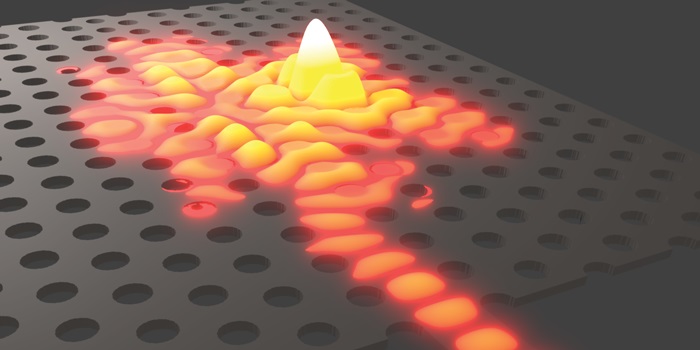
“The Fano laser,” Mørk said, “with a size of a few microns, operates in an unusual optical state, a so-called bound-state-in-the-continuum, induced by the Fano resonance. “In the paper, we show that the characteristics of such a bound-state-in-the-continuum can be harnessed to improve the coherence of the laser.”
“The observation is somewhat surprising since a bound-state-in-the-continuum is much less robust than the states commonly used in lasers,” said Yi Yu, lead author and senior researcher at DTU Fotonik. “We show in our paper, experimentally as well as theoretically, that the peculiarities of this new state can be used to advantage.”
To achieve that goal, the team collaborated with professor Kresten Yvind’s group at DTU Fotonik to create an advanced nanotechnology called Buried Heterostructure Technology.
“This technology allows realizing small, nanometer-size regions of active material, where the light generation takes place, while the remaining laser structure is passive,” Yu said. “It is the physics of Fano resonance combined with this technology that eventually enables the suppression of quantum noise, leading to the highest measured coherence for microscopic lasers.”
This new finding may lead to the use of Fano lasers in integrated electronic-photonic circuits, particularly in the development of high-speed computers. Due to ohmic loss, current components sending electric signals can be inefficient, leading to a bottleneck in potential speed. A Fano laser could be used to convert the electrical data to light signals that can be transmitted within the computer with almost no loss.
The research was published in Nature Photonics (www.doi.org/10.1038/s41566-021-00860-5).
