
| Date | 4th, Sep 2021 |
|---|
Home > Press > Enhanced ambient ammonia photosynthesis by Mo-doped Bi5O7Br nanosheets with light-switchable oxygen vacancies
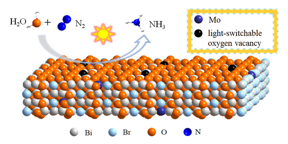 RESEARCHERS HAVE PRESENTED A STRATEGY BY SIMULTANEOUSLY INTRODUCING LIGHT-SWITCHABLE OXYGEN VACANCY AND DOPING Mo INTO BI5O7BR NANOSHEETS FOR EFFICIENT PHOTOCATALYTIC N2 FIXATION. THE MODIFIED PHOTOCATALYST HAS ACHIEVED ELEVATED N2 FIXATION PHOTOACTIVITIES BY VIRTUE OF THE OPTIMIZED CONDUCTION BAND POSITION, ENHANCED LIGHT AVAILABILITY, IMPROVED N2 ADSORPTION AND CHARGE CARRIER SEPARATION.
CREDIT
Chinese Journal of Catalysis
RESEARCHERS HAVE PRESENTED A STRATEGY BY SIMULTANEOUSLY INTRODUCING LIGHT-SWITCHABLE OXYGEN VACANCY AND DOPING Mo INTO BI5O7BR NANOSHEETS FOR EFFICIENT PHOTOCATALYTIC N2 FIXATION. THE MODIFIED PHOTOCATALYST HAS ACHIEVED ELEVATED N2 FIXATION PHOTOACTIVITIES BY VIRTUE OF THE OPTIMIZED CONDUCTION BAND POSITION, ENHANCED LIGHT AVAILABILITY, IMPROVED N2 ADSORPTION AND CHARGE CARRIER SEPARATION.
CREDIT
Chinese Journal of Catalysis
Abstract: The issue to achieve efficient nitrogen (N2) reduction to ammonia (NH3) has posed a significant challenge for decades as the inert N≡N bond could be hardly broken because of the extremely large bond energy of 940.95 kJ mol�1. To date, the industrial fixation of N2 to NH3 is monopolized by the energy-intensive Haber-Bosch process (673-873 K and 15-25 MPa), which unsustainably employs natural gas to make the hydrogen (H2) feedstock with enormous energy consumption from fossil fuels, leading to a large amount of carbon dioxide (CO2) emission. In this context, photocatalytic N2 reduction is regarded as a sustainable alternative way for NH3 synthesis from N2 and water under ambient conditions.
Beijing, China | Posted on September 3rd, 2021
However, the efficiency of most traditional photocatalysts is still far from satisfactory mainly due to the hard bond dissociation of the inert N2, which results from the weak binding of N2 to the catalytic material and further inefficient electron transfer from photocatalyst into the antibonding orbitals of N2. In order to promote efficiency of N2 photofixation, introducing the electron-donating centers as the catalytic activation sites for optimizing the N2 adsorption properties and improving the photoexcited charge transport in the catalysts is a promising strategy.
Oxygen vacancy (OV) represents the most widely and prevalent studied type of surface defect for N2 fixation. On one hand, OV can be facilely created for its relatively low formation energy; on the other hand, OV can assist photocatalysts to gain exciting N2 fixation photoactivity by virtue of its superiority in N2 capture and activation. Therefore, a semiconductor with sufficient OVs may be favorable to improve their N2 fixation performance. Transition metal (TM) doping is another widely investigated effective method to improve the photoactivity of N2 fixation, because the TM species possess the advantageous ability of binding (and even functionalizing) with inert N2 at low temperatures due to their empty and occupied d-orbitals, which can achieve the TM-N2 interaction via �acceptance-donation� of electrons. Mo, as a critical element of the catalytic center in mysterious Mo-dependent nitrogenase, has attracted a lot of attention for the N2 fixation. To this end, OVs-rich and Mo-doped materials would be ideal candidates for N2 photofixation. In addition, layered bismuth oxybromide (BiOBr) materials have attracted numerous attentions because of their suitable band gaps and unique layer structures. For BiOBr-based semiconductors, such as Bi3O4Br and Bi5O7Br, it has been revealed that OV with sufficient localized electrons on their surface facilitates the capture and activation of inert N2 molecules.
Recently, a research team led by Prof. Yi-Jun Xu from Fuzhou University, China reported that the introduction of OVs and Mo dopant into Bi5O7Br nanosheets can remarkably improve the photoactivity of N2 fixation. The modified photocatalysts have showed the optimized conduction band position, the enhanced light absorption, the improved N2 adsorption and charge carrier separation, which jointly contribute to the elevating N2 fixation photoactivities. This work provides a promising approach to design photocatalysts with light-switchable OVs for N2 reduction to NH3 under mild conditions, highlighting the wide application scope of nanostructured BiOBr-based photocatalysts as effective N2 fixation systems.
####
About Dalian Institute of Chemical Physics, Chinese Academy SciencesAbout the Journal
Chinese Journal of Catalysis is co-sponsored by Dalian Institute of Chemical Physics, Chinese Academy of Sciences and Chinese Chemical Society, and it is currently published by Elsevier group. This monthly journal publishes in English timely contributions of original and rigorously reviewed manuscripts covering all areas of catalysis. The journal publishes Reviews, Accounts, Communications, Articles, Highlights, Perspectives, and Viewpoints of highly scientific values that help understanding and defining of new concepts in both fundamental issues and practical applications of catalysis. Chinese Journal of Catalysis ranks among the top six journals in Applied Chemistry with a current SCI impact factor of 8.271. The Editors-in-Chief are Profs. Can Li and Tao Zhang.
At Elsevier http://www.journals.elsevier.com/chinese-journal-of-catalysis
Manuscript submission https://mc03.manuscriptcentral.com/cjcatal
For more information, please click here
Contacts:Fan HeDalian Institute of Chemical Physics, Chinese Academy Sciences
Office: 86-411-843-79240
Copyright © Dalian Institute of Chemical Physics, Chinese Academy Sciences
If you have a comment, please Contact us.
Issuers of news releases, not 7th Wave, Inc. or Nanotechnology Now, are solely responsible for the accuracy of the content.
Bookmark:


 The results were published in Chinese Journal of Catalysis:
News and information
University of Illinois Chicago joins Brookhaven Lab's Quantum Center June 10th, 2022
Organic water splitters get a boost June 10th, 2022
Chemistry
Nanoscale chemically ordered-disordered domains in Fe3Pt alloys and their three-dimensional interface and lattice strain May 27th, 2022
Flexible quantum sieve made at TU Dresden filters the fuel of Starship Enterprise April 15th, 2022
Possible Futures
Electron-phonon coupling assisted universal red luminescence of o-phenylenediamine-based CDs June 10th, 2022
Marching to the Cadence of Electronics: Innovation A new paper in Nature validates technology developed by John Bowers and collaborators June 10th, 2022
Small materials may be key to reducing cardiovascular disease deaths, researchers say June 10th, 2022
Decoding a key part of the cell, atom by atom June 10th, 2022
Discoveries
Electron-phonon coupling assisted universal red luminescence of o-phenylenediamine-based CDs June 10th, 2022
Marching to the Cadence of Electronics: Innovation A new paper in Nature validates technology developed by John Bowers and collaborators June 10th, 2022
Small materials may be key to reducing cardiovascular disease deaths, researchers say June 10th, 2022
Decoding a key part of the cell, atom by atom June 10th, 2022
Announcements
Organic water splitters get a boost June 10th, 2022
Interviews/Book Reviews/Essays/Reports/Podcasts/Journals/White papers/Posters
Decoding a key part of the cell, atom by atom June 10th, 2022
Organic water splitters get a boost June 10th, 2022
Food/Agriculture/Supplements
Polymer fibers with graphene nanotubes make it possible to heat hard-to-reach, complex-shaped items February 11th, 2022
Unprecedented view of a single catalyst nanoparticle at work: X-rays reveal compositional changes on active surface under reaction conditions October 1st, 2021
New technology enables rapid sequencing of entire genomes of plant pathogens May 14th, 2021
Environment
University of Strathclyde and National University of Singapore to co-ordinate satellite quantum communications May 13th, 2022
Lightening up the nanoscale long-wavelength optoelectronics May 13th, 2022
