
| Date | 4th, Sep 2021 |
|---|
Home > Press > Researchers use gold film to enhance quantum sensing with qubits in a 2D material
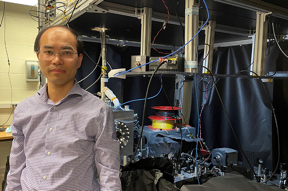 Tongcang Li and his team at Purdue University have developed ultrathin quantum sensors with 2D materials.
CREDIT
Cheryl Pierce, Purdue University
Tongcang Li and his team at Purdue University have developed ultrathin quantum sensors with 2D materials.
CREDIT
Cheryl Pierce, Purdue University
Abstract: As recently as 2019, spin defects known as qubits were discovered in 2D materials (hexagonal boron nitride), which could amplify the field of ultrathin quantum sensing. These scientists hit a snag in their discovery that has unleashed a scientific race to resolve the issues. The sensitivity of spin qubits in hexagonal boron nitride was limited by their low brightness and the low contrast of their magnetic resonance signal. Last month, Nature Physics published an article titled �Quantum sensors go flat,� highlighting the benefits and outlining current shortfalls of this new means of sensing via qubits in 2D materials.
West Lafayette, IN | Posted on September 3rd, 2021
A team of researchers at Purdue University took on the challenge of overcoming qubit signal shortcomings in their work to develop ultrathin quantum sensors with 2D materials. Their publication in Nano Letters demonstrates that they have solved some of the critical issues and yielded better results through experimentation.
�We used a gold film to increase the brightness of spin qubits by up to 17-fold,� said Tongcang Li, associate professor of physics and astronomy and electrical and computer engineering. �The gold film supports the surface plasmon that can speed up photon emission so we can collect more photons and, hence, more signals. In addition, we improved the contrast of their magnetic resonance signal by a factor of 10 by optimizing the design of a microwave waveguide. As a result, we substantially improved the sensitivity of these spin defects for detecting magnetic field, local temperature and local pressure.�
Funding
Seed grant from Purdue Quantum Science and Engineering Institute, DARPA Nascent Light-Matter Interactions program and the DARPA QUEST program; National Science Foundation (award No. 1839164). U.S. Department of Energy, Office of Science, National Quantum Information Science Research Centers, Quantum Science Center.
Brief summary of methods
The group applied a green laser and a microwave onto these spin qubits in a 2D material. The material will then emit photons with different colors (red and near-infrared) under the illumination of a green laser. The rate of photon emission depends on the magnetic field, temperature and pressure. Therefore, the brightness of these spin qubits will change when the magnetic field, temperature or pressure changes. Thus, they were able to accurately measure the magnetic field with high sensitivity.
Writer: Cheryl Pierce
Media contact: Brittany Steff,
Source: Tongcang Li,
####
For more information, please click here
Contacts:Brittany SteffPurdue University
Office: 765-494-7833Cell: 317-439-0771Expert Contact
Tongcang LiPurdue University
Copyright © Purdue University
If you have a comment, please Contact us.
Issuers of news releases, not 7th Wave, Inc. or Nanotechnology Now, are solely responsible for the accuracy of the content.
Bookmark:


Quantum Physics
 University of Illinois Chicago joins Brookhaven Lab's Quantum Center June 10th, 2022
Bumps could smooth quantum investigations: Rice University models show unique properties of 2D materials stressed by contoured substrates June 10th, 2022
Observation of fractional exclusion statistics in quantum critical matter May 27th, 2022
News and information
University of Illinois Chicago joins Brookhaven Lab's Quantum Center June 10th, 2022
Organic water splitters get a boost June 10th, 2022
2 Dimensional Materials
Bumps could smooth quantum investigations: Rice University models show unique properties of 2D materials stressed by contoured substrates June 10th, 2022
Possible Futures
Electron-phonon coupling assisted universal red luminescence of o-phenylenediamine-based CDs June 10th, 2022
Marching to the Cadence of Electronics: Innovation A new paper in Nature validates technology developed by John Bowers and collaborators June 10th, 2022
Small materials may be key to reducing cardiovascular disease deaths, researchers say June 10th, 2022
Decoding a key part of the cell, atom by atom June 10th, 2022
Quantum Computing
University of Illinois Chicago joins Brookhaven Lab's Quantum Center June 10th, 2022
Bumps could smooth quantum investigations: Rice University models show unique properties of 2D materials stressed by contoured substrates June 10th, 2022
A one-stop shop for quantum sensing materials May 27th, 2022
Sensors
A one-stop shop for quantum sensing materials May 27th, 2022
New nanomechanical oscillators with record-low loss May 13th, 2022
Discoveries
Electron-phonon coupling assisted universal red luminescence of o-phenylenediamine-based CDs June 10th, 2022
Marching to the Cadence of Electronics: Innovation A new paper in Nature validates technology developed by John Bowers and collaborators June 10th, 2022
Small materials may be key to reducing cardiovascular disease deaths, researchers say June 10th, 2022
Decoding a key part of the cell, atom by atom June 10th, 2022
Announcements
Organic water splitters get a boost June 10th, 2022
Interviews/Book Reviews/Essays/Reports/Podcasts/Journals/White papers/Posters
Decoding a key part of the cell, atom by atom June 10th, 2022
Organic water splitters get a boost June 10th, 2022
Quantum nanoscience
Bumps could smooth quantum investigations: Rice University models show unique properties of 2D materials stressed by contoured substrates June 10th, 2022
UCI scientists turn a hydrogen molecule into a quantum sensor: New technique enables precise measurement of electrostatic properties of materials April 22nd, 2022
New hardware integrates mechanical devices into quantum tech April 22nd, 2022
