
| Date | 4th, Sep 2021 |
|---|
Home > Press > Actuator discovery outperforms existing technology: University of Houston researchers use organic semiconductor nanotubes to create new electrochemical actuator
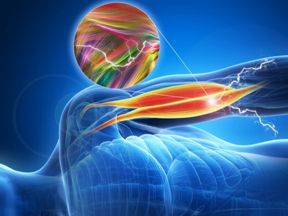 Depiction of the application of organic semiconductor nanotubes in artificial muscle. Artwork courtesy of Mohammad Reza Abidian.
CREDIT
Mohammad Reza Abidian
Depiction of the application of organic semiconductor nanotubes in artificial muscle. Artwork courtesy of Mohammad Reza Abidian.
CREDIT
Mohammad Reza Abidian
Abstract: University of Houston researchers are reporting a breakthrough in the field of materials science and engineering with the development of an electrochemical actuator that uses specialized organic semiconductor nanotubes (OSNTs).
Houston, TX | Posted on September 3rd, 2021
Currently in the early stages of development, the actuator will become a key part of research contributing to the future of robotic, bioelectronic and biomedical science.
�Electrochemical devices that transform electrical energy to mechanical energy have potential use in numerous applications, ranging from soft robotics and micropumps to autofocus microlenses and bioelectronics,� said Mohammad Reza Abidian, associate professor of biomedical engineering in the UH Cullen College of Engineering. He�s the corresponding author of the article �Organic Semiconductor Nanotubes for Electrochemical Devices,� published in the journal Advanced Functional Materials, which details the discovery.
Significant movement (which scientists define as actuation and measure as deformation strain) and fast response time have been elusive goals, especially for electrochemical actuator devices that operate in liquid. This is because the drag force of a liquid restricts an actuator�s motion and limits the ion transportation and accumulation in electrode materials and structures. In Abidian�s lab, he and his team refined methods of working around those two stumbling blocks.
�Our organic semiconductor nanotube electrochemical device exhibits high actuation performance with fast ion transport and accumulation and tunable dynamics in liquid and gel-polymer electrolytes. This device demonstrates an excellent performance, including low power consumption/strain, a large deformation, fast response and excellent actuation stability,� Abidian said.
This outstanding performance, he explained, stems from the enormous effective surface area of the nanotubular structure. The larger area facilitates the ion transport and accumulation, which results in high electroactivity and durability.
�The low power consumption/strain values for this OSNT actuator, even when it operates in liquid electrolyte, mark a profound improvement over previously reported electrochemical actuators operating in liquid and air,� Abidian said. �We evaluated long-term stability. This organic semiconductor nanotube actuator exhibited superior long-term stability compared with previously reported conjugated polymer-based actuators operating in liquid electrolyte.�
Joining Abidian on the project were Mohammadjavad Eslamian, Fereshtehsadat Mirab, Vijay Krishna Raghunathan and Sheereen Majd, all from the Department of Biomedical Engineering at the UH Cullen College of Engineering.
The organic semiconductors used, called conjugated polymers, were discovered in the 1970s by three scientists � Alan J. Heeger, Alan MacDiarmid and Hideki Shirakawa � who won a Nobel prize in 2000 for the discovery and development of conjugated polymers.
For a new type of actuator to outshine the status quo, the end product must prove not only to be highly effective (in this case, in both liquid and gel polymer electrolyte), but also that it can last.
�To demonstrate potential applications, we designed and developed a micron-scale movable neural probe that is based on OSNT microactuators. This microprobe potentially can be implanted in the brain, where neural signal recordings that are adversely affected, by either damaged tissue or displacement of neurons, may be enhanced by adjusting the position of the movable microcantilevers,� said Abidian.
The next step is animal testing, which will be undertaken soon at Columbia University. Early results are expected by the end of 2021, with longer term tests to follow.
�Considering the achievements so far, we anticipate these new OSNT-based electrochemical devices will help advance the next generation of soft robotics, artificial muscles, bioelectronics and biomedical devices,� Abidian said.
####
For more information, please click here
Contacts:Sara StrongUniversity of Houston
Office: 713-743-1530
Copyright © University of Houston
If you have a comment, please Contact us.
Issuers of news releases, not 7th Wave, Inc. or Nanotechnology Now, are solely responsible for the accuracy of the content.
Bookmark:


News and information
 University of Illinois Chicago joins Brookhaven Lab's Quantum Center June 10th, 2022
Organic water splitters get a boost June 10th, 2022
Robotics
Nanostructured fibers can impersonate human muscles June 3rd, 2022
Shape memory in hierarchical networks � the astonishing property that allows manipulation of morphing materials with micro scale resolutions February 25th, 2022
Possible Futures
Electron-phonon coupling assisted universal red luminescence of o-phenylenediamine-based CDs June 10th, 2022
Marching to the Cadence of Electronics: Innovation A new paper in Nature validates technology developed by John Bowers and collaborators June 10th, 2022
Small materials may be key to reducing cardiovascular disease deaths, researchers say June 10th, 2022
Decoding a key part of the cell, atom by atom June 10th, 2022
Nanomedicine
Electron-phonon coupling assisted universal red luminescence of o-phenylenediamine-based CDs June 10th, 2022
Small materials may be key to reducing cardiovascular disease deaths, researchers say June 10th, 2022
Decoding a key part of the cell, atom by atom June 10th, 2022
Discoveries
Electron-phonon coupling assisted universal red luminescence of o-phenylenediamine-based CDs June 10th, 2022
Marching to the Cadence of Electronics: Innovation A new paper in Nature validates technology developed by John Bowers and collaborators June 10th, 2022
Small materials may be key to reducing cardiovascular disease deaths, researchers say June 10th, 2022
Decoding a key part of the cell, atom by atom June 10th, 2022
Announcements
Organic water splitters get a boost June 10th, 2022
Interviews/Book Reviews/Essays/Reports/Podcasts/Journals/White papers/Posters
Decoding a key part of the cell, atom by atom June 10th, 2022
Organic water splitters get a boost June 10th, 2022
