
| Date | 4th, Sep 2021 |
|---|
Home > Press > Imaging single spine structural plasticity at the nanoscale level: Researchers at the Max Planck Florida Institute for Neuroscience (MPFI) have developed a new imaging technique capable of visualizing the dynamically changing structure of dendritic spines with unprecedented resol
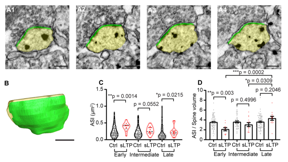 A, B, Serial images of an example spine (A) and 3D reconstruction of the example spine (B) with spine head shown in yellow and ASI shown in green. Scale bar, 200 nm. C, ASI area size at early, intermediate, and late phases of sLTP for sLTP and control (Ctrl) spines. Welch�s t test was used on log-transformed data. D, Ratio of ASI area to spine volume at early, intermediate, and late phases of sLTP.
CREDIT
Max Planck Florida Institute for Neuroscience
A, B, Serial images of an example spine (A) and 3D reconstruction of the example spine (B) with spine head shown in yellow and ASI shown in green. Scale bar, 200 nm. C, ASI area size at early, intermediate, and late phases of sLTP for sLTP and control (Ctrl) spines. Welch�s t test was used on log-transformed data. D, Ratio of ASI area to spine volume at early, intermediate, and late phases of sLTP.
CREDIT
Max Planck Florida Institute for Neuroscience
Abstract: For most, the relentless snapping of camera shutters is an all too familiar sound associated with trips and vacations. When venturing to a new place, travelers everywhere are constantly on the search for that picture-perfect, Instagram worthy shot. Persevering through many takes, amateur photographers fight blurred backgrounds, closed eyes, and photo-bombing passersby all in search of that ever-elusive perfect picture.
West Palm Beach, FL | Posted on September 3rd, 2021
As it turns out, neuroscientists are very similar to travelers in this regard, constantly developing and practicing new ways to take perfect, crystal-clear images. But instead of picturesque natural backdrops or striking city scenes, neuroscientists are interested in detailed snapshots of brain cells and their small-scale structures.
The Yasuda Lab at MPFI is incredibly well versed in small-scale structures of the brain, focused on studying the dynamic changes to tiny synaptic compartments called dendritic spines. Robust changes in spine structure known as structural plasticity, allow synapses to robustly modulate their connection strength. By doing so, cells in the brain can actively strengthen important connections and weaken those that are less needed. This process is thought to underlie how we learn and remember. But revealing the fine structures of spines in detail during such a dynamic process is a difficult undertaking. Until recently, imaging methodologies lacked the capabilities to do so.
In a recent publication in The Journal of Neuroscience, researchers in the Yasuda Lab have developed a powerful new imaging strategy capable of visualizing the fine, ultrastructural changes to dendritic spines during structural plasticity. By modifying and building off an established imaging technique known as correlative light and electron microscopy (CLEM), MPFI scientists have harnessed the best that both imaging modalities can provide.
�Dendritic spines are such small-scale neuronal compartments, that it�s difficult to get an accurate picture of what�s actually occurring in terms of structural changes using traditional imaging methods,� explains Dr. Ryohei Yasuda, Scientific Director at MPFI. �Using more standard optical techniques like 2-photon microscopy, dendritic spines look like smooth spheres. In actuality, we know from using more powerful imaging methods, like electron microscopy, that the actual size and shape of spines are far more complex. So, we were interested in learning what changes occur during the various stages of structural plasticity, at a resolution where we could take a deeper look at the spine�s complexity.�
The MPFI team first induced structural plasticity in single dendritic spines using 2-photon optical microscopy and glutamate uncaging. The induced spine was then fixed in time at one of three distinct timepoints, representing the major stages of structural plasticity. In close collaboration with MPFI�s Electron Microscopy (EM) Core, brain tissue samples containing the stimulated spines were cut into ultra-thin sections using a specialized device called ATUMtome. These sections were then re-imaged using the extreme resolving power of the Electron Microscope to reveal the ultrastructural details and reconstruct accurate pictures of the spine�s complex topography.
�When we started this project, our goal was to see if it was even possible to collect spines at various stages of structural plasticity, successfully relocate them, and resolve their ultrastructure using EM,� describes Ye Sun, Ph.D., former Graduate Student in the Yasuda Lab and first author of the publication. �Single, spine-specific forms of structural plasticity have never been imaged in this way before. Dr. Naomi kamasawa, Head of MPFI�s EM Core, was instrumental in helping to establish and optimize our EM workflow for the project.�
Examining the reconstructed spine images, the MPFI team noticed unique changes to a protein-rich region of dendritic spines, called the postsynaptic density (PSD). This region is critically important for the spine, implicated in regulating synaptic strength and plasticity. MPFI researchers found that compared to control spines, the area and size of the PSD region was significantly greater in spines that underwent structural plasticity. PSD growth in these spines occurred on a slower timescale, needing hours to reach its maximal change. Interestingly while growth was on a slower scale, PSD structure in stimulated spines reorganized at a rapid pace. After the induction of structural plasticity, PSD complexity immediately increased, dramatically transforming in shape and structural features.
�Our imaging strategy synergizes the best of both optical and EM microscopies, allowing us to study spine structural changes never before seen in nanoscale resolution,� notes Dr. Yasuda. �For the future, our lab is interested in using this new protocol in combination with advanced molecular techniques, such as SLENDR, to study individual protein dynamics in tandem with finely detailed structural changes during spine structural plasticity.
####
For more information, please click here
Contacts:Helena DeckerMax Planck Florida Institute for Neuroscience
Office: 561-972-9253
Copyright © Max Planck Florida Institute for Neuroscience
If you have a comment, please Contact us.
Issuers of news releases, not 7th Wave, Inc. or Nanotechnology Now, are solely responsible for the accuracy of the content.
Bookmark:


News and information
 University of Illinois Chicago joins Brookhaven Lab's Quantum Center June 10th, 2022
Organic water splitters get a boost June 10th, 2022
Imaging
Snapshot measurement of single nanostructure�s circular dichroism March 25th, 2022
Better understanding superconductors with Higgs spectroscopy Prof. Stefan Kaiser from TU Dresden awarded ERC Consolidator Grant March 18th, 2022
Visualizing the invisible: New fluorescent DNA label reveals nanoscopic cancer features March 4th, 2022
Possible Futures
Electron-phonon coupling assisted universal red luminescence of o-phenylenediamine-based CDs June 10th, 2022
Marching to the Cadence of Electronics: Innovation A new paper in Nature validates technology developed by John Bowers and collaborators June 10th, 2022
Small materials may be key to reducing cardiovascular disease deaths, researchers say June 10th, 2022
Decoding a key part of the cell, atom by atom June 10th, 2022
Nanomedicine
Electron-phonon coupling assisted universal red luminescence of o-phenylenediamine-based CDs June 10th, 2022
Small materials may be key to reducing cardiovascular disease deaths, researchers say June 10th, 2022
Decoding a key part of the cell, atom by atom June 10th, 2022
Discoveries
Electron-phonon coupling assisted universal red luminescence of o-phenylenediamine-based CDs June 10th, 2022
Marching to the Cadence of Electronics: Innovation A new paper in Nature validates technology developed by John Bowers and collaborators June 10th, 2022
Small materials may be key to reducing cardiovascular disease deaths, researchers say June 10th, 2022
Decoding a key part of the cell, atom by atom June 10th, 2022
Announcements
Organic water splitters get a boost June 10th, 2022
Interviews/Book Reviews/Essays/Reports/Podcasts/Journals/White papers/Posters
Decoding a key part of the cell, atom by atom June 10th, 2022
Organic water splitters get a boost June 10th, 2022
Tools
Snapshot measurement of single nanostructure�s circular dichroism March 25th, 2022
Eyebrow-raising: Researchers reveal why nanowires stick to each other February 11th, 2022
JEOL Introduces New Scanning Electron Microscope with �Simple SEM� Automation and Live Elemental and 3D Analysis January 14th, 2022
Super-resolved imaging of a single cold atom on a nanosecond timescale January 7th, 2022
Nanobiotechnology
Electron-phonon coupling assisted universal red luminescence of o-phenylenediamine-based CDs June 10th, 2022
Small materials may be key to reducing cardiovascular disease deaths, researchers say June 10th, 2022
Decoding a key part of the cell, atom by atom June 10th, 2022
