
| Date | 7th, Sep 2021 |
|---|
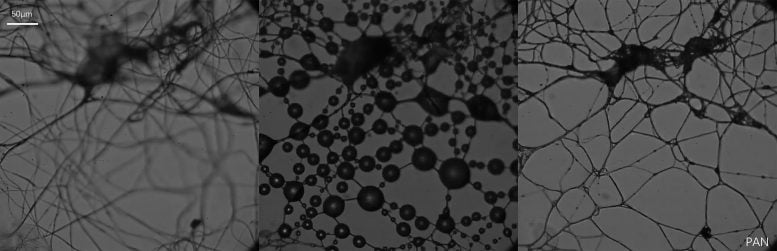
Polyacrylonitrile nanofiber mesh before (left), during (middle), and after (right) capturing water aerosols. The mesh becomes coarser as some nanofibers stick together after the captured water droplets are fully evaporated. Credit: Southern University of Science and Technology, Shenzhen, China
Videos capture nanofiber behavior under water aerosol exposure.
Since its outbreak, the COVID-19 virus has infected more than 220.9 million people worldwide and has claimed more than 4.5 million lives, according to the World Health Organization coronavirus dashboard as of September 7, 2021.
However, many medical professionals attribute the consequential role of face masks in slowing the spread of the virus and protecting human health.
Innovations to improve mask efficacy, with increasing focus on nanofiber manufacturing, have resulted in higher filtration efficiency, greater comfort, and easier breathing capacity. However, the effects of microwater droplets on the integrity of nanofibers are relatively unclear.
In Physics of Fluids, by AIP Publishing, researchers from Southern University of Science and Technology in Shenzhen, China, examine these ambiguities through a visualization of nanofibers interacting with water aerosol exposure.
