
| Date | 7th, Sep 2021 |
|---|
An effervescent nozzle sprays tiny droplets of saltwater inside the team's testing tent.
As we confront the enormous challenge of climate change, we should take inspiration from even the most unlikely sources. Take, for example, the tens of thousands of fossil-fueled ships that chug across the ocean, spewing plumes of pollutants that contribute to acid rain, ozone depletion, respiratory ailments, and global warming.
The particles produced by these ship emissions can also create brighter clouds, which in turn can produce a cooling effect via processes that occur naturally in our atmosphere. What if we could achieve this cooling effect without simultaneously releasing the greenhouse gases and toxic pollutants that ships emit? That's the question the Marine Cloud Brightening (MCB) Project intends to answer.
Scientists have known for decades that the particulate emissions from ships can have a dramatic effect on low-lying stratocumulus clouds above the ocean. In satellite images, parts of the Earth's oceans are streaked with bright white strips of clouds that correspond to shipping lanes. These artificially brightened clouds are a result of the tiny particles produced by the ships, and they reflect more sunlight back to space than unperturbed clouds do, and much more than the dark blue ocean underneath. Since these "ship tracks" block some of the sun's energy from reaching Earth's surface, they prevent some of the warming that would otherwise occur.
The formation of ship tracks is governed by the same basic principles behind all cloud formation. Clouds naturally appear when the relative humidity exceeds 100 percent, initiating condensation in the atmosphere. Individual cloud droplets form around microscopic particles called cloud condensation nuclei (CCN). Generally speaking, an increase in CCN increases the number of cloud droplets while reducing their size. Through a phenomenon known as the Twomey effect, this high concentration of droplets boosts the clouds' reflectivity (also called albedo). Sources of CCN include aerosols like dust, pollen, soot, and even bacteria, along with man-made pollution from factories and ships. Over remote parts of the ocean, most CCN are of natural origin and include sea salt from crashing ocean waves.
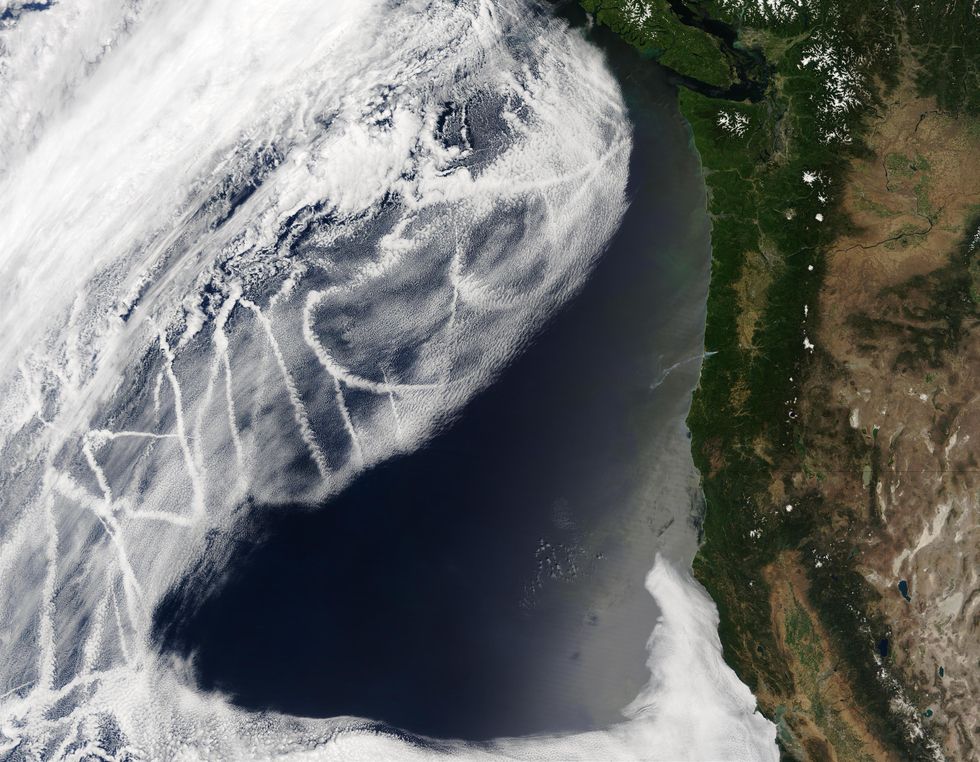 Satellite imagery shows "ship tracks" over the ocean: bright clouds that form because of particles spewed out by ships.Jeff Schmaltz/MODIS Rapid Response Team/GSFC/NASA
The aim of the MCB Project is to consider whether deliberately adding more sea salt CCN to low marine clouds would cool the planet. The CCN would be generated by spraying seawater from ships. We expect that the sprayed seawater would instantly dry in the air and form tiny particles of salt, which would rise to the cloud layer via convection and act as seeds for cloud droplets. These generated particles would be much smaller than the particles from crashing waves, so there would be only a small relative increase in sea salt mass in the atmosphere. The goal would be to produce clouds that are slightly brighter (by 5 to 10 percent) and possibly longer lasting than typical clouds, resulting in more sunlight being reflected back to space.
"Solar climate intervention" is the umbrella term for projects such as ours that involve reflecting sunlight to reduce global warming and its most dangerous impacts. Other proposals include sprinkling reflective silicate beads over polar ice sheets and injecting materials with reflective properties, such as sulfates or calcium carbonate, into the stratosphere. None of the approaches in this young field are well understood, and they all carry potentially large unknown risks.
Solar climate intervention is not a replacement for reducing greenhouse gas emissions, which is imperative. But such reductions won't address warming from existing greenhouse gases that are already in the atmosphere. As the effects of climate change intensify and tipping points are reached, we may need options to prevent the most catastrophic consequences to ecosystems and human life. And we'll need a clear understanding of both the efficacy and risks of solar climate intervention technologies so people can make informed decisions about whether to implement them.
Our team, based at the University of Washington, the Palo Alto Research Center (PARC), and the Pacific Northwest National Laboratory, comprises experts in climate modeling, aerosol-cloud interactions, fluid dynamics, and spray systems. We see several key advantages to marine cloud brightening over other proposed forms of solar climate intervention. Using seawater to generate the particles gives us a free, abundant source of environmentally benign material, most of which would be returned to the ocean through deposition. Also, MCB could be done from sea level and wouldn't rely on aircraft, so costs and associated emissions would be relatively low.
The effects of particles on clouds are temporary and localized, so experiments on MCB could be carried out over small areas and brief time periods (maybe spraying for a few hours per day over several weeks or months) without seriously perturbing the environment or global climate. These small studies would still yield significant information on the impacts of brightening. What's more, we can quickly halt the use of MCB, with very rapid cessation of its effects.
Solar climate intervention is the umbrella term for projects that involve reflecting sunlight to reduce global warming and its most dangerous impacts.
Our project encompasses three critical areas of research. First, we need to find out if we can reliably and predictably increase reflectivity. To this end, we'll need to quantify how the addition of generated sea salt particles changes the number of droplets in these clouds, and study how clouds behave when they have more droplets. Depending on atmospheric conditions, MCB could affect things like cloud droplet evaporation rate, the likelihood of precipitation, and cloud lifetime. Quantifying such effects will require both simulations and field experiments.
Second, we need more modeling to understand how MCB would affect weather and climate both locally and globally. It will be crucial to study any negative unintended consequences using accurate simulations before anyone considers implementation. Our team is initially focusing on modeling how clouds respond to additional CCN. At some point we'll have to check our work with small-scale field studies, which will in turn improve the regional and global simulations we'll run to understand the potential impacts of MCB under different climate change scenarios.
The third critical area of research is the development of a spray system that can produce the size and concentration of particles needed for the first small-scale field experiments. We'll explain below how we're tackling that challenge.
One of the firststeps in our project was to identify the clouds most amenable to brightening. Through modeling and observational studies, we determined that the best target is stratocumulus clouds, which are low altitude (around 1 to 2 km) and shallow; we're particularly interested in "clean" stratocumulus, which have low numbers of CCN. The increase in cloud albedo with the addition of CCN is generally strong in these clouds, whereas in deeper and more highly convective clouds other processes determine their brightness. Clouds over the ocean tend to be clean stratocumulus clouds, which is fortunate, because brightening clouds over dark surfaces, such as the ocean, will yield the highest albedo change. They're also conveniently close to the liquid we want to spray.
