
| Date | 11th, Sep 2021 |
|---|
Home > Press > �Anti-rust� coating for plants protects against disease with cellulose nanofiber: Researchers from the University of Tsukuba find that coating soybean plant leaves with cellulose nanofiber offers resistance to infection by Asian soybean rust pathogen
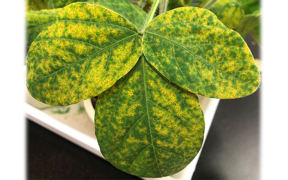 Researchers from the University of Tsukuba have found that coating soybean plant leaves with cellulose nanofiber (CNF) gives protection against an aggressive fungal disease. The CNF coating changed leaf surfaces from water repellent to water absorbent, and suppressed pathogen gene expression associated with infection mechanisms, offering resistance to the destructive Asian rust disease. This is the first study to examine CNF application for controlling plant diseases, and it offers a sustainable alternative to managing plant disease.
CREDIT
University of Tsukuba
Researchers from the University of Tsukuba have found that coating soybean plant leaves with cellulose nanofiber (CNF) gives protection against an aggressive fungal disease. The CNF coating changed leaf surfaces from water repellent to water absorbent, and suppressed pathogen gene expression associated with infection mechanisms, offering resistance to the destructive Asian rust disease. This is the first study to examine CNF application for controlling plant diseases, and it offers a sustainable alternative to managing plant disease.
CREDIT
University of Tsukuba
Abstract: A water-absorbent coat to keep rust away? It may seem counterintuitive but when it comes to soybean plants and rust disease, researchers from Japan have discovered that applying a coating that makes leaf surfaces water absorbent helps to protect against infection.
Tsukuba, Japan | Posted on September 10th, 2021
In a study published this month in Frontiers in Plant Science, researchers from the University of Tsukuba have revealed that coating soybean plant leaves with cellulose nanofiber changes the leaf surface from water repellent to water absorbent and offers resistance against Asian soybean rust.
Rusts are plant diseases that get their name from the powdery rust- or brown-colored fungal spores on the surfaces of infected plants. Asian soybean rust (ASR) is an aggressive disease of soybean plants, causing estimated crop yield losses of up to 90%. ASR is caused by Phakopsora pachyrhizi, a fungal pathogen that requires a living plant host to survive. The timely application of fungicide is currently the only way of controlling ASR in the field. But the use of fungicides can be problematic, resulting in negative environmental effects, increased production costs, and fungicide-resistant pathogens.
�We investigated cellulose nanofiber (CNF) as an alternative method of controlling ASR,� says senior author of the study, Professor Yasuhiro Ishiga. �Specifically, we wanted to know whether coating soybean plant leaves with CNF protected plants against P. pachyrhizi.�
Of the available methods for isolating CNF, aqueous counter collision (ACC) has been shown to alter the hydrophilic (water absorbent) and hydrophobic (water repellent) properties of surfaces, switching one to the other. Previous research has indicated that CNF obtained via ACC has higher wettability than CNF isolated by other methods.
�We showed that CNF can change the soybean leaf surface from hydrophobic to hydrophilic,� explains senior author, Professor Yuji Yamashita. �This offers resistance against P. pachyrhizi.�
The team found fewer lesions and significantly reduced formation of P. pachyrhizi appressoria, which are specialized pre-infection structures used to break through the outer surface of the host plant, on CNF-treated leaves compared with control (untreated) leaves. The results also revealed suppressed gene expression linked to the formation of pre-infection structures in P. pachyrhizi on treated versus control leaves.
�In particular, chitin synthase gene expression was suppressed, and P. pachyrhizi needs chitin synthases to form pre-infection structures,� says Professor Ishiga.
This study is the first to investigate the application of CNF for controlling plant diseases in the field, and this technique offers new possibilities for sustainable and eco-friendly management of plant diseases.
####
For more information, please click here
Contacts:Naoko YamashinaUniversity of Tsukuba
Copyright © University of Tsukuba
If you have a comment, please Contact us.
Issuers of news releases, not 7th Wave, Inc. or Nanotechnology Now, are solely responsible for the accuracy of the content.
Bookmark:


News and information
 University of Illinois Chicago joins Brookhaven Lab's Quantum Center June 10th, 2022
Organic water splitters get a boost June 10th, 2022
Possible Futures
Electron-phonon coupling assisted universal red luminescence of o-phenylenediamine-based CDs June 10th, 2022
Marching to the Cadence of Electronics: Innovation A new paper in Nature validates technology developed by John Bowers and collaborators June 10th, 2022
Small materials may be key to reducing cardiovascular disease deaths, researchers say June 10th, 2022
Decoding a key part of the cell, atom by atom June 10th, 2022
Discoveries
Electron-phonon coupling assisted universal red luminescence of o-phenylenediamine-based CDs June 10th, 2022
Marching to the Cadence of Electronics: Innovation A new paper in Nature validates technology developed by John Bowers and collaborators June 10th, 2022
Small materials may be key to reducing cardiovascular disease deaths, researchers say June 10th, 2022
Decoding a key part of the cell, atom by atom June 10th, 2022
Announcements
Organic water splitters get a boost June 10th, 2022
Interviews/Book Reviews/Essays/Reports/Podcasts/Journals/White papers/Posters
Decoding a key part of the cell, atom by atom June 10th, 2022
Organic water splitters get a boost June 10th, 2022
Food/Agriculture/Supplements
Polymer fibers with graphene nanotubes make it possible to heat hard-to-reach, complex-shaped items February 11th, 2022
Unprecedented view of a single catalyst nanoparticle at work: X-rays reveal compositional changes on active surface under reaction conditions October 1st, 2021
Enhanced ambient ammonia photosynthesis by Mo-doped Bi5O7Br nanosheets with light-switchable oxygen vacancies September 3rd, 2021
New technology enables rapid sequencing of entire genomes of plant pathogens May 14th, 2021
