
| Date | 11th, Sep 2021 |
|---|
Home > Press > Leibniz Prize winner Professor Dr. Oliver G. Schmidt moves to Chemnitz University of Technology: President Professor Dr. Gerd Strohmeier refers to an 'absolute top transfer'
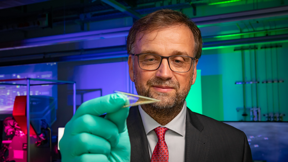 Prof. Dr. Oliver G. Schmidt is a pioneer in the field of microrobotics and micromotors. Schmidt is Chair of the Professorship Materials for Nanoelectronics at Chemnitz University of Technology and initiator of the Center for Materials, Architectures and Integration of Nanomembranes (MAIN).
CREDIT
Jacob M�ller
Prof. Dr. Oliver G. Schmidt is a pioneer in the field of microrobotics and micromotors. Schmidt is Chair of the Professorship Materials for Nanoelectronics at Chemnitz University of Technology and initiator of the Center for Materials, Architectures and Integration of Nanomembranes (MAIN).
CREDIT
Jacob M�ller
Abstract: Prof. Dr. Oliver G. Schmidt, who is, among others, long-time Director of the Institute for Integrative Nanosciences at the Leibniz Institute for Solid State and Materials Research Dresden, will move to Chemnitz University of Technology on September 16, 2021. Here he will continue his research work, especially in the field of nanomembrane-based materials, one of the most modern research areas in the field of micro- and nanotechnologies, at the new, state-of-the-art Center for Materials, Architectures and Integration of Nanomembranes (MAIN) as well as at the Faculty of Electrical Engineering and Information Technology (professorship Materials for Nanoelectronics).
Chemnitz, Germany | Posted on September 10th, 2021
"In soccer, people would talk of an absolute top transfer at this point. This was preceded by extremely intense negotiations, in which not only the transfer from Dresden to Chemnitz was at stake, but also a top-class offer from abroad had to be fended off. It is therefore all the more gratifying that Prof. Schmidt ultimately chose Chemnitz University of Technology. I am firmly convinced that he will not only contribute significantly to the further development of the Center for MAIN but will also act as the centerpiece of the excellence strategy of Chemnitz University of Technology in the core competence Materials and Intelligent Systems," said President Prof. Dr. Gerd Strohmeier.
Prof. Schmidt is among the top 1 percent of the world's most cited scientists in his discipline (according to the SCOPUS literature database), has about 870 publications in peer-reviewed journals, including extremely prestigious international journals such as Nature and Science (h-index of 108), and was awarded the 2018 Gottfried Wilhelm Leibniz Prize, Germany's most important research funding prize, by the German Research Foundation for his outstanding work on the research, fabrication, and innovative application of functional nanostructures.
Outstanding innovations are associated with his name:
- In 2021, heading an international research team, Prof. Schmidt succeeded in developing the world's smallest so-called "biosupercapacitor" - an energy storage device for biomedical applications. It is smaller than a speck of dust, already works in (artificial) bloodstreams and provides enough energy for a tiny sensor system to measure the pH value in human blood (published in the journal Nature Communications).
- In 2020, Prof. Schmidt led an international research team to develop the world's smallest microelectronic robot. The robot is 0.8 mm long, 0.8 mm wide and 0.14 mm high, is driven by a twin jet and is mechanically extremely flexible, mobile, and equipped with various functions (published in the journal Nature Electronics).
- Over the last few years, Prof. Schmidt and his research team and various cooperation partners have developed a new method for folding or rolling up wafer-thin materials on a chip into three-dimensional complex microcomponents. With this so-called "micro-origami technique," novel three-dimensional micro- and sensor systems as well as ultra-compact and powerful energy storage systems can be designed and fabricated, which exhibit excellent characteristics and are extremely light and compact (published in the journals Nature, Nature Communications, etc.).
Prof. Dr. Oliver G. Schmidt says: "I am very pleased that research sites such as the Smart Systems Campus and the MAIN research center have been created at Chemnitz University of Technology where the limits of what is feasible in the field of micro- and nanotechnologies can be pushed and completely new application concepts can be developed. With the sustained support of the university and in cooperation with many excellent colleagues in Chemnitz, we will continue to achieve results with national and international visibility in this highly competitive branch of research.�
Prof. Schmidt was previously the longstanding Director of the Institute for Integrative Nanosciences at the Leibniz Institute for Solid State and Materials Research (IFW) Dresden. Since the position at IFW Dresden was filled in a joint appointment with Chemnitz University of Technology, Prof. Schmidt was already active at Chemnitz University of Technology. These activities include, above all, the initiative for the Center for Materials, Architectures and Integration of Nanomembranes (MAIN) � a research center unique in Europe, which was built after a successful application to the German Science Council with around 34.3 million euros in federal and state funding and was handed over to Chemnitz University of Technology in August 2018.
About Prof. Dr. Oliver G. SchmidtAfter graduating from the German School in London in 1990, Oliver G. Schmidt studied physics at Kiel University, King's College London, and Berlin Institute of Technology. In 1999, Schmidt received his PhD from Berlin University of Technology and subsequently worked as a research associate at the Max Planck Institute for Solid State Research in Stuttgart. After a research stay at the University of Southern California, he returned to Stuttgart as a research group leader. In 2003, he habilitated at the University of Hamburg. In 2007, he was appointed Professor for Materials for Nanoelectronics at the Faculty of Electrical Engineering and Information Technology at Chemnitz University of Technology. At the same time, he became the Director of the Institute for Integrative Nanoscience at the Leibniz Institute for Solid State and Materials Research Dresden. Furthermore, he holds a secondary membership in the Faculty of Natural Sciences at Chemnitz University of Technology since 2007. Schmidt initiated the new construction of the Center for Materials, Architectures and Integration of Nanomembranes (MAIN) at Chemnitz University of Technology, which has been offering state-of-the-art research and working conditions to about 100 scientists since 2018. Schmidt has received several awards, including the Gottfried Wilhelm Leibniz Prize from the German Research Foundation in 2018. Also in 2018, he was elected a member of the German Academy of Science and Engineering (acatech). Since 2020, he has been a member of the Saxon Academy of Sciences. Prof. Schmidt was listed as a highly cited scientist in 2018 and 2019. This was the result of the annual Highly Cited Researcher ranking by the American data analytics company Clarivate Analytics.
####
For more information, please click here
Contacts:Matthias FejesChemnitz University of Technology
Office: 0049-371-531-32026Expert Contact
Prof. Dr. Oliver G. SchmidtChemnitz University of Technology
Office: +49 371 531-36761
Copyright © Chemnitz University of Technology
If you have a comment, please Contact us.
Issuers of news releases, not 7th Wave, Inc. or Nanotechnology Now, are solely responsible for the accuracy of the content.
Bookmark:


News and information
 University of Illinois Chicago joins Brookhaven Lab's Quantum Center June 10th, 2022
Organic water splitters get a boost June 10th, 2022
Robotics
Nanostructured fibers can impersonate human muscles June 3rd, 2022
Shape memory in hierarchical networks � the astonishing property that allows manipulation of morphing materials with micro scale resolutions February 25th, 2022
Thin films
Thin-film, high-frequency antenna array offers new flexibility for wireless communications November 5th, 2021
Possible Futures
Electron-phonon coupling assisted universal red luminescence of o-phenylenediamine-based CDs June 10th, 2022
Marching to the Cadence of Electronics: Innovation A new paper in Nature validates technology developed by John Bowers and collaborators June 10th, 2022
Small materials may be key to reducing cardiovascular disease deaths, researchers say June 10th, 2022
Decoding a key part of the cell, atom by atom June 10th, 2022
Chip Technology
Marching to the Cadence of Electronics: Innovation A new paper in Nature validates technology developed by John Bowers and collaborators June 10th, 2022
Bumps could smooth quantum investigations: Rice University models show unique properties of 2D materials stressed by contoured substrates June 10th, 2022
�Fruitcake� structure observed in organic polymers June 3rd, 2022
On-Chip Photodetection: Two-dimensional material heterojunctions hetero-integration May 13th, 2022
Nanomedicine
Electron-phonon coupling assisted universal red luminescence of o-phenylenediamine-based CDs June 10th, 2022
Small materials may be key to reducing cardiovascular disease deaths, researchers say June 10th, 2022
Decoding a key part of the cell, atom by atom June 10th, 2022
Sensors
A one-stop shop for quantum sensing materials May 27th, 2022
New nanomechanical oscillators with record-low loss May 13th, 2022
Nanoelectronics
Eyebrow-raising: Researchers reveal why nanowires stick to each other February 11th, 2022
Visualizing temperature transport: An unexpected technique for nanoscale characterization November 19th, 2021
Non-linear effects in coupled optical microcavities August 5th, 2021
Announcements
Organic water splitters get a boost June 10th, 2022
Appointments/Promotions/New hires/Resignations/Deaths
JEOL USA Welcomes New Managing Director, Hidetaka Sawada April 19th, 2021
The National Space Society Remembers Ben Bova : NSS Mourns the Loss of a Visionary NSS Leader December 2nd, 2020
Erick Carreira to lead the Journal of the American Chemical Society September 4th, 2020
Grants/Sponsored Research/Awards/Scholarships/Gifts/Contests/Honors/Records
Nanostructured fibers can impersonate human muscles June 3rd, 2022
Bacteria-killing drills get an upgrade Visible light triggers: Rice�s molecular machines to treat infections June 1st, 2022
A new step in the search for room-temperature superconductors May 27th, 2022
Nanobiotechnology
Electron-phonon coupling assisted universal red luminescence of o-phenylenediamine-based CDs June 10th, 2022
Small materials may be key to reducing cardiovascular disease deaths, researchers say June 10th, 2022
Decoding a key part of the cell, atom by atom June 10th, 2022
