
| Date | 18th, Sep 2021 |
|---|
Home > Press > New nano particles suppress resistance to cancer immunotherapy
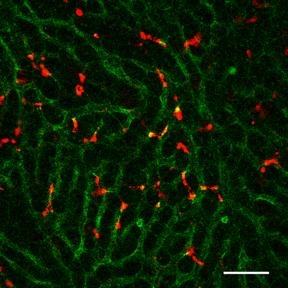 After intravenous injection into mice, STING-lipid nanoparticles (red) transported through blood vessels(green) accumulate in the liver (Takashi Nakamura, et al. Journal for ImmunoTherapy of Cancer. July 2, 2021).
CREDIT
Takashi Nakamura, et al. Journal for ImmunoTherapy of Cancer. July 2, 2021.
After intravenous injection into mice, STING-lipid nanoparticles (red) transported through blood vessels(green) accumulate in the liver (Takashi Nakamura, et al. Journal for ImmunoTherapy of Cancer. July 2, 2021).
CREDIT
Takashi Nakamura, et al. Journal for ImmunoTherapy of Cancer. July 2, 2021.
Abstract: A specially designed lipid nanoparticle could deliver immune-signaling molecules into liver macrophage cells to overcome resistance to anti-tumor immunotherapy.
Hokkaido, Japan | Posted on September 17th, 2021
Hokkaido University scientists and colleagues in Japan have found a way that could help some patients overcome resistance to an immunotherapy treatment for cancer. The approach, proven in mice experiments, was reported in the Journal for Immunotherapy of Cancer.
The activation of checkpoint proteins on the surfaces of immune cells help regulate the immune response by preventing them from indiscriminately attacking the body�s other cells. But some cancer cells are able to hijack this mechanism, preventing an immune response against them as well. Scientists have recently developed immune checkpoint inhibitors that can counteract this strategy, but some people are resistant to the treatments.
Now, scientists at Hokkaido University and Aichi Institute of Technology have found a way around this by developing a specially designed lipid nanoparticle that can carry immunity-triggering molecules into immune cells in the liver called macrophages.
The lipid, called YSK12-C4, has a high affinity for immune cells. When intravenously injected into mice with metastatic melanoma, it was able to deliver signaling molecules, called cyclic dinucleotides, across the cell membranes of their liver macrophages, where they stimulated the production of immune-related proteins called type 1 interferons via a stimulator of an interferon gene (STING) pathway. These were released into the blood, activating another type of immune cell called natural killer cells in the spleen and lung, which produced interferon-gamma inside the lung metastases.
This treatment, on its own, only elicited a mild anti-tumor effect. This is because the type 1 interferons and interferon-gamma triggered the expression of a protein called PD-L1 on the cancer cells. PD-L1 prevents a strong tumor-killing immune response of natural killer cells that express PD-1. Administering an anti-PD-1 immunotherapy treatment, however, prevented the cancer cells from turning off those natural killer cells, which then became armed and able to launch a full-scale attack.
�The findings suggest that our lipid nanoparticles carrying immune-signaling molecules convert the immune status from immunologically cold to immunologically hot,� says Takashi Nakamura of Hokkaido University�s faculty of pharmaceutical sciences. �This could lead to the development of a promising adjuvant that reduces resistance to anti-PD-1 antibody treatment in some cancer patients.�
Further studies will need to examine whether the treatment can cause liver toxicity and if different signaling molecules can be used.
####
For more information, please click here
Contacts:Sohail Keegan PintoHokkaido University
Office: +81-11-706-2185
Copyright © Hokkaido University
If you have a comment, please Contact us.
Issuers of news releases, not 7th Wave, Inc. or Nanotechnology Now, are solely responsible for the accuracy of the content.
Bookmark:


News and information
 University of Illinois Chicago joins Brookhaven Lab's Quantum Center June 10th, 2022
Organic water splitters get a boost June 10th, 2022
Possible Futures
Electron-phonon coupling assisted universal red luminescence of o-phenylenediamine-based CDs June 10th, 2022
Marching to the Cadence of Electronics: Innovation A new paper in Nature validates technology developed by John Bowers and collaborators June 10th, 2022
Small materials may be key to reducing cardiovascular disease deaths, researchers say June 10th, 2022
Decoding a key part of the cell, atom by atom June 10th, 2022
Nanomedicine
Electron-phonon coupling assisted universal red luminescence of o-phenylenediamine-based CDs June 10th, 2022
Small materials may be key to reducing cardiovascular disease deaths, researchers say June 10th, 2022
Decoding a key part of the cell, atom by atom June 10th, 2022
Discoveries
Electron-phonon coupling assisted universal red luminescence of o-phenylenediamine-based CDs June 10th, 2022
Marching to the Cadence of Electronics: Innovation A new paper in Nature validates technology developed by John Bowers and collaborators June 10th, 2022
Small materials may be key to reducing cardiovascular disease deaths, researchers say June 10th, 2022
Decoding a key part of the cell, atom by atom June 10th, 2022
Announcements
Organic water splitters get a boost June 10th, 2022
Interviews/Book Reviews/Essays/Reports/Podcasts/Journals/White papers/Posters
Decoding a key part of the cell, atom by atom June 10th, 2022
Organic water splitters get a boost June 10th, 2022
Nanobiotechnology
Electron-phonon coupling assisted universal red luminescence of o-phenylenediamine-based CDs June 10th, 2022
Small materials may be key to reducing cardiovascular disease deaths, researchers say June 10th, 2022
Decoding a key part of the cell, atom by atom June 10th, 2022
