
| Date | 18th, Sep 2021 |
|---|
Home > Press > Ultrasound at the nanometre scale reveals the nature of force
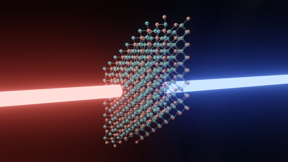 The figure describes the picosecond ultrasonics technique to probe atomic bonds and vdW forces in In2Se3. In the experiment, blue-coloured pump laser pulses are shined on a flake of 2D material, and red-coloured probe laser pules are used to probe the strength of atomic bonds.
CREDIT
Wenjing Yan, University of Nottingham
The figure describes the picosecond ultrasonics technique to probe atomic bonds and vdW forces in In2Se3. In the experiment, blue-coloured pump laser pulses are shined on a flake of 2D material, and red-coloured probe laser pules are used to probe the strength of atomic bonds.
CREDIT
Wenjing Yan, University of Nottingham
Abstract: Researchers have developed a new method to measure force and atomic bonds at the nanoscale that reveals that the speed of sound depends on the structure it is travelling through.
Nottingham, UK | Posted on September 17th, 2021
Scientists from the University of Nottingham and Loughborough University used a measurement method called picosecond ultrasonics, similar to medical ultrasound, to measure the strength of atom bonding within material. Their research has been published in Advanced Functional Materials.
Force is fundamental to everything in daily life. From as large-scale as gravitational force that underlines the operation of the whole universe, to as small-scale as electron-electron interaction that can be hair raising. Force is very difficult to measure especially when the forces are too big or too small, this is especially the case when we enter the nanoworld, for example in the so-called two-dimensional van der Waals (2D-vdW) materials where objects have length scales in the range of 10-9 metres.
These materials are called 2D materials because their geometrical, physical and chemical properties are confined in two dimensions within a thin sheet of material. Within the sheet, atoms are tightly bonded to each other through strong covalent or ionic bonds, whereas the layers themselves are held together by weak van der Waals force. The utterly different nature and coexistence of these vastly different strength forces allow scientists to �peel� the material from bulky mined crystals to perfect single atomic layers and discover amazing phenomena including room temperature superconductivity. Drawing on a piece of paper using pencils for example, is in fact a scientific experiment to make single atomic layers of carbon atoms (graphene), something we all have been doing for centuries without realising. Despite intensive investigation of vdW materials by many research groups around the world, there are barely any experimental techniques to measure the strength of atomic bonds and vdW forces without destroying the materials.
Wenjing Yan was one of the lead researchers from the School of Physics and Astronomy at University of Nottingham, she explains: �We used picosecond ultrasonics to measure both the strong covalent bonds and weak vdW forces without damaging the material. The technique is similar to medical ultrasound but with a much higher frequency (terahertz) and thus non-invasive. The study shines 120 femtosecond (0.00000000000012 second) �pump� laser pulses on flakes of 2D materials, generating phonons which are quantised sound waves. As phonons travel through the material, they feel and interact with the atoms and the bonds within the material. The properties of these phonons, which reflect the strength of the atomic bonds, is then measured by a second �probe� laser pulse. We found that sound travels at very different speeds in different phases (structures) of the same substance.�
Alexander Balanov and Mark Greenaway from Loughborough University expand: �Whilst travelling through the vdW material, the ultrasonic acoustic wave does not destroy the crystal, only slightly deforms it, which means the structure can be thought of as a system of �springs�. By knowing the speed of sound from measurements and how these springs respond to the deformation, we can extract the relative strength of the covalent forces between the atoms and the vdW forces between the layers. If we apply so-called density function theory with the help of high performance computers we can numerically estimate these forces for different stacking configurations and suggest how to tune the elastic, electric and even chemical properties of different polymorphs of vdW materials�
Wenjing continues: �A good analogy for our findings can be made by thinking about pancake and Yorkshire pudding! Both foods are made from the same mixture: egg, flour and milk, but their different cooking processes give them different structures and properties. Although this is obvious in the macroscopic world, finding such differences in nanostructured materials due to subtle differences in vdW forces is surprising and exciting. This opens possibilities to tune vdW forces by stacking materials in different ways and at the same time non-destructively monitor the properties of these forces and their correlation with the physical and chemical properties of the multilayer structure. By doing this, we will be able to design the material for purpose just like building Lego blocks as proposed by the Nobel Prize laureates Andre Geim and Konstantin Novoselov.�
####
For more information, please click here
Contacts:Emma ThorneUniversity of Nottingham
Office: 115-951-5798Expert Contact
Wenjing YanUniversity of Nottingham
Copyright © University of Nottingham
If you have a comment, please Contact us.
Issuers of news releases, not 7th Wave, Inc. or Nanotechnology Now, are solely responsible for the accuracy of the content.
Bookmark:


News and information
 University of Illinois Chicago joins Brookhaven Lab's Quantum Center June 10th, 2022
Organic water splitters get a boost June 10th, 2022
Physics
Observation of fractional exclusion statistics in quantum critical matter May 27th, 2022
Possible Futures
Electron-phonon coupling assisted universal red luminescence of o-phenylenediamine-based CDs June 10th, 2022
Marching to the Cadence of Electronics: Innovation A new paper in Nature validates technology developed by John Bowers and collaborators June 10th, 2022
Small materials may be key to reducing cardiovascular disease deaths, researchers say June 10th, 2022
Decoding a key part of the cell, atom by atom June 10th, 2022
Discoveries
Electron-phonon coupling assisted universal red luminescence of o-phenylenediamine-based CDs June 10th, 2022
Marching to the Cadence of Electronics: Innovation A new paper in Nature validates technology developed by John Bowers and collaborators June 10th, 2022
Small materials may be key to reducing cardiovascular disease deaths, researchers say June 10th, 2022
Decoding a key part of the cell, atom by atom June 10th, 2022
Announcements
Organic water splitters get a boost June 10th, 2022
Interviews/Book Reviews/Essays/Reports/Podcasts/Journals/White papers/Posters
Decoding a key part of the cell, atom by atom June 10th, 2022
Organic water splitters get a boost June 10th, 2022
Tools
Snapshot measurement of single nanostructure�s circular dichroism March 25th, 2022
Eyebrow-raising: Researchers reveal why nanowires stick to each other February 11th, 2022
JEOL Introduces New Scanning Electron Microscope with �Simple SEM� Automation and Live Elemental and 3D Analysis January 14th, 2022
Super-resolved imaging of a single cold atom on a nanosecond timescale January 7th, 2022
